RankRizzStart free

Ray Optics & Optical Instruments — JEE Main Previous Year Questions

Every Ray Optics & Optical Instruments question JEE Main has set, grouped by the idea it tests rather than the order of the syllabus. 272 questions across 9 distinct ideas. Free to read, answer key on every one.

Questions

272

Distinct ideas

9

Share of marks

7%

Difficulty

MEDIUM

The ideas inside Ray Optics & Optical Instruments

A chapter is not one subject — it is a handful of procedures the examiner reuses. These are the ones Ray Optics & Optical Instruments questions actually test.

01Reflection and plane mirrorsset 2×
02Spherical mirrors: mirror formula and magnificationset 38×
03Refraction at plane surfaces, Snell's law and apparent depthset 96×
04Total internal reflection and critical angleset 12×
05Refraction at spherical surfacesset 1×
06Thin lenses: lens formula, lens maker's formula and powerset 98×
07Combinations of lenses and mirrorsset 2×
08Prism: deviation and dispersionset 2×
09Optical instruments: microscopes and telescopesset 21×

Every Ray Optics & Optical Instruments question

61–80 OF 272 · NEWEST FIRST

JEE MAIN 2025 · 07 APR S2Refraction at plane surfaces, Snell's law and apparent depthTRANSCRIBED

Given below are two statements : one is labelled as Assertion (A) and the other is labelled as Reason(R).
Assertion (A) :
Refractive index of glass is higher than that of air.
Reason (R) : Optical density of a medium is directly proportionate to its mass density which results in a proportionate refractive index.
In the light of the above statements, choose the most appropriate answer from the options given below :

  1. A

    (A) is not correct but (R) is correct

  2. B

    Both (A) and (R) are correct and (R) is the correct explanation of (A)

  3. C

    (A) is correct but (R) is not correct

  4. D

    Both (A) and (R) are correct but (R) is not the correct explanation of (A)
JEE MAIN 2025 · 23 JAN S1Refraction at plane surfaces, Snell's law and apparent depthTRANSCRIBED

What is the lateral shift of a ray refracted through a parallel-sided glass slab of thickness 'h' in terms of the angle of incidence 'i' and angle of refraction 'r', if the glass slab is placed in air medium?

  1. A

  2. B

  3. C

    h

  4. D

JEE MAIN 2025 · 02 APR S2Spherical mirrors: mirror formula and magnificationTRANSCRIBED

Two identical objects are placed in front of convex mirror and concave mirror having same radii of curvature of 12 cm, at same distance of 18 cm from the respective mirrors. The ratio of the sizes of images formed by convex mirror and by concave mirror is :

  1. A

  2. B

  3. C

  4. D

JEE MAIN 2025 · 29 JAN S2Refraction at plane surfaces, Snell's law and apparent depthTRANSCRIBED
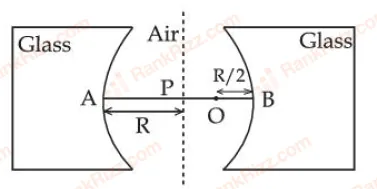
page7_img2


Two concave refracting surfaces of equal radii of curvature and refractive index 1.5 face each other in air as shown in figure. A point object O is placed midway, between P and B . The separation between the images of O , formed by each refracting surface is :

  1. A

    0.214 R

  2. B

    0.411 R

  3. C

    0.124 R

  4. D

    0.114 R

JEE MAIN 2025 · 22 JAN S1Thin lenses: lens formula, lens maker's formula and powerTRANSCRIBED

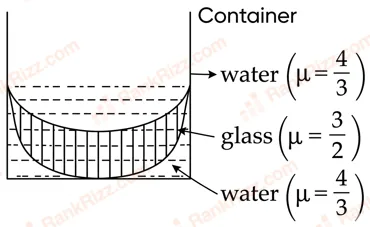
In the diagram given below, there are three lenses formed. Considering negligible thickness of each of them as compared to , i.e., the radii of curvature for upper and lower surfaces of the glass lens, the power of the combination is

image
  1. A

  2. B

  3. C

  4. D

JEE MAIN 2025 · 02 APR S1Refraction at plane surfaces, Snell's law and apparent depthTRANSCRIBED
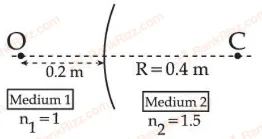
image


A spherical surface separates two media of refractive indices 1 and 1.5 as shown in figure. Distance of the image of an object 'O', is: (C is the center of curvature of the spherical surface and R is the radius of curvature)

  1. A

    0.24 m right to the spherical surface

  2. B

    0.4 m left to the spherical surface

  3. C

    0.24 m left to the spherical surface

  4. D

    0.4 m right to the spherical surface

JEE MAIN 2025 · 02 APR S2Thin lenses: lens formula, lens maker's formula and powerTRANSCRIBED

A bi-convex lens has radius of curvature of both the surfaces same as 1/6 cm. If this lens is required to be replaced by another convex lens having different radii of curvatures on both sides , without any change in lens power then possible combination of and is :

  1. A

    cm and cm

  2. B

    cm and cm

  3. C

    cm and cm

  4. D

    cm and cm

JEE MAIN 2025 · 03 APR S1Thin lenses: lens formula, lens maker's formula and powerTRANSCRIBED

The radii of curvature for a thin convex lens are 10 cm and 15 cm respectively. The focal length of the lens is 12 cm. The refractive index of the lens material is

  1. A

  2. B

  3. C

  4. D

JEE MAIN 2025 · 04 APR S2Spherical mirrors: mirror formula and magnificationTRANSCRIBED

A finite size object is placed normal to the principal axis at a distance of 30 cm from a convex mirror of focal length 30 cm. A plane mirror is now placed in such a way that the image produced by both the mirrors coincide with each other. The distance between the two mirrors is :

  1. A

    45 cm

  2. B

    7.5 cm

  3. C

    22.5 cm

  4. D

    15 cm

JEE MAIN 2025 · 07 APR S2Refraction at plane surfaces, Snell's law and apparent depthTRANSCRIBED

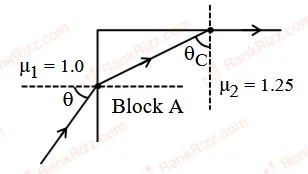
A transparent block A having refractive index is surrounded by another medium of refractive index . A light ray is incident on the flat face of the block with incident angle . What is the maximum value of for which light suffers total internal reflection at the top surface of the block?

image
  1. A

  2. B

  3. C

  4. D

JEE MAIN 2025 · 03 APR S1Refraction at plane surfaces, Snell's law and apparent depthTRANSCRIBED

Consider following statements for refraction of light through prism, when angle of deviation is minimum.
(A) The refracted ray inside prism becomes parallel to the base.
(B) Larger angle prisms provide smaller angle of minimum deviation.
(C) Angle of incidence and angle of emergence becomes equal.
(D) There are always two sets of angle of incidence for which deviation will be same except at minimum deviation setting.
(E) Angle of refraction becomes double of prism angle.

Choose the correct answer from the options given below.

  1. A

    A, C and D Only

  2. B

    B, C and D Only

  3. C

    A, B and E Only

  4. D

    B, D and E Only

JEE MAIN 2025 · 22 JAN S1Spherical mirrors: mirror formula and magnificationTRANSCRIBED

The driver sitting inside a parked car is watching vehicles approaching from behind with the help of his side view mirror, which is a convex mirror with radius of curvature R=2 m. Another car approaches him from behind with a uniform speed of 90 km/hr. When the car is at a distance of 24 m from him, the magnitude of the acceleration of the image of the car in the side view mirror is ' a '. The value of 100 a is ________ .

JEE MAIN 2025 · 03 APR S2Refraction at plane surfaces, Snell's law and apparent depthTRANSCRIBED

Light from a point source in air falls on a spherical glass surface (refractive index, and radius of curvature = 50 cm). The image is formed at a distance of 200 cm inside the glass. The magnitude of distance of the light source from the glass surface is ________ m.

JEE MAIN 2025 · 29 JAN S1Refraction at plane surfaces, Snell's law and apparent depthTRANSCRIBED

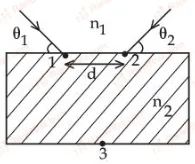
Two light beams fall on a transparent material block at point 1 and 2 with angle and , respectively, as shown in figure. After refraction, the beams intersect at point 3 which is exactly on the interface at other end of the block. Given : the distance between 1 and 2, and , where refractive index of the block n_{2} > refractive index of the outside medium , then the thickness of the block is ________cm. 

page8_img1
JEE MAIN 2025 · 02 APR S2Refraction at plane surfaces, Snell's law and apparent depthTRANSCRIBED

A ray of light suffers minimum deviation when incident on a prism having angle of the prism equal to 60°. The refractive index of the prism material is . The angle of incidence (in degrees) is _________.

JEE MAIN 2025 · 07 APR S1Refraction at plane surfaces, Snell's law and apparent depthTRANSCRIBED

A container contains a liquid with refractive index of 1.2 up to a height of 60 cm and another liquid having refractive index 1.6 is added to height H above first liquid. If viewed from above, the apparent shift in the position of bottom of container is 40 cm. The value of H is ___ cm.
(Consider liquids are immisible)

JEE MAIN 2025 · 04 APR S1Spherical mirrors: mirror formula and magnificationTRANSCRIBED

Distance between object and its image (magnified by ) is 30 cm. The focal length of the mirror used is cm, where magnitude of value of x is ________.

JEE MAIN 2024 · 09 APR S2Thin lenses: lens formula, lens maker's formula and powerTRANSCRIBED

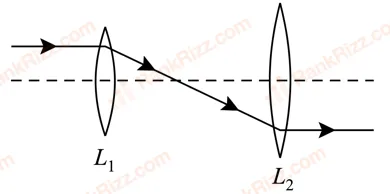
The following figure represents two biconvex lenses and having focal length and respectively. The distance between & is 

image
  1. A

  2. B

  3. C

  4. D

JEE MAIN 2024 · 08 APR S1Refraction at plane surfaces, Snell's law and apparent depthTRANSCRIBED

Critical angle of incidence for a pair of optical media is . The refractive indices of first and second media are in the ratio:

  1. A

  2. B

  3. C

  4. D

JEE MAIN 2024 · 08 APR S2Thin lenses: lens formula, lens maker's formula and powerTRANSCRIBED

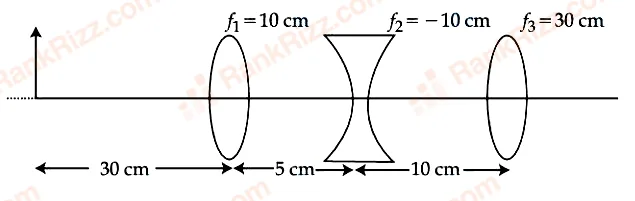
The position of the image formed by the combination of lenses is 

page3_img1
  1. A

    15 cm (right of second lens)

  2. B

    30 cm (left of third lens)

  3. C

    15 cm (left of second lens)

  4. D

    30 cm (right of third lens)