RankRizzStart free

Ray Optics & Optical Instruments — JEE Main Previous Year Questions

Every Ray Optics & Optical Instruments question JEE Main has set, grouped by the idea it tests rather than the order of the syllabus. 272 questions across 9 distinct ideas. Free to read, answer key on every one.

Questions

272

Distinct ideas

9

Share of marks

7%

Difficulty

MEDIUM

The ideas inside Ray Optics & Optical Instruments

A chapter is not one subject — it is a handful of procedures the examiner reuses. These are the ones Ray Optics & Optical Instruments questions actually test.

01Reflection and plane mirrorsset 2×
02Spherical mirrors: mirror formula and magnificationset 38×
03Refraction at plane surfaces, Snell's law and apparent depthset 96×
04Total internal reflection and critical angleset 12×
05Refraction at spherical surfacesset 1×
06Thin lenses: lens formula, lens maker's formula and powerset 98×
07Combinations of lenses and mirrorsset 2×
08Prism: deviation and dispersionset 2×
09Optical instruments: microscopes and telescopesset 21×

Every Ray Optics & Optical Instruments question

221–240 OF 272 · NEWEST FIRST

JEE MAIN 2019 · 09 APR S2Thin lenses: lens formula, lens maker's formula and powerTRANSCRIBED

A thin convex lens L (refractive index = 1.5) is placed on a plane mirror M. When a pin is placed at A, such that OA = 18 cm, its real inverted image is formed at A itself, as shown in figure. When liquid of refractive index is put between the lens and the mirror, the pin has to be moved to A', such that OA' = 27 cm, to get its inverted real image at A' itself. The value of will be:
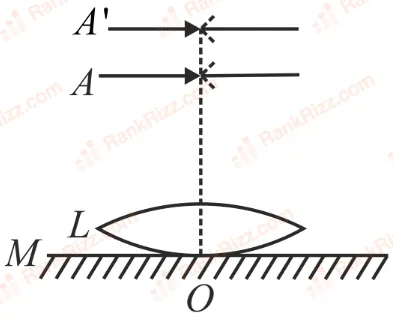
image
  1. A

  2. B

  3. C

  4. D

JEE MAIN 2019 · 09 JAN S1Thin lenses: lens formula, lens maker's formula and powerTRANSCRIBED

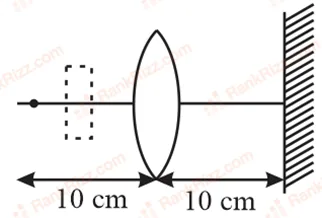
A convex lens is put 10 cm from a light source and it makes a sharp image on a screen, kept 10 cm from the lens. Now a glass block (refractive index 1.5) of 1.5 cm thickness is placed in between the light source and the lens. To get the sharp image again, the screen is shifted by a distance . Then is:

  1. A

    0

  2. B

    0.55 cm away from the lens

  3. C

    0.55 cm towards the lens

  4. D

    1.1 cm away from the lens

JEE MAIN 2019 · 08 APR S2Thin lenses: lens formula, lens maker's formula and powerTRANSCRIBED

A convex lens (of focal length 20 cm) and a concave mirror, having their principal axes along the same lines, are kept 80 cm apart from each other. The concave mirror is to the right of the convex lens. When an object is kept at a distance of 30 cm to the left of the convex lens, its image remains at the same position even if the concave mirror is removed. The maximum distance of the object for which this concave mirror, by itself would produce a virtual image would be:

  1. A

    30 cm

  2. B

    25 cm

  3. C

    20 cm

  4. D

    10 cm

JEE MAIN 2018 · 15 APR S1Thin lenses: lens formula, lens maker's formula and powerTRANSCRIBED

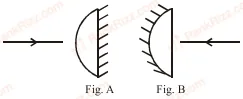
A planoconvex lens becomes an optical system of 28 cm focal length when its plane surface is silvered and illuminated from left to right as shown in Fig. A. If the same lens is instead silvered on the curved surface and illuminated from other side as in Fig. B, it acts like an optical system of focal length 10 cm. The refractive index of the material of lens is:

  1. A

    1.50

  2. B

    1.55

  3. C

    1.75

  4. D

    1.51

JEE MAIN 2018 · 15 APR S1Spherical mirrors: mirror formula and magnificationTRANSCRIBED

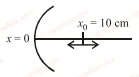
A particle is oscillating on the X-axis with an amplitude 2 cm about the point cm with a frequency . A concave mirror of focal length 5 cm is placed at the origin (see figure). Identify the correct statements: (A) The image executes periodic motion (B) The image executes non-periodic motion (C) The turning points of the image are asymmetric w.r.t the image of the point at x = 10 cm (D) The distance between the turning points of the oscillation of the image is cm.

  1. A

    (B), (D)

  2. B

    (B), (C)

  3. C

    (A), (C), (D)

  4. D

    (A), (D)

JEE MAIN 2018 · 15 APR S2Thin lenses: lens formula, lens maker's formula and powerTRANSCRIBED

A convergent doublet of separated lenses, corrected for spherical aberration, has resultant focal length of 10 cm. The separation between the two lenses is 2 cm. The focal lengths of the component lenses are:

  1. A

    18 cm, 20 cm

  2. B

    10 cm, 12 cm

  3. C

    12 cm, 14 cm

  4. D

    16 cm, 18 cm

JEE MAIN 2018 · 16 APR ONLINERefraction at plane surfaces, Snell's law and apparent depthTRANSCRIBED

A ray of light is incident at an angle of 60 on one face of a prism of angle 30. The emergent ray of light makes an angle of 30 with incident ray. The angle made by the emergent ray with second face of prism will be:

  1. A

    0

  2. B

    90

  3. C

    30

  4. D

    45

JEE MAIN 2017 · 08 APR ONLINERefraction at plane surfaces, Snell's law and apparent depthTRANSCRIBED

Let the refractive index of a denser medium with respect to a rarer medium be and its critical angle be . At an angle of incidence when light is travelling from denser medium to rarer medium, a part of the light is reflected and the rest is refracted and the angle between reflected and refracted rays is 90°. Angle is given by:

  1. A

  2. B

  3. C

  4. D

JEE MAIN 2017 · 02 APR OFFLINEThin lenses: lens formula, lens maker's formula and powerTRANSCRIBED

A diverging lens with magnitude of focal length 25 cm is placed at a distance of 15 cm from a converging lens of magnitude of focal length 20 cm. A beam of parallel light falls on the diverging lens. The final image formed is:

  1. A

    Real and at a distance of 6 cm from the convergent lens

  2. B

    Real and at a distance of 40 cm from the convergent lens

  3. C

    Virtual and at a distance of 40 cm from the convergent lens

  4. D

    Real and at a distance of 40 cm from the divergent lens

JEE MAIN 2017 · 09 APR ONLINEThin lenses: lens formula, lens maker's formula and powerTRANSCRIBED

In an experiment a convex lens of focal length 15 cm is placed coaxially on an optical bench in front of a convex mirror at a distance of 5 cm from it. It is found that an object and its image coincide, if the object is placed at a distance of 20 cm from the lens. The focal length of the convex mirror is-

  1. A

    20.0 cm

  2. B

    30.5 cm

  3. C

    25.0 cm

  4. D

    27.5 cm

JEE MAIN 2016 · 03 APR OFFLINEOptical instruments: microscopes and telescopesTRANSCRIBED

An observer looks at a distant tree of height 10 m with a telescope of magnifying power of 20. To the observer, the tree appears as

  1. A

    20 times taller.

  2. B

    20 times nearer.

  3. C

    10 times taller.

  4. D

    10 times nearer.

JEE MAIN 2016 · 03 APR OFFLINERefraction at plane surfaces, Snell's law and apparent depthTRANSCRIBED

In an experiment for determination of refractive index of glass of a prism by i v/s plot, it was found that a ray incident at angle 35°, suffers a deviation of 40° and that it emerges at angle 79°. In that case which of the following is closest to the maximum possible value of the refractive index?

  1. A

    1.7

  2. B

    1.8

  3. C

    1.5

  4. D

    1.6

JEE MAIN 2016 · 09 APR ONLINEThin lenses: lens formula, lens maker's formula and powerTRANSCRIBED

To find the focal length of a convex mirror, a student records the following data:
Object pin: 22.2 cm, Convex Lens: 32.2 cm, Convex Mirror: 45.8 cm, Image Pin: 71.2 cm
The focal length of the convex lens is and that of mirror is . Then taking index correction to be negligibly small, and are close to:

  1. A

    cm, cm

  2. B

    cm, cm

  3. C

    cm, cm

  4. D

    cm, cm

JEE MAIN 2016 · 10 APR ONLINERefraction at plane surfaces, Snell's law and apparent depthTRANSCRIBED

To determine refractive index of glass slab using a travelling microscope, minimum number of readings required are:

  1. A

    Two

  2. B

    Four

  3. C

    Three

  4. D

    Five

JEE MAIN 2016 · 09 APR ONLINEThin lenses: lens formula, lens maker's formula and powerTRANSCRIBED

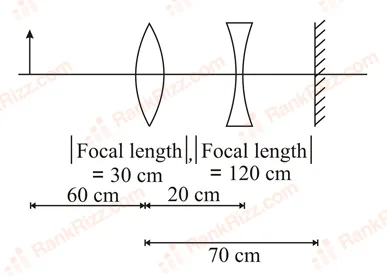
A convex lens, of focal length 30 cm, a concave lens of focal length 120 cm, and a plane mirror are arranged as shown. For an object kept at a distance of 60 cm from the convex lens, the final image, formed by the combination, is a real image, at a distance of:

  1. A

    60 cm from the convex lens

  2. B

    60 cm from the concave lens

  3. C

    70 cm from the convex lens

  4. D

    70 cm from the concave lens

JEE MAIN 2016 · 10 APR ONLINESpherical mirrors: mirror formula and magnificationTRANSCRIBED

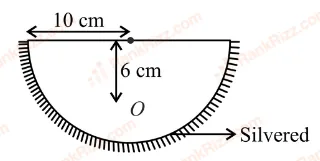
A hemispherical glass body of radius 10 cm and refractive index 1.5 is silvered on its curved surface. A small air bubble is 6 cm below the flat surface inside it along the axis. The position of the image of the air bubble made by the mirror is seen:

image
  1. A

    14 cm below flat surface

  2. B

    20 cm below flat surface

  3. C

    16 cm below flat surface

  4. D

    30 cm below flat surface

JEE MAIN 2015 · 10 APR ONLINEOptical instruments: microscopes and telescopesTRANSCRIBED

A telescope has an objective lens of focal length 150 cm and an eyepiece of focal length 5 cm. If a 50 m tall tower at a distance of 1 km is observed through this telescope in a normal setting, the angle formed by the image of the tower is , then is close to

  1. A

    30

  2. B

    15

  3. C

    1

  4. D

    86

JEE MAIN 2015 · 04 APR OFFLINERefraction at plane surfaces, Snell's law and apparent depthTRANSCRIBED

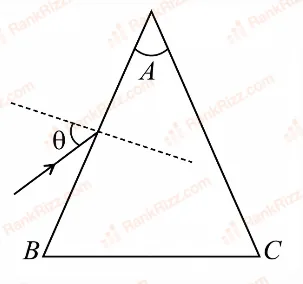
Monochromatic light is incident on a glass prism of angle A. If the refractive index of the material of the prism is , a ray, incident at an angle , on the face AB would get transmitted through the face AC of the prism provided:

image
  1. A

    \theta < \cos^{-1}\left[\mu \sin\left(A + \sin^{-1}\left(\frac{1}{\mu}\right)\right)\right]

  2. B

    \theta > \sin^{-1}\left[\mu \sin\left(A - \sin^{-1}\left(\frac{1}{\mu}\right)\right)\right]

  3. C

    \theta < \sin^{-1}\left[\mu \sin\left(A - \sin^{-1}\left(\frac{1}{\mu}\right)\right)\right]

  4. D

    \theta > \cos^{-1}\left[\mu \sin\left(A + \sin^{-1}\left(\frac{1}{\mu}\right)\right)\right]

JEE MAIN 2015 · 10 APR ONLINESpherical mirrors: mirror formula and magnificationTRANSCRIBED

You are asked to design a shaving mirror assuming that a person keeps it at 10 cm from his face and views the magnified image of the face at the closest comfortable distance of 25 cm. The radius of curvature of the mirror would then be:

  1. A

    24 cm

  2. B

    30 cm

  3. C

    60 cm

  4. D

    -24 cm

JEE MAIN 2015 · 11 APR ONLINEThin lenses: lens formula, lens maker's formula and powerTRANSCRIBED

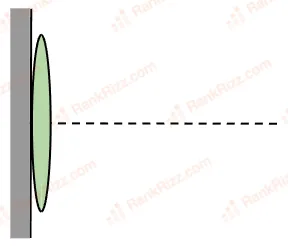
A thin convex lens of focal length is put on a plane mirror as shown in the figure. When an object is kept at a distance from the lens-mirror combination, its image is formed at a distance in front of the combination. The value of is:

image
  1. A

  2. B

  3. C

  4. D