Ray Optics & Optical Instruments — JEE Main Previous Year Questions
Every Ray Optics & Optical Instruments question JEE Main has set, grouped by the idea it tests rather than the order of the syllabus. 272 questions across 9 distinct ideas. Free to read, answer key on every one.
A chapter is not one subject — it is a handful of procedures the examiner reuses. These are the ones Ray Optics & Optical Instruments questions actually test.
01Reflection and plane mirrorsset 2×
02Spherical mirrors: mirror formula and magnificationset 38×
03Refraction at plane surfaces, Snell's law and apparent depthset 96×
04Total internal reflection and critical angleset 12×
05Refraction at spherical surfacesset 1×
06Thin lenses: lens formula, lens maker's formula and powerset 98×
07Combinations of lenses and mirrorsset 2×
08Prism: deviation and dispersionset 2×
09Optical instruments: microscopes and telescopesset 21×
Every Ray Optics & Optical Instruments question
181–200 OF 272 · NEWEST FIRST
JEE MAIN 2021 · 16 MAR S2Refraction at plane surfaces, Snell's law and apparent depthTRANSCRIBED
A deviation of 2° is produced in the yellow ray when prism of crown and flint glass are achromatically combined. Taking dispersive powers of crown and flint glass are 0.02 and 0.03 respectively and refractive index for yellow light for these glasses are 1.5 and 1.6 respectively. The refracting angles for crown glass prism will be ________° (in degree). (Round off to the Nearest Integer)
JEE MAIN 2021 · 25 FEB S1Thin lenses: lens formula, lens maker's formula and powerTRANSCRIBED
The same size images are formed by a convex lens when the object is placed at 20 cm or at 10 cm from the lens. The focal length of convex lens is ______
JEE MAIN 2020 · 06 SEP S1Thin lenses: lens formula, lens maker's formula and powerTRANSCRIBED
A point like object is placed at distance of 1m in front of a convex lens of focal length 0.5m. A plane mirror is placed at a distance of 2m behind the lens. The position and nature of the image formed by the system is:
JEE MAIN 2020 · 07 JAN S1Optical instruments: microscopes and telescopesTRANSCRIBED
If we need a magnification of 375 from a compound microscope of tube length 150mm and an objective of focal length 5mm, the focal length of the eye-piece, should be close to:
JEE MAIN 2020 · 08 JAN S1Total internal reflection and critical angleTRANSCRIBED
The critical angle of a medium for a specific wavelength, if the medium has relative permittivity 3 and relative permeability 34 for this wavelength, will be:
JEE MAIN 2020 · 09 JAN S1Refraction at plane surfaces, Snell's law and apparent depthTRANSCRIBED
A vessel of depth 2h is half filled with a liquid of refractive index 22 and the upper half with another liquid of refractive index 2. The liquids are immiscible. The apparent depth of the inner surface of the bottom of the vessel will be:
JEE MAIN 2020 · 09 JAN S2Refraction at plane surfaces, Snell's law and apparent depthTRANSCRIBED
There is a small source of light at some depth below the surface of water (refractive index =34) in a tank of large cross sectional surface area. Neglecting any reflection from the bottom and absorption by water, percentage of light that emerges out of surface is (nearly): [Use the fact that surface area of a spherical cap of height h and radius of curvature r is 2πrh]
JEE MAIN 2020 · 07 JAN S2Thin lenses: lens formula, lens maker's formula and powerTRANSCRIBED
A thin lens made of glass (refractive index = 1.5) of focal length f=16 cm is immersed in a liquid of refractive index 1.42. If its focal length in liquid is fl, then the ratio fl/f is closest to the integer:
JEE MAIN 2020 · 02 SEP S1Spherical mirrors: mirror formula and magnificationTRANSCRIBED
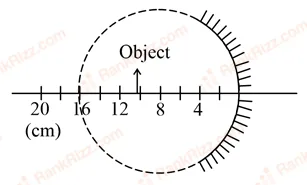
A spherical mirror is obtained as shown in the figure from a hollow glass sphere, if an object is positioned in front of the mirror, what will be the nature and magnification of the image of the object? (Figure down as schematic and not to scale)
JEE MAIN 2020 · 08 JAN S2Spherical mirrors: mirror formula and magnificationTRANSCRIBED
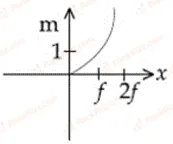
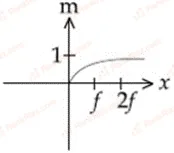
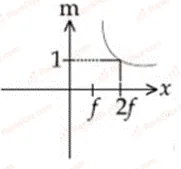
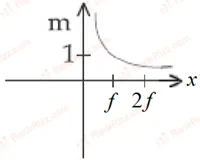
An object is gradually moving away from the focal point of a concave mirror along the axis of the mirror. The graphical representation of the magnitude of linear magnification (m) versus distance of the object from the mirror (x) is correctly given by (Graphs are drawn schematically and are not to scale)
JEE MAIN 2020 · 05 SEP S1Thin lenses: lens formula, lens maker's formula and powerTRANSCRIBED
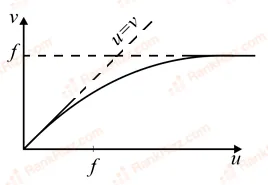
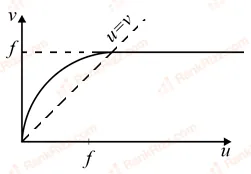
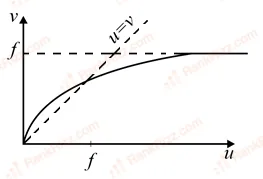
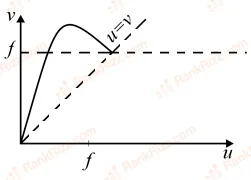
For a concave lens of focal length f, the relation between object and image distance u and v, respectively, from its pole can best be represented by (u=v is the reference line):
JEE MAIN 2020 · 06 SEP S2Thin lenses: lens formula, lens maker's formula and powerTRANSCRIBED
A double convex lens has power P and same radii of curvature R of both the surfaces. The radius of curvature of a surface of a plano-convex lens made of the same material with power 1.5P is:
JEE MAIN 2020 · 05 SEP S1Optical instruments: microscopes and telescopesTRANSCRIBED
A compound microscope consists of an objective lens of focal length 1cm and an eye piece of focal length 5cm with a separation of 10cm. The distance between an object and the objective lens, at which the strain on the eye is minimum is 40ncm. The value of n is.......
JEE MAIN 2020 · 04 SEP S1Optical instruments: microscopes and telescopesTRANSCRIBED
In a compound microscope, the magnified virtual image is formed at a distance of 25 cm from the eye-piece. The focal length of its objective lens is 1 cm. If the magnification is 100 and the tube length of the microscope is 20 cm, then the focal length of the eye-piece lens (in cm) is __________
JEE MAIN 2020 · 04 SEP S2Thin lenses: lens formula, lens maker's formula and powerTRANSCRIBED
The distance between an object and a screen is 100 cm. A lens can produce real image of the object on the screen for two different positions between the screen and the object. The distance between these two positions is 40 cm. If the power of the lens is close to (100N)D where N is an integer, the value of N is __________
JEE MAIN 2020 · 03 SEP S1Refraction at plane surfaces, Snell's law and apparent depthTRANSCRIBED
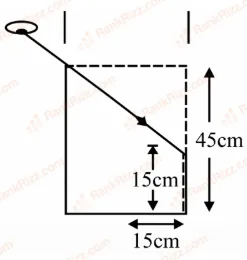
An observer can see through a small hole on the side of a jar (radius 15 cm) at a point at height of 15 cm from the bottom (see figure). The hole is at a height of 45 cm. When the jar is filled with a liquid up to a height of 30 cm the same observer can see the edge at the bottom of the jar. If the refractive index of the liquid is 100N, where N is an integer, the value of N i
JEE MAIN 2020 · 03 SEP S2Spherical mirrors: mirror formula and magnificationTRANSCRIBED
When an object is kept at a distance of 30 cm from a concave mirror, the image is formed at a distance of 10 cm from the mirror. If the object is moved with a speed of 9 cm s−1, the speed (in cm s−1) with which image moves at that instant is
JEE MAIN 2020 · 08 JAN S1Thin lenses: lens formula, lens maker's formula and powerTRANSCRIBED
A point object in air is in front of the curved surface of a plano-convex lens. The radius of curvature of the curved surface is 30 cm and the refractive index of the lens material is 1.5, then the focal length of the lens (in cm) is