A diver looking up through the water sees the outside world contained in a circular horizon. The refractive index of water is , and the diver's eyes are 15 cm below the surface of the water. Then the radius of the circle is:
- A
cm
- B
cm
- C
cm
- D
cm
Every Ray Optics & Optical Instruments question JEE Main has set, grouped by the idea it tests rather than the order of the syllabus. 272 questions across 9 distinct ideas. Free to read, answer key on every one.
Questions
272
Distinct ideas
9
Share of marks
7%
Difficulty
MEDIUM
A chapter is not one subject — it is a handful of procedures the examiner reuses. These are the ones Ray Optics & Optical Instruments questions actually test.
241–260 OF 272 · NEWEST FIRST
A diver looking up through the water sees the outside world contained in a circular horizon. The refractive index of water is , and the diver's eyes are 15 cm below the surface of the water. Then the radius of the circle is:
cm
cm
cm
cm
The diameter of the objective lens of the microscope makes an angle at the focus of the microscope. Further, the medium between the object and the lens is the oil of the refractive index n. Then the resolving power of the microscope:
Increases with decreasing value of
Increases with increasing value of
Increases with decreasing value of
A thin convex lens made from crown glass () has focal length . When it is measured in two different liquids having refractive indices and , it has the focal lengths and respectively. The correct relation between the focal lengths is:
f_1 = f_2 < f
f_1 > f and becomes negative
f_2 > f and becomes negative
and both become negative
The focal lengths of objective lens and eye lens of a Galilean Telescope are respectively 30 cm and 3.0 cm. Telescope produces virtual, erect image of an object situated far away from it at least distance of distinct vision from the eye lens. In this condition the Magnifying Power of the Galilean Telescope should be:
+8.8
+11.2
An object is located in a fixed position in front of a screen. Sharp image is obtained on the screen for two positions of a thin lens separated by 10 cm. The size of the images in two situations are in the ratio 3 : 3. What is the distance between the screen and the object?
124.5 cm
144.5 cm
65.0 cm
99.0 cm
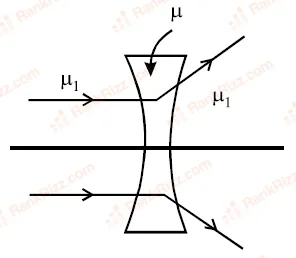
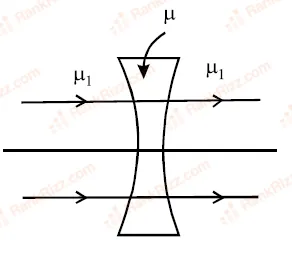
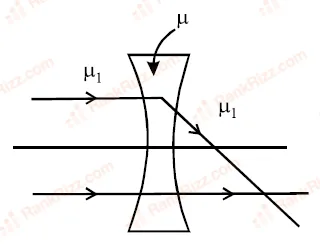
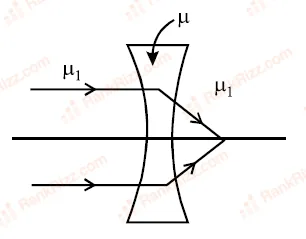
The refractive index of the material of a concave lens is . It is immersed in a medium of refractive index . A parallel beam of light is incident on the lens. The path of the emergent rays when \mu_1 > \mu is:


A green light is incident from the water to the air-water interface at the critical angle (). Select the correct statement.
The entire spectrum of visible light will come out of the water at an angle of 90° to the normal
The spectrum of visible light whose frequency is less than that of green light will come out to the air medium
The spectrum of visible light whose frequency is more than that of green light will come out to the air medium
The entire spectrum of visible light will come out of the water at various angles to the normal
In a compound microscope the focal length of objective lens is 1.2 cm and focal length of eye piece is 3.0 cm. When object is kept at 1.25 cm in front of objective, final image is formed at infinity. Magnifying power of the compound microscope should be:
200
100
400
150
A printed page is pressed by a glass of water. The refractive index of the glass and water is 1.5 and 1.33, respectively. If the thickness of the bottom of glass is 1 cm and depth of water is 5 cm, how much the page will appear to be shifted if viewed from the top?
1.033 cm
3.581 cm
1.3533 cm
1.90 cm
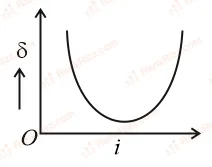
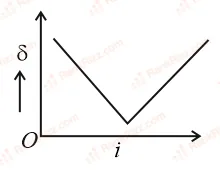
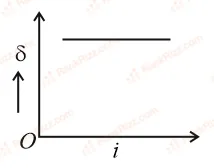
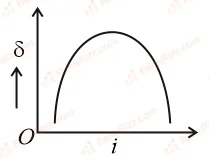
The graph between angle of deviation () and angle of incidence () for a triangular prism is represented by :


This question has Statement-1 and Statement-2. Of the four choices given after the Statements, choose the one that best describes the two Statements.
Statement 1: Very large size telescopes are reflecting telescopes instead of refracting telescopes.
Statement 2: It is easier to provide mechanical support to large size mirrors than large size lenses.
Statement-1 is true and Statement-2 is false.
Statement-1 is false and Statement-2 is true.
Statements-1 and statement-2 are true and Statement-2 is correct explanation for statement-1.
Statements-1 and statement-2 are true and Statement-2 is not the correct explanation for statement-1.
Diameter of a plano-convex lens is 6 cm and thickness at the centre is 3 mm. If the speed of light in the material of lens is m s, the focal length of the lens is:
30 cm
10 cm
15 cm
20 cm
Light is incident from a medium into air at two possible angles of incidence (A) 20° and (B) 40°. In the medium light travels 3.0 cm in 0.2 ns. The ray will :
suffer total internal reflection in both cases (A) and (B)
suffer total internal reflection in case (B) only
have partial reflection and partial transmission in case (B)
have 100% transmission in case (A)
The focal length of the objective and the eyepiece of a telescope are 50 cm and 5 cm respectively. If the telescope is focussed for distinct vision on a scale distant 2 m from its objective, then its magnifying power will be :
-4
-8
+8
-2
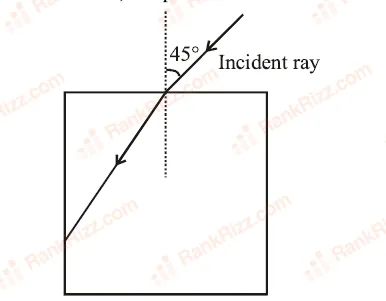
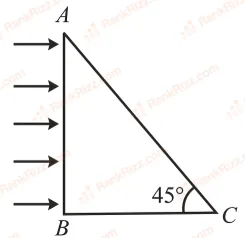
A light ray falls on a square glass slab as shown in the diagram. The index of refraction of the glass, if total internal reflection is to occur at the vertical face, is equal to :

The image of an illuminated square is obtained on a screen with the help of a converging lens. The distance of the square from the lens is 40 cm. The area of the image is 9 times that of the square. The focal length of the lens is :
36 cm
27 cm
60 cm
30 cm
An object m in front of a lens forms a sharp image on a film cm behind the lens. A glass plate cm thick, of refractive index is interposed between lens and film with its plane faces parallel to film. At what distance (from lens) should object be shifted to be in sharp focus on film?
m
m
m
m
Which of the following processes play a part in the formation of a rainbow? (i) Refraction (ii) Total internal reflection (iii) Dispersion (iv) Interference
(i), (ii) and (iii)
(i) and (ii)
(i), (ii) and (iv)
(iii) and (iv)
A beam of light consisting of red, green and blue colours is incident on a right-angled prism on face . The refractive indices of the material for the above red, green and blue colours are 1.39, 1.44 and 1.47 respectively.
A person looking on surface of the prism will see
no light
green and blue colours
red and green colours
red colour only
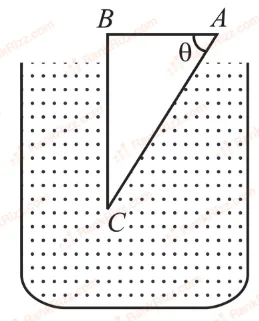
A glass prism of refractive index is immersed in water (refractive index ) as shown in figure. A light beam incident normally on the face is totally reflected to reach the face , if

\sin\theta > \frac{5}{9}
\sin\theta > \frac{2}{3}
\sin\theta > \frac{8}{9}
\sin\theta > \frac{1}{3}
OTHER PHYSICS CHAPTERS