JEE MAIN 2020 · 04 SEP S1Molar specific heats of gases, Mayer's relation and gas mixturesTRANSCRIBED
Match the CvCp ratio for ideal gases with different type of molecules:
Molecule Type Cp/Cv
(A) Monoatomic (I) 7/5
(B) Diatomic rigid molecules (II) 9/7
(C) Diatomic non-rigid molecules (III) 4/3
(D) Triatomic rigid molecules (IV) 5/3
- A
(A) - (IV), (B) - (II), (C) - (I), (D) - (III)
- B
(A) - (III), (B) - (IV), (C) - (II), (D) - (I)
- C
(A) - (IV), (B) - (I), (C) - (II), (D) - (III)
- D
(A) - (II), (B) - (III), (C) - (I), (D) - (IV)
JEE MAIN 2020 · 03 SEP S2Molar specific heats of gases, Mayer's relation and gas mixturesTRANSCRIBED
To raise the temperature of a certain mass of gas by 50°C at a constant pressure, 160 calories of heat is required. When the same mass of gas is cooled by 100°C at constant volume, 240 calories of heat is released. How many degrees of freedom does each molecule of this gas have (assume gas to be ideal)?
- A
- B
- C
- D
JEE MAIN 2020 · 08 JAN S2Molar specific heats of gases, Mayer's relation and gas mixturesTRANSCRIBED
Consider a mixture of n moles of helium gas and 2n moles of oxygen gas (molecules taken to be rigid) as an ideal gas. Its CVCP value will be:
- A
- B
- C
- D
JEE MAIN 2019 · 10 APR S1Molar specific heats of gases, Mayer's relation and gas mixturesTRANSCRIBED
n moles of an ideal gas with constant volume heat capacity CV undergo an isobaric expansion by certain volume. The ratio of the work done in the process, to the heat supplied is:
- A
CV+nR4nR
- B
CV−nR4nR
- C
CV+nRnR
- D
CV−nRnR
JEE MAIN 2019 · 10 APR S1Molar specific heats of gases, Mayer's relation and gas mixturesTRANSCRIBED
A cylinder with fixed capacity of 67.2 litre contains helium gas at STP. The amount of heat needed to raise the temperature of the gas by 20°C is:
[Given that R = 8.31 J mol−1 K−1]
- A
- B
- C
- D
JEE MAIN 2019 · 09 JAN S2Molar specific heats of gases, Mayer's relation and gas mixturesTRANSCRIBED
A 15 g mass of nitrogen gas is enclosed in a vessel at a temperature, 27∘C. The amount of heat transferred to the gas, so that R.M.S. velocity of molecules is doubled, is about. [R=8.3 J (K mole)−1]
- A
- B
- C
- D
JEE MAIN 2019 · 12 APR S1Molar specific heats of gases, Mayer's relation and gas mixturesTRANSCRIBED
Two moles of helium gas is mixed with three moles of hydrogen molecules (taken to be rigid). What is the molar specific heat of mixture at constant volume? R = 8.3 J/mol K
- A
- B
- C
- D
JEE MAIN 2019 · 09 APR S2Molar specific heats of gases, Mayer's relation and gas mixturesTRANSCRIBED
The specific heats, Cp and Cv of a gas of diatomic molecules, A, are given (in units of J mol−1 K−1) by 29 and 22, respectively. Another gas of diatomic molecules, B, has the corresponding values 30 and 21. If they are treated as ideal gases, then:
- A
A has one vibrational mode and B has two
- B
A has a vibrational mode but B has none.
- C
Both A and B have a vibrational mode each.
- D
A is rigid but B has a vibrational mode.
JEE MAIN 2019 · 12 APR S2Molar specific heats of gases, Mayer's relation and gas mixturesTRANSCRIBED
A diatomic gas with rigid molecules does 10 J of work when expanded at constant pressure. What would be the heat energy absorbed by the gas, in this process?
- A
- B
- C
- D
JEE MAIN 2019 · 10 APR S2Molar specific heats of gases, Mayer's relation and gas mixturesTRANSCRIBED
When heat Q is supplied to a diatomic gas of rigid molecules, at constant volume its temperature increases by ΔT. The heat required to produce the same change in temperature, at a constant pressure is:
- A
- B
- C
- D
JEE MAIN 2018 · 16 APR ONLINEMolar specific heats of gases, Mayer's relation and gas mixturesTRANSCRIBED
Two moles of helium are mixed with n moles of hydrogen. If CvCp=23 for the mixture then the value of n is:
- A
- B
- C
- D
JEE MAIN 2017 · 02 APR OFFLINEMolar specific heats of gases, Mayer's relation and gas mixturesTRANSCRIBED
Cp−Cv=MR and Cv are specific heats at constant pressure and constant volume respectively. It is observed that, Cp−Cv=a for hydrogen gas and Cp−Cv=b for nitrogen gas. The correct relation between a and b is:
- A
- B
a=141b
- C
- D
JEE MAIN 2017 · 08 APR ONLINEMolar specific heats of gases, Mayer's relation and gas mixturesTRANSCRIBED
An ideal gas has molecules with 5 degrees of freedom. The ratio of specific heats at constant pressure (Cp) and at constant volume (CV) is:
- A
- B
- C
- D
JEE MAIN 2016 · 09 APR ONLINEMolar specific heats of gases, Mayer's relation and gas mixturesTRANSCRIBED
The ratio of work done by an ideal monoatomic gas to the heat supplied to it in an isobaric process is
- A
- B
- C
- D
JEE MAIN 2015 · 11 APR ONLINEMolar specific heats of gases, Mayer's relation and gas mixturesTRANSCRIBED
Using equipartition of energy, the specific heat (in J kg−1 K−1) of Aluminium at high temperature can be estimated to be (atomic weight of Aluminium = 27)
- A
- B
- C
- D
JEE MAIN 2013 · 09 APR ONLINEMolar specific heats of gases, Mayer's relation and gas mixturesTRANSCRIBED
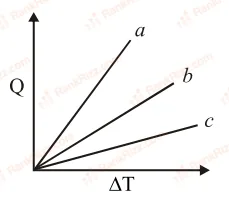
Figure shows the variation in temperature (ΔT) with the amount of heat supplied (Q) in an isobaric process corresponding to a monoatomic (M), diatomic (D) and a polyatomic (P) gas. The initial state of all the gases are the same and the scales for the two axes coincide. Ignoring vibrational degrees of freedom, the lines a, b and c respectively correspond to :
- A
- B
- C
- D
JEE MAIN 2013 · 23 APR ONLINEMolar specific heats of gases, Mayer's relation and gas mixturesTRANSCRIBED
This question has Statement-1 and Statement-2. Of the four choices given after the Statements, choose the one that best describes the two Statements.
Statement 1: The internal energy of a perfect gas is entirely kinetic and depends only on absolute temperature of the gas and not on its pressure or volume.
Statement 2: A perfect gas is heated keeping pressure constant and later at constant volume. For the same amount of heat the temperature of the gas at constant pressure is lower than that at constant volume.
- A
Statement-1 is true, Statement-2 is true and Statement-2 is the correct explanation of Statement-1.
- B
Statement-1 is true, Statement-2 is false.
- C
Statement-1 is true, Statement-2 is true but Statement-2 is not the correct explanation of Statement-1.
- D
Statement-1 is false, Statement-2 is true.
JEE MAIN 2007Molar specific heats of gases, Mayer's relation and gas mixturesTRANSCRIBED
If Cp and Cv denote the specific heats of nitrogen per unit mass at constant pressure and constant volume respectively, then
- A
Cp−Cv=R/28
- B
Cp−Cv=R/14
- C
Cp−Cv=R
- D
Cp−Cv=28R
JEE MAIN 2005Molar specific heats of gases, Mayer's relation and gas mixturesTRANSCRIBED
A gaseous mixture consists of 16 g of helium and 16 g of oxygen. The ratio CvCp of the mixture is
- A
- B
- C
- D
JEE MAIN 2004Molar specific heats of gases, Mayer's relation and gas mixturesTRANSCRIBED
One mole of ideal monoatomic gas (γ=5/3) is mixed with one mole of diatomic gas (γ=7/5). What is γ for the mixture? γ denotes the ratio of specific heat at constant pressure, to that at constant volume.
- A
- B
- C
- D