JEE MAIN 2023 · 24 JAN S2Electric potential and potential energyTRANSCRIBED
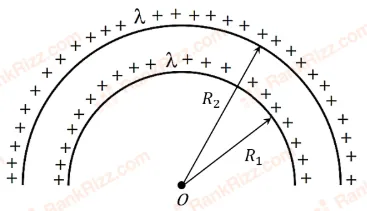
The electric potential at the centre of two concentric half rings of radii and , having same linear charge density is
- A
- B
- C
- D
Every Electrostatics question JEE Main has set, grouped by the idea it tests rather than the order of the syllabus. 294 questions across 9 distinct ideas. Free to read, answer key on every one.
Questions
294
Distinct ideas
9
Share of marks
6%
Difficulty
MEDIUM
A chapter is not one subject — it is a handful of procedures the examiner reuses. These are the ones Electrostatics questions actually test.
101–120 OF 294 · NEWEST FIRST
The electric potential at the centre of two concentric half rings of radii and , having same linear charge density is
A C charge is divided into two parts and placed at cm distance so that the repulsive force between them is maximum. The charges of the two parts are:
C, C
C, C
C, C
C, C
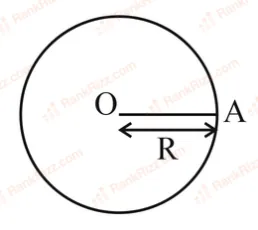
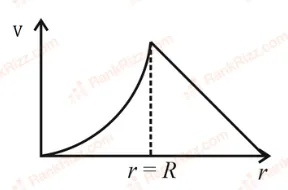
For a uniformly charged thin spherical shell, the electric potential radially away from the centre of shell can be graphically represented as
(1)
(2)
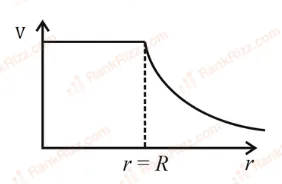
(3)
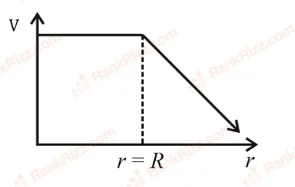
(4)
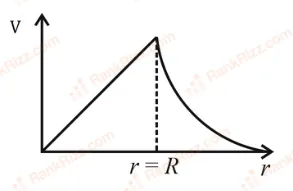
Graph (1)
Graph (2)
Graph (3)
Graph (4)
Two isolated metallic solid spheres of radii and are charged such that both have same charge density . The spheres are then connected by a thin conducting wire. If the new charge density of the bigger sphere is . The ratio is:
The electric field due to a short electric dipole at a large distance from center of dipole on the equatorial plane varies with distance as :
Electric potential at a point due to a point charge of C is 50 V. The distance of from the point charge is:
(Assume, N m C)
9 cm
3 cm
0.9 cm
90 cm
A dipole comprises of two charged particles of identical magnitude and opposite in nature. The mass of the positive charged particle is half of the mass of the negative charged particle. The two charges are separated by a distance . If the dipole is placed in a uniform electric field , in such a way that dipole axis makes a very small angle with the electric field, . The angular frequency of the oscillations of the dipole when released is given by:
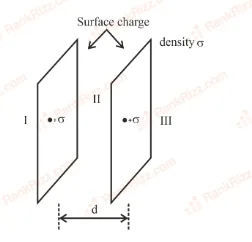
Let be the uniform surface charge density of two infinite thin plane sheets as shown in the figure. Then the electric fields in three different regions, , and are:
A capacitor of capacitance is charged to a potential . The flux of the electric field through a closed surface enclosing the positive plate of the capacitor is:
Zero
Two charges of each magnitude C and separated by a distance of mm constitute an electric dipole. If the dipole is placed in an uniform electric field of dyne C making angle with , the magnitude of torque acting on dipole is:
N m
N m
N m
N m
A point charge of 10 C is placed at the origin. At what location on the X-axis should a point charge of 40 C be placed so that the net electric field is zero at cm on the X-axis?
cm
cm
cm
cm
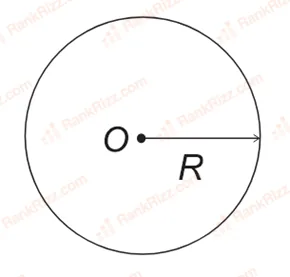
Graphical variation of electric field due to a uniformly charged insulating solid sphere of radius R, with distance r from the centre O is represented by:
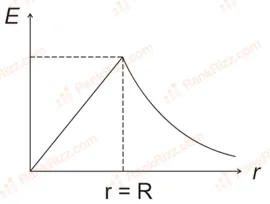
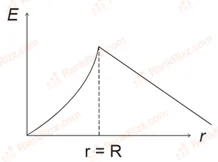
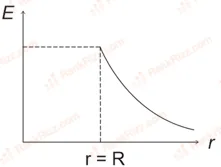
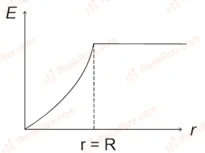
64 identical drops each charged upto potential of mV are combined to form a bigger drop. The potential of the bigger drop will be _____ mV.
A thin infinite charged sheet and an infinite line charge of respective charge densities and are placed parallel at m distance from each other. Points P and Q are at m and m perpendicular distances from line charge towards sheet charge, respectively. and are the magnitudes of resultant electric field intensities at point P and Q respectively. If for , then the value of is _____.
A point charge is placed at origin. Another point charge is placed at cm. Charge of proton is . The proton is placed on -axis so that the electrostatic force on the proton in zero. In this situation, the position of the proton from the origin is ______ cm.
For a charged spherical ball, electrostatic potential inside the ball varies with as . Here, and are constant and is the distance from the center. The volume charge density inside the ball is . The value of is ______.
= permittivity of medium.
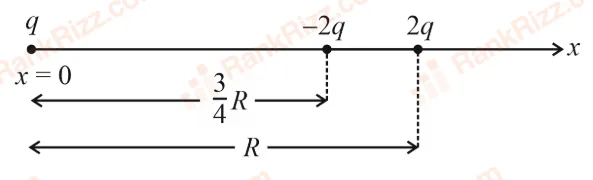
Three point charges , and are placed on x axis at a distance , and respectively from origin as shown. If C and cm, the magnitude of net force experienced by the charge is _____ N.
Two equal positive point charges are separated by a distance . The distance of a point from the centre of the line joining two charges on the equatorial line (perpendicular bisector) at which force experienced by a test charge becomes maximum is . The value of is _____.
Three concentric spherical metallic shells , and of radius , and respectively a < b < c have surface charge densities , and , respectively. The shells and are at same potential. If the radii of & are 2 cm and 3 cm, respectively. The radius of shell Z is _______ cm.
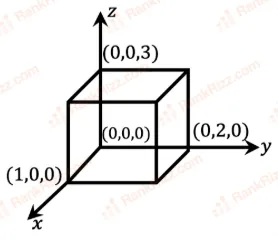
As shown in figure, a cuboid lies in a region with electric field N C. The magnitude of charge within the cuboid is C. The value of is ______ (if dimension of cuboid is m)
OTHER PHYSICS CHAPTERS