RankRizzStart free

Electrostatics — JEE Main Previous Year Questions

Every Electrostatics question JEE Main has set, grouped by the idea it tests rather than the order of the syllabus. 294 questions across 9 distinct ideas. Free to read, answer key on every one.

Questions

294

Distinct ideas

9

Share of marks

6%

Difficulty

MEDIUM

The ideas inside Electrostatics

A chapter is not one subject — it is a handful of procedures the examiner reuses. These are the ones Electrostatics questions actually test.

01Electric charge and Coulomb's lawset 42×
02Electric field due to point charges and superpositionset 25×
03Electric field of continuous charge distributionsset 42×
04Motion and equilibrium of charged bodies in electric fieldsset 7×
05Electric flux and Gauss's lawset 53×
06Electric potential and potential energyset 62×
07Relation between field and potential, equipotential surfacesset 13×
08Electric dipole and dipole in external fieldset 39×
09Conductors, concentric shells and earthingset 11×

Every Electrostatics question

181–200 OF 294 · NEWEST FIRST

JEE MAIN 2021 · 26 FEB S2Electric potential and potential energyTRANSCRIBED

27 similar drops of mercury are maintained at 10 V each. All these spherical drops combine into a single big drop. The potential energy of the bigger drop is ______ times that of a smaller drop.
JEE MAIN 2021 · 25 FEB S2Electric charge and Coulomb's lawTRANSCRIBED

Two small spheres each of mass 10 mg are suspended from a point by threads 0.5 m long. They are equally charged and repel each other to a distance of 0.20 m. The charge on each of the sphere is C. The value of will be ______. [Given m s]

JEE MAIN 2021 · 22 JUL S1Electric flux and Gauss's lawTRANSCRIBED

The total charge enclosed in an incremental volume of m located at the origin is ___ nC, if electric flux density of its field is found as C m

JEE MAIN 2021 · 25 FEB S2Electric charge and Coulomb's lawTRANSCRIBED

Two identical conducting spheres with negligible volume have 2.1 nC and nC charges, respectively. They are brought into contact and then separated by a distance of 0.5 m. The electrostatic force acting between the spheres is ______ N.
[Given : = SI Units}]

JEE MAIN 2020 · 04 SEP S2Motion and equilibrium of charged bodies in electric fieldsTRANSCRIBED

A particle of charge and mass is subjected to an electric field in the -direction, where and are constants. Initially the particle was at rest at . Other than the initial position the kinetic energy of the particle becomes zero when the distance of the particle from the origin is:

  1. A

  2. B

  3. C

  4. D

JEE MAIN 2020 · 08 JAN S2Motion and equilibrium of charged bodies in electric fieldsTRANSCRIBED

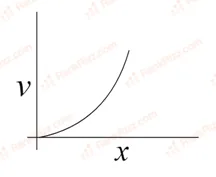
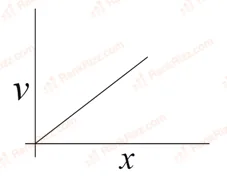
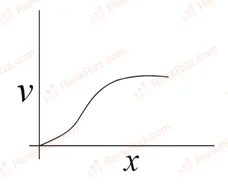
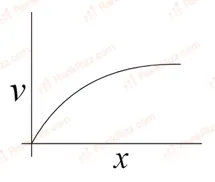
A particle of mass and charge is released from rest in a uniform electric field. If there is no other force on the particle, the dependence of its speed on the distance travelled by it is correctly given by (graphs are schematic and not drawn to scale)

  1. A
  2. B
  3. C
  4. D
JEE MAIN 2020 · 03 SEP S2Electric potential and potential energyTRANSCRIBED

Hydrogen ion and singly ionized helium atom are accelerated, from rest, through the same potential difference. The ratio of final speeds of hydrogen and helium ions is close to:

  1. A

  2. B

  3. C

  4. D

JEE MAIN 2020 · 03 SEP S1Electric potential and potential energyTRANSCRIBED

Two isolated conducting spheres and of radius and have 12 and charges, respectively, and are at a large distance from each other. They are now connected by a conducting wire. A long time after this is done the charges on and are respectively:

  1. A

    of both

  2. B

    and

  3. C

    and

  4. D

    and

JEE MAIN 2020 · 07 JAN S1Electric field of continuous charge distributionsTRANSCRIBED

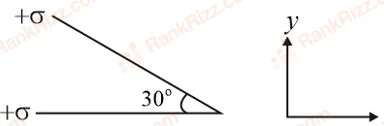
Two infinite planes each with uniform surface charge density are kept in such a way that the angle between them is 30. The electric field in the region shown between them is given by:

  1. A

  2. B

  3. C

  4. D

JEE MAIN 2020 · 02 SEP S2Electric potential and potential energyTRANSCRIBED

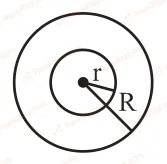
A charge Q is distributed over two concentric conducting thin spherical shells radii r and R (R > r). If the surface charge densities on the two shells are equal, the electric potential at the common centre is:

  1. A

  2. B

  3. C

  4. D

JEE MAIN 2020 · 09 JAN S1Electric field of continuous charge distributionsTRANSCRIBED

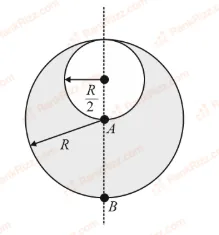
Consider a sphere of radius which carries a uniform charge density . If a sphere of radius is carved out of it, as shown, the ratio of magnitude of electric field and , respectively, at points and due to the remaining portion is:

image
  1. A

  2. B

  3. C

  4. D

JEE MAIN 2020 · 05 SEP S2Electric potential and potential energyTRANSCRIBED

Ten charges are placed on the circumference of a circle of radius R with constant angular separation between successive charges. Alternate charges 1, 3, 5, 7, 9 have charge each, while 2, 4, 6, 8, 10 have charge each. The potential V and the electric field E at the centre of the circle are respectively: (Take at infinity)

  1. A

    ;

  2. B

    ,

  3. C

    ;

  4. D

    ;

JEE MAIN 2020 · 06 SEP S1Electric field due to point charges and superpositionTRANSCRIBED

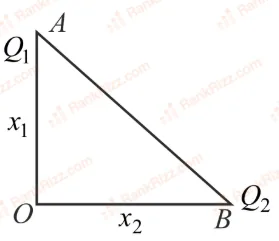
Charges and are at points A and B of a right-angled triangle OAB. The resultant electric field at point O is perpendicular to the hypotenuse, then is proportional to:

image
  1. A

  2. B

  3. C

  4. D

JEE MAIN 2020 · 04 SEP S1Electric field of continuous charge distributionsTRANSCRIBED

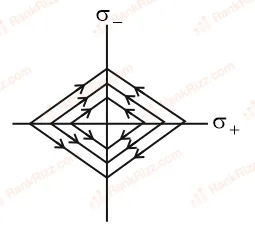
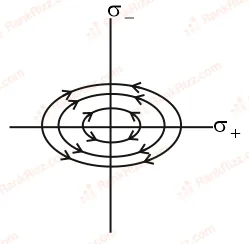
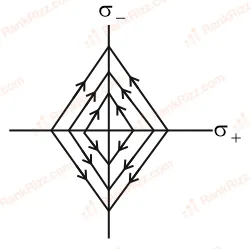
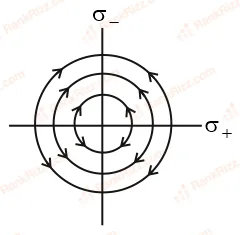
Two charged thin infinite plane sheets of uniform charge density and , where |\sigma_+| > |\sigma_-|, intersect at the right angle. Which of the following best represents the electric field lines for the system:

  1. A
  2. B
  3. C
  4. D
JEE MAIN 2020 · 08 JAN S1Electric field due to point charges and superpositionTRANSCRIBED

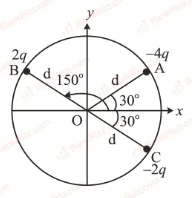
Three charged particles A, B and C with charges , and are present on the circumference of a circle of radius . The charged particles A, C and centre O of the circle formed an equilateral triangle as shown in the figure. The electric field at the point O is

image
  1. A

  2. B

  3. C

  4. D

JEE MAIN 2020 · 09 JAN S1Electric dipole and dipole in external fieldTRANSCRIBED

An electric dipole of moment C m at the origin . The electric field due to this dipole at (note that ) is parallel to:

  1. A

  2. B

  3. C

  4. D

JEE MAIN 2020 · 03 SEP S2Electric potential and potential energyTRANSCRIBED

Concentric metallic hollow spheres of radii R and 4R hold charges and respectively. Given that surface charge densities of the concentric spheres are equal, the potential difference V(R) - V(4R) is:

  1. A

  2. B

  3. C

  4. D

JEE MAIN 2020 · 04 SEP S1Electric potential and potential energyTRANSCRIBED

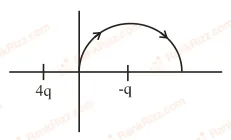
A two point charges and are fixed on the -axis at and , respectively. If the third point charge 'q' is taken from the origin to along the semicircle as shown in the figure, the energy of the charge will:

  1. A

    Increase by

  2. B

    Increase by

  3. C

    decrease by

  4. D

    decrease by

JEE MAIN 2020 · 08 JAN S1Electric flux and Gauss's lawTRANSCRIBED

In finding the electric field using Gauss law the formula is applicable. In the formula is permittivity of free space, A is the area of the Gaussian surface and is charge enclosed by the Gaussian surface. This equation can be used in which of the following situation?

  1. A

    Only when the Gaussian surface is an equipotential surface

  2. B

    Only when the Gaussian surface is an equipotential surface and is constant on the surface.

  3. C

    Only when = constant on the surface.

  4. D

    For any choice of Gaussian surface.

JEE MAIN 2020 · 06 SEP S2Electric dipole and dipole in external fieldTRANSCRIBED

Two identical electric point dipoles have dipole moments and and are held on the x-axis at distance 'a' from each other. When released, they move along the x-axis with the direction of their dipole moments remaining unchanged. If the mass of each dipole is 'm', their speed when they are infinitely far apart is:

  1. A

  2. B

  3. C

  4. D