RankRizzStart free

Electrostatics — JEE Main Previous Year Questions

Every Electrostatics question JEE Main has set, grouped by the idea it tests rather than the order of the syllabus. 294 questions across 9 distinct ideas. Free to read, answer key on every one.

Questions

294

Distinct ideas

9

Share of marks

6%

Difficulty

MEDIUM

The ideas inside Electrostatics

A chapter is not one subject — it is a handful of procedures the examiner reuses. These are the ones Electrostatics questions actually test.

01Electric charge and Coulomb's lawset 42×
02Electric field due to point charges and superpositionset 25×
03Electric field of continuous charge distributionsset 42×
04Motion and equilibrium of charged bodies in electric fieldsset 7×
05Electric flux and Gauss's lawset 53×
06Electric potential and potential energyset 62×
07Relation between field and potential, equipotential surfacesset 13×
08Electric dipole and dipole in external fieldset 39×
09Conductors, concentric shells and earthingset 11×

Every Electrostatics question

261–280 OF 294 · NEWEST FIRST

JEE MAIN 2013 · 22 APR ONLINERelation between field and potential, equipotential surfacesTRANSCRIBED

Two small equal point charges of magnitude are suspended from a common point on the ceiling by insulating mass less strings of equal lengths. They come to equilibrium with each string making angle from the vertical. If the mass of each charge is , then the electrostatic potential at the centre of line joining them will be .

  1. A

  2. B

  3. C

  4. D

JEE MAIN 2013 · 23 APR ONLINEConductors, concentric shells and earthingTRANSCRIBED

Consider a finite insulated, uncharged conductor placed near a finite positively charged conductor. The uncharged body must have a potential :

  1. A

    less than the charged conductor and more than at infinity.

  2. B

    more than the charged conductor and less than at infinity.

  3. C

    more than the charged conductor and more than at infinity.

  4. D

    less than the charged conductor and less than at infinity.

JEE MAIN 2013 · 23 APR ONLINEElectric field of continuous charge distributionsTRANSCRIBED

A liquid drop having 6 excess electrons is kept stationary under a uniform electric field of 25.5 kVm. The density of liquid is kg m. The radius of the drop is (neglect buoyancy).

  1. A

    m

  2. B

    m

  3. C

    m

  4. D

    m

JEE MAIN 2013 · 09 APR ONLINEElectric field of continuous charge distributionsTRANSCRIBED

A uniform electric field exists between the plates of a charged condenser. A charged particle enters the space between the plates and perpendicular to . The path of the particle between the plates is a:

  1. A

    straight line

  2. B

    hyperbola

  3. C

    parabola

  4. D

    circle

JEE MAIN 2012Electric flux and Gauss's lawTRANSCRIBED

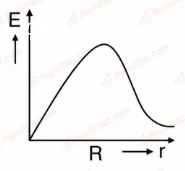
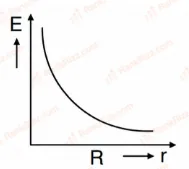
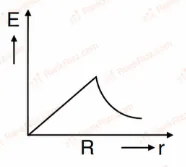
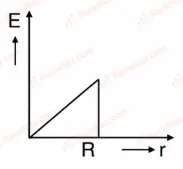
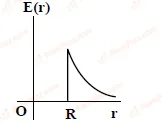
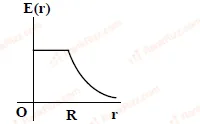
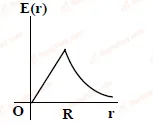
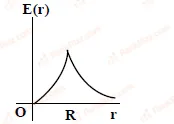
In a uniformly charged sphere of total charge and radius , the electric field is plotted as a function of distance from the centre. The graph which would correspond to the above will be

  1. A
    image
  2. B
    image
  3. C
    image
  4. D
    image
JEE MAIN 2012Electric potential and potential energyTRANSCRIBED

This question has statement 1 and statement 2. Of the four choices given after the statements, choose the one that best describes the two statements. 

An insulating solid sphere of radius has a uniformly positive charge density . As a result of this uniform charge distribution there is a finite value of electric potential at the centre of the sphere, at the surface of the sphere and also at a point out side the sphere. The electric potential at infinity is zero. 

Statement 1: When a charge is taken from the centre to the surface of the sphere, its potential energy changes by . 

Statement 2: The electric field at a distance r\ (r < R) from the centre of the sphere is  

  1. A

    Statement 1 is true, Statement 2 is true, Statement 2 is not the correct explanation for statement 1.

  2. B

    Statement 1 is true, Statement 2 is false

  3. C

    Statement 1 is false, Statement 2 is true

  4. D

    Statement 1 is true, Statement 2 is the correct explanation for statement 1

JEE MAIN 2012Electric flux and Gauss's lawTRANSCRIBED

The electric potential in a region around the origin is given by volts. The electric charge enclosed in a cube of 1 m side with its centre at the origin is (in coulomb)

  1. A

  2. B

  3. C

    0

  4. D

JEE MAIN 2012Electric field due to point charges and superpositionTRANSCRIBED

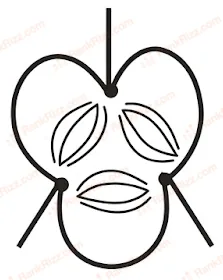
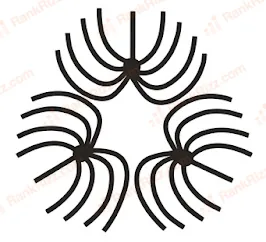
Three positive charges of equal value are placed at vertices of an equilateral triangle. The resulting lines of force should be sketched as in

  1. A
    image
  2. B
    image
  3. C
    image
  4. D
    image
JEE MAIN 2012Conductors, concentric shells and earthingTRANSCRIBED

A charge of total amount is distributed over two concentric hollow spheres of radii and R\ (R > r) such that the surface charge densities on the two spheres are equal. The electric potential at the common centre is

  1. A

  2. B

  3. C

  4. D

JEE MAIN 2012Electric flux and Gauss's lawTRANSCRIBED

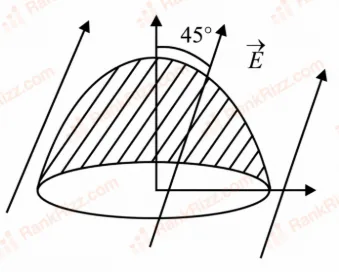
The flat base of a hemisphere of radius with no charge inside it lies in a horizontal plane. A uniform electric field is applied at an angle with the vertical direction. The electric flux through the curved surface of the hemisphere is

image
  1. A

  2. B

  3. C

  4. D

JEE MAIN 2011Electric charge and Coulomb's lawTRANSCRIBED

Two identical charged spheres suspended from a common point by two massless strings of length are initially a distance apart because of their mutual repulsion. The charge begins to leak from both the spheres at a constant rate. As a result the charges approach each other with a velocity . Then as a function of distance between them,

  1. A

  2. B

  3. C

  4. D

JEE MAIN 2011Electric flux and Gauss's lawTRANSCRIBED

The electrostatic potential inside a charged spherical ball is given by where is the distance from the centre; are constants. Then the charge density inside ball is:

  1. A

  2. B

  3. C

  4. D

JEE MAIN 2010Electric field of continuous charge distributionsTRANSCRIBED

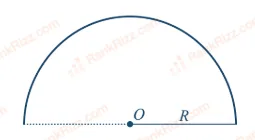
A thin semi-circular ring of radius has a positive charge distributed uniformly over it. The net field at the centre is

image
  1. A

  2. B

  3. C

  4. D

JEE MAIN 2010Electric flux and Gauss's lawTRANSCRIBED

Let there be a spherically symmetric charge distribution with charge density varying as upto , and for r > R, where is the distance from the origin. The electric field at a distance (r < R) from the origin is given by

  1. A

  2. B

  3. C

  4. D

JEE MAIN 2010Electric charge and Coulomb's lawTRANSCRIBED

Two identical charged spheres are suspended by strings of equal lengths. The strings make an angle of with each other. When suspended in a liquid of density g cm, the angle remains the same. If density of the material of the sphere is g cm, the dielectric constant of the liquid is

  1. A

    4

  2. B

    3

  3. C

    2

  4. D

    1

JEE MAIN 2009Electric potential and potential energyTRANSCRIBED

This question contains Statement-1 and Statement-2. Of the four choices given after the statements, choose the one that best describes the two statements. Statement - 1: For a charged particle moving from point to point , the net work done by an electrostatic field on the particle is independent of the path connecting point to point . Statement-2: The net work done by a conservative force on an object moving along a closed loop is zero

  1. A

    Statement-1 is true, Statement-2 is false

  2. B

    Statement-1 is true, Statement-2 is true; Statement-2 is the correct explanation of Statement-1.

  3. C

    Statement-1 is true, Statement-2 is true; Statement-2 is not the correct explanation of Statement-1.

  4. D

    Statement-1 is false, Statement-2 is true

JEE MAIN 2009Electric flux and Gauss's lawTRANSCRIBED

Let be the charge density distribution for a solid sphere of radius and total charge . For a point '' inside the sphere at distance from the centre of the sphere, the magnitude of electric field is

  1. A

  2. B

  3. C

  4. D

JEE MAIN 2009Electric potential and potential energyTRANSCRIBED

Two points and are maintained at the potentials of V and V respectively. The work done in moving electrons from to is

  1. A

    J

  2. B

    J

  3. C

    J

  4. D

    J

JEE MAIN 2009Electric charge and Coulomb's lawTRANSCRIBED

A charge is placed at each of the opposite corners of a square. A charge is placed at each of the other two corners. If the net electrical force on is zero, then the equals

  1. A

  2. B

  3. C

  4. D

JEE MAIN 2008Electric flux and Gauss's lawTRANSCRIBED

A thin spherical shell of radius has charge spread uniformly over its surface. Which of the following graphs most closely represents the electric field produced by the shell in the range 0 \le r < \infty, where is the distance from the centre of the shell?

  1. A
  2. B
  3. C
  4. D