RankRizzStart free

Electrostatics — JEE Main Previous Year Questions

Every Electrostatics question JEE Main has set, grouped by the idea it tests rather than the order of the syllabus. 294 questions across 9 distinct ideas. Free to read, answer key on every one.

Questions

294

Distinct ideas

9

Share of marks

6%

Difficulty

MEDIUM

The ideas inside Electrostatics

A chapter is not one subject — it is a handful of procedures the examiner reuses. These are the ones Electrostatics questions actually test.

01Electric charge and Coulomb's lawset 42×
02Electric field due to point charges and superpositionset 25×
03Electric field of continuous charge distributionsset 42×
04Motion and equilibrium of charged bodies in electric fieldsset 7×
05Electric flux and Gauss's lawset 53×
06Electric potential and potential energyset 62×
07Relation between field and potential, equipotential surfacesset 13×
08Electric dipole and dipole in external fieldset 39×
09Conductors, concentric shells and earthingset 11×

Every Electrostatics question

201–220 OF 294 · NEWEST FIRST

JEE MAIN 2020 · 08 JAN S2Electric potential and potential energyTRANSCRIBED

Consider two charged metallic spheres and of radii and , respectively. The electric fields (on ) and (on ) on their surfaces are such that . Then the ratio (on )/ (on ) of the electrostatic potentials on each sphere is:

  1. A

  2. B

  3. C

  4. D

JEE MAIN 2020 · 05 SEP S1Electric potential and potential energyTRANSCRIBED

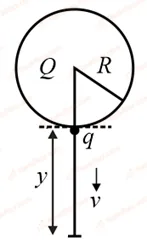
A solid sphere of radius carries a charge distributed uniformly over its volume. A very small point like piece of it of mass gets detached from the bottom of the sphere and falls down vertically under gravity. This piece carries charge . If it acquires a speed when it has fallen through a vertical height (see figure), then (assume the remaining portion to be spherical)

  1. A

  2. B

  3. C

  4. D

JEE MAIN 2020 · 06 SEP S2Electric field due to point charges and superpositionTRANSCRIBED

Consider the force F on a charge 'q' due to a uniformly charged spherical shell of radius R carrying charge Q distributed uniformly over it. Which one of the following statements is true for F, if 'q' is placed at distance r from the centre of the shell?

  1. A

    for r < R

  2. B

    \frac{1}{4\pi\varepsilon_0}\frac{qQ}{R^2} > F > 0 for r < R

  3. C

    for r > R

  4. D

    for all r

JEE MAIN 2020 · 02 SEP S1Electric field due to point charges and superpositionTRANSCRIBED

A charged particle (mass m and charge q) moves along X axis with velocity . When it passes through the origin it enters a region having uniform electric field which extends upto . Equation of path of electron in the region x > d is:

  1. A

  2. B

  3. C

  4. D

JEE MAIN 2020 · 02 SEP S2Electric field of continuous charge distributionsTRANSCRIBED

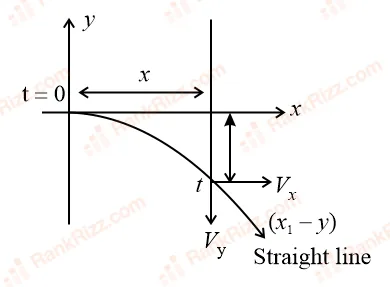
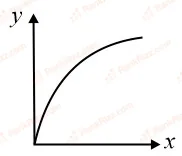
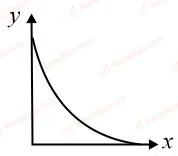
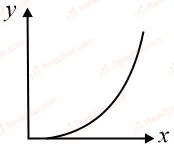
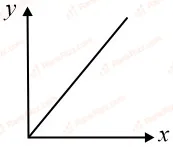
A small point mass carrying some positive charge on it, is released from the edge of a table. There is a uniform electric field in this region in the horizontal direction. Which of the following options then correctly describe the trajectory of the mass? (Curves are drawn schematically and are not to scale)

  1. A
  2. B
  3. C
  4. D
JEE MAIN 2020 · 09 JAN S2Electric flux and Gauss's lawTRANSCRIBED

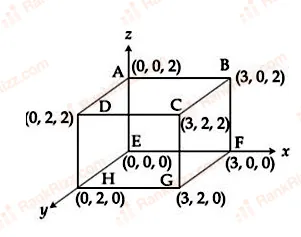
An electric field N/C passes through the box shown in figure. The flux of the electric field through surfaces ABCD and BCGF are marked as and respectively. The absolute difference between is (in Nm/C) ___________.

JEE MAIN 2019 · 10 APR S1Electric potential and potential energyTRANSCRIBED

A uniformly charged ring of radius 3a and total charge q is placed in x-y plane centred at origin. A point charge q is moving towards the ring along the z-axis and has speed v at z = 4a. The minimum value of v such that it crosses the origin is:

  1. A

  2. B

  3. C

  4. D

JEE MAIN 2019 · 12 JAN S1Electric dipole and dipole in external fieldTRANSCRIBED

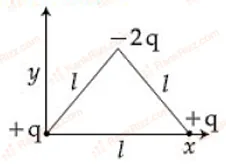
Determine the electric dipole moment of the system of three charges, placed on the vertices of an equilateral triangle, as shown in the figure:

  1. A

  2. B

  3. C

  4. D

JEE MAIN 2019 · 08 APR S1Electric field due to point charges and superpositionTRANSCRIBED

The bob of a simple pendulum has mass 2 g and a charge of 5.0 C. It is at rest in a uniform horizontal electric field of intensity 2000 V/m. At equilibrium, the angle that the pendulum makes with the vertical is: (take g = 10 m/s)

  1. A

  2. B

  3. C

  4. D

JEE MAIN 2019 · 09 JAN S1Electric charge and Coulomb's lawTRANSCRIBED

Three charges , , are placed respectively, at distance, , and from the origin, on the -axis. If the net force experienced by , placed at , is zero, then value of is:

  1. A

  2. B

  3. C

  4. D

JEE MAIN 2019 · 11 JAN S1Electric potential and potential energyTRANSCRIBED

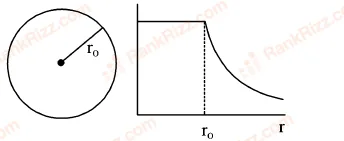
The given graph shows variation (with distance r from centre) of:

  1. A

    Electric field of a uniformly charged sphere

  2. B

    Potential of a uniformly charged spherical shell

  3. C

    Potential of a uniformly charged sphere

  4. D

    Electric field of a uniformly charged spherical shell

JEE MAIN 2019 · 09 JAN S2Electric charge and Coulomb's lawTRANSCRIBED

Charge is distributed within a sphere of radius with a volume charge density , where and are constants. If is the total charge of this charge distribution, the radius is:

  1. A

  2. B

  3. C

  4. D

JEE MAIN 2019 · 08 APR S2Electric potential and potential energyTRANSCRIBED

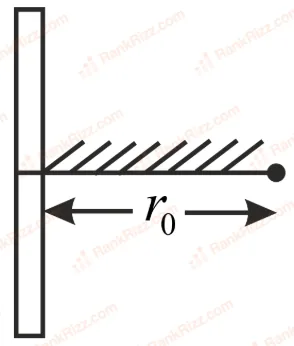
A positive point charge is released from rest at a distance from a positive line charge with uniform charge density. The speed (v) of the point charge, as a function of instantaneous distance r from line charge, is proportional to:

image
  1. A

  2. B

  3. C

  4. D

JEE MAIN 2019 · 10 JAN S1Electric dipole and dipole in external fieldTRANSCRIBED

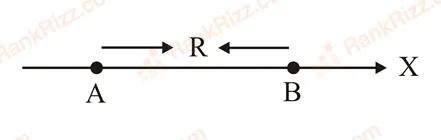
Two electric dipoles, A, B with respective dipole moments and are placed on the -axis with a separation , as shown in the figure.


The distance from A at which both of them produce the same potential is:

  1. A

  2. B

  3. C

  4. D

JEE MAIN 2019 · 12 JAN S1Electric potential and potential energyTRANSCRIBED

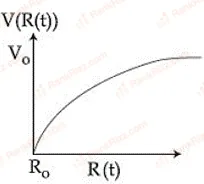
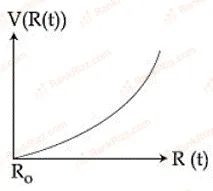
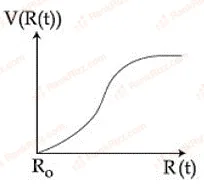
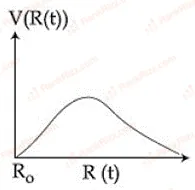
There is a uniform spherically symmetric surface charge density at a distance from the origin. The charge distribution is initially at rest and starts expanding because of mutual repulsion. The figure that represents best the speed of the distribution as a function of its instantaneous radius is:

  1. A
  2. B
  3. C
  4. D
JEE MAIN 2019 · 12 APR S1Electric dipole and dipole in external fieldTRANSCRIBED

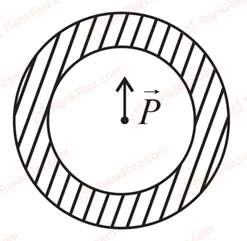
Shown in the figure is a shell made of a conductor. It has inner radius a and outer radius b, and carries charge Q. At its centre a dipole is placed as shown then:

  1. A

    Surface charge density on the inner surface of the shell is zero everywhere.

  2. B

    Electric field outside the shell is the same as that of a point charge at the centre of the shell.

  3. C

    Surface charge density on the inner surface is uniform and equal to .

  4. D

    Surface charge density on the outer surface depends on .

JEE MAIN 2019 · 08 APR S1Electric potential and potential energyTRANSCRIBED

A solid conducting sphere, having a charge Q, is surrounded by an uncharged conducting hollow spherical shell. Let the potential difference between the surface of the solid sphere and that of the outer surface of the hollow shell be V. If the shell is now given a charge of -4Q, the new potential difference between the same two surfaces is:

  1. A

    -2V

  2. B

    2 V

  3. C

    V

  4. D

    4 V

JEE MAIN 2019 · 09 JAN S1Electric field of continuous charge distributionsTRANSCRIBED

For a uniformly charged ring of radius , the electric field on its axis has the largest magnitude at a distance from its centre. Then value of is:

  1. A

  2. B

  3. C

  4. D

JEE MAIN 2019 · 11 JAN S1Electric potential and potential energyTRANSCRIBED

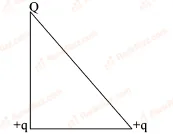
Three charges , and are placed at the vertices of a right-angle isosceles triangle as shown below. The net electrostatic energy of the configuration is zero, if the value of Q is:

  1. A

  2. B

  3. C

  4. D

JEE MAIN 2019 · 09 JAN S2Electric field of continuous charge distributionsTRANSCRIBED

Two point charges C) and C) are placed on the -axis at m and m respectively. The electric field (in V/m) at a point m on -axis is, [Take N mC]

  1. A

  2. B

  3. C

  4. D