JEE Main 2015 Physics question — Conductors, concentric shells and earthing
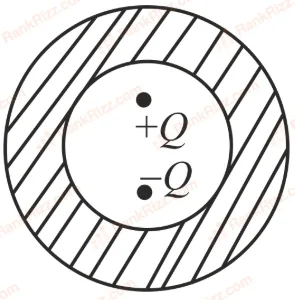
Shown in the figure are two point charges and inside the cavity of a spherical shell. The charges are kept near the surface of the cavity on opposite sides of the centre of the shell. If is the surface charge on the inner surface and net charge on it and the surface charge on the outer surface and net charge on it then:
SOLUTION
1. Inner surface:
According to Gauss’s Law, the electric field inside the material of a conducting shell must be zero (). If we draw a Gaussian surface entirely within the metal of the shell, the total enclosed charge must be zero.
Net Charge (): Since the charges inside the cavity are and , their sum is zero. Therefore, .
Surface Density (): Although the net charge is zero, the point charges inside are not at the same location. The charge will attract negative charges to the nearby inner surface, and the charge will attract positive charges. This electrostatic induction causes a redistribution of charge.
Because the distribution is not uniform, the surface charge density (it is positive in some areas and negative in others).
2. Outer surface:
The shielding effect of a conductor means that the distribution of charges on the outer surface depends only on the net charge enclosed by the shell and any external electric fields.
Net Charge (): Since the shell is neutral and the net charge induced on the inner surface () is zero, the net charge on the outer surface must also be to maintain charge conservation.
Surface Density (): Because the net charge enclosed by the inner surface is zero, there is no net electric flux leaking out to induce a charge on the exterior. In the absence of an external field, the charge remains perfectly balanced.
Therefore, the outer surface charge density is .
Tagged Conductors, concentric shells and earthing. Machine-assigned, so read it as a strong shortlist rather than a verdict.