A uniform metallic wire carries a current 2 A, when 3.4 V battery is connected across it. The mass of uniform metallic wire is kg, density is kg m and resistivity is - m. The length of wire is:
- A
m
- B
m
- C
m
- D
m
Every Current Electricity question JEE Main has set, grouped by the idea it tests rather than the order of the syllabus. 386 questions across 10 distinct ideas. Free to read, answer key on every one.
Questions
386
Distinct ideas
10
Share of marks
5.6%
Difficulty
MEDIUM
A chapter is not one subject — it is a handful of procedures the examiner reuses. These are the ones Current Electricity questions actually test.
101–120 OF 386 · NEWEST FIRST
A uniform metallic wire carries a current 2 A, when 3.4 V battery is connected across it. The mass of uniform metallic wire is kg, density is kg m and resistivity is - m. The length of wire is:
m
m
m
m
With the help of potentiometer, we can determine the value of emf of a given cell. The sensitivity of the potentiometer is
(A) directly proportional to the length of the potentiometer wire
(B) directly proportional to the potential gradient of the wire
(C) inversely proportional to the potential gradient of the wire
(D) inversely proportional to the length of the potentiometer wire
Choose the correct option for the above statements:
B and D only
A and C only
A only
C only
In a metallic conductor, under the effect of applied electric field, the free electrons of the conductor
Drift from higher potential to lower potential
Move with the uniform velocity throughout from lower potential to higher potential
Move in the straight line paths in the same direction
Move in the curved paths from lower potential to higher potential
The drift velocity of electrons for a conductor connected in an electrical circuit is . The conductor is now replaced by another conductor with same material and same length but double the area of cross-section. The applied voltage remains same. The new drift velocity of electrons will be
Equivalent resistance between the adjacent corners of a regular -sided polygon of uniform wire of resistance would be:
A wire of resistance is melted and drawn in a wire of one-fourth of its length. The new resistance of the wire will be
A cell of emf 90 V is connected across series combination of two resistors each of 100 resistance. A voltmeter of resistance 400 is used to measure the potential difference across each resistor. The reading of the voltmeter will be:
40 V
45 V
80 V
90 V
The amount of thermal energy is developed by a resistor in 10 s when a current of 4 A is passed through it. If the current is increased to 16 A, the thermal energy developed by the resistor in 10 s will be
The charge flowing in a conductor changes with time as , where , and are constants. Minimum value of current is:
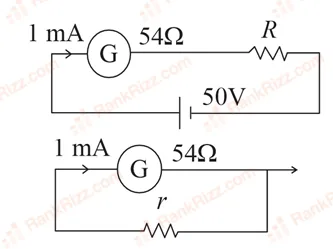
For designing a voltmeter of range 50 V and an ammeter of range 10 mA using a galvanometer which has a coil of resistance 54 showing a full scale deflection for 1 mA as in figure.
(A) for voltmeter k
(B) for ammeter
(C) for ammeter
(D) for voltmeter k
(E) for voltmeter
Choose the correct answer from the options given below:
(A) and (C)
(C) and (E)
(C) and (D)
(A) and (B)
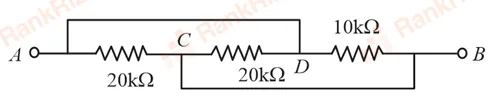
The equivalent resistance between A and B as shown in figure is:

10 k
5 k
20 k
30 k
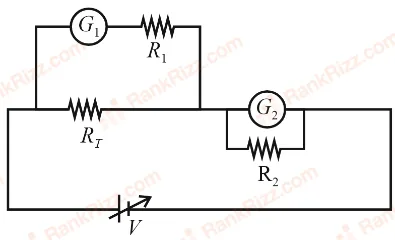
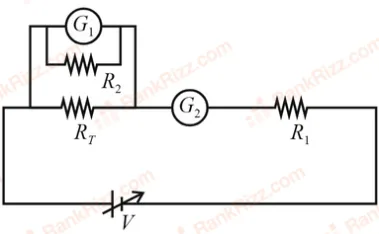
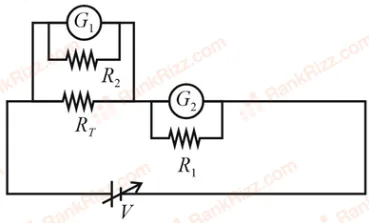
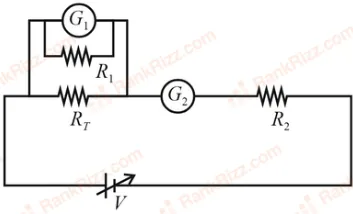
A student is provided with a variable voltage source , a test resistor , two identical galvanometers and and two additional resistors, and . For conducting an experiment to verify ohm's law, the most suitable circuit is:


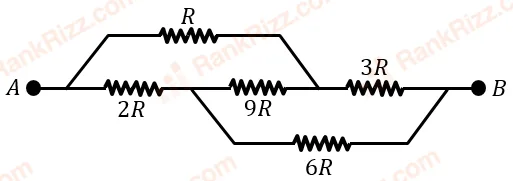
The equivalent resistance between A and B of the network shown in the figure:

14 R
21 R
R
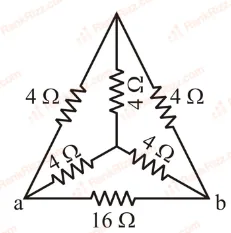
The equivalent resistance of the circuit shown below between points a and b is:

16
3.2
24
20
Two identical heater filaments are connected first in parallel and then in series. At the same applied voltage, the ratio of heat produced in same time for parallel to series will be:
1 : 4
4 : 1
2 : 1
1 : 2
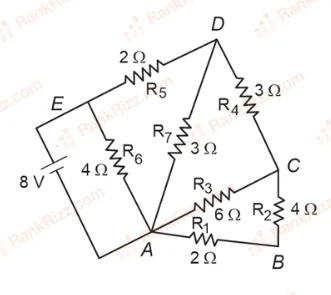
The current flowing through is:
A
A
A
A
In the given circuit the value of is:

1
1.5
2
1.33
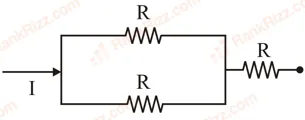
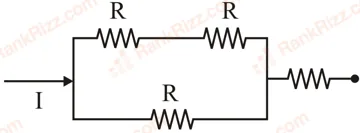
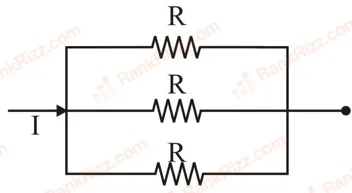
Different combination of 3 resistors of equal resistance are shown in the figures. The increasing order for power dissipation is:
(A)
(B)
(C)
(D)

P_B < P_C < P_D < P_A
P_C < P_D < P_A < P_B
P_C < P_B < P_A < P_D
P_A < P_B < P_C < P_D
The resistance of a wire is 5 . Its new resistance in ohm, if stretched to 5 times of its original length will be:
625
125
5
25
Given below are two statements:
Statement I : The equivalent resistance of resistors in a series combination is smaller than least resistance used in the combination.
Statement II : The resistivity of the material is independent of temperature. In the light of the above statements, choose the correct answer from the options given below:
Both Statement I and Statement II are false
Both Statement I and Statement II are true
Statement I is true but Statement II is false
Statement I is false but Statement II is true
OTHER PHYSICS CHAPTERS