JEE MAIN 2022 · 29 JUL S1Combination of resistors and equivalent resistanceTRANSCRIBED
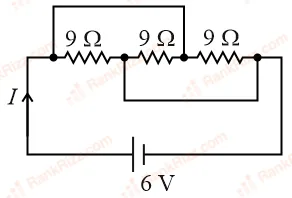
The current I flowing through the given circuit will be _____ A.
Every Current Electricity question JEE Main has set, grouped by the idea it tests rather than the order of the syllabus. 386 questions across 10 distinct ideas. Free to read, answer key on every one.
Questions
386
Distinct ideas
10
Share of marks
5.6%
Difficulty
MEDIUM
A chapter is not one subject — it is a handful of procedures the examiner reuses. These are the ones Current Electricity questions actually test.
181–200 OF 386 · NEWEST FIRST
The current I flowing through the given circuit will be _____ A.
The current density in a cylindrical wire of radius mm is A m. The current through the outer portion of the wire between radial distances and is ______ A.
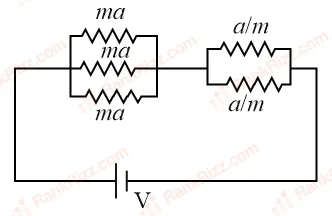
In the given circuit 'a' is an arbitrary constant. The value of for which the equivalent circuit resistance is minimum, will be . The value of is ______.
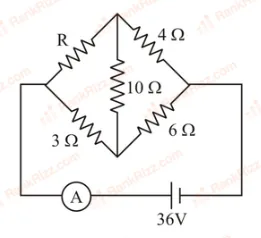
Current measured by the ammeter in the reported circuit when no current flows through resistance, will be ______ A.
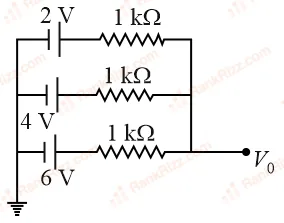
In the given figure, the value of will be ______ V.
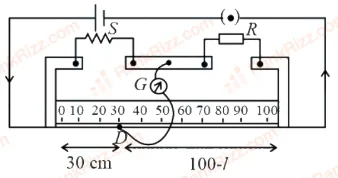
In meter bridge experiment for measuring unknown resistance '', the null point is obtained at a distance from the left side as shown at point . If is , then the value of unknown resistance '' will be ______ .
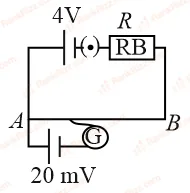
As shown in the figure, a potentiometer wire of resistance 20 and length 300 cm is connected with resistance box (R.B.) and a standard cell of emf 4 V. For a resistance 'R' of resistance box introduced into the circuit, the null point for a cell of 20 mV is found to be 60 cm. The value of 'R' is _____ .
An electrical bulb rated 220 V, 100 W, is connected in series with another bulb rated 220 V, 60 W. If the voltage across combination is 220 V, the power consumed by the 100 W bulb will be about _____ W.
A resistor develops J of thermal energy in s, when a current of A is passed through it. If the current increases to A, the energy developed in s is ______ J.
The length of a given cylindrical wire is increased to double of its original length. The percentage increase in the resistance of the wire will be ______ %.
Eight copper wires of length and diameter are joined in parallel to form a single composite conductor of resistance . If a single copper wire of length has the same resistance then its diameter will be ______ .
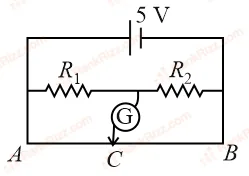
In the given figure of meter bridge experiment, the balancing length AC corresponding to null deflection of the galvanometer is 40 cm. The balancing length, if the radius of the wire AB is doubled, will be _____ cm.
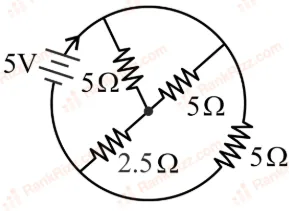
The total current supplied to the circuit as shown in the figure by the V battery is ______ A.
A wire of 1 has a length of 1 m. It is stretched till its length increases by 25%. The percentage change in resistance to the nearest integer is:
12.5%
76%
25%
56%
Due to cold weather, a 1 m water pipe of cross-sectional area 1 cm is filled with ice at -10°C. Resistive heating is used to melt the ice. Current of 0.5 A is passed through 4 k resistance. Assuming that all the heat produced is used for melting, what is the minimum time required?
(Given latent heat of fusion for water/ice = J kg, specific heat of ice = J kg °C and density of ice = kg m)
3.53 s
0.353 s
35.3 s
70.6 s
A resistor develops 500 J of thermal energy in 20 s when a current of 1.5 A is passed through it. If the current is increased from 1.5 A to 3 A, what will be the energy developed in 20 s.
1500 J
1000 J
500 J
2000 J
In the given figure, the emf of the cell is 2.2 V and if internal resistance is 0.6 . Calculate the power dissipated in the whole circuit:
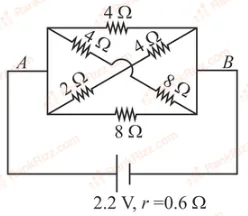
1.32 W
4.4 W
0.65 W
2.2 W
A Copper (Cu) rod of length 25 cm and cross-sectional area 3 mm is joined with a similar Aluminium (Al) rod as shown in figure. Find the resistance of the combination between the ends A and B.
(Take resistivity of Copper = 1.7 m, Resistivity of aluminium = 2.6 m)
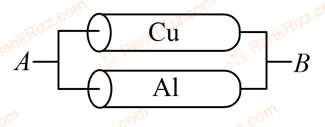
2.170 m
1.420 m
0.0858 m
0.858 m
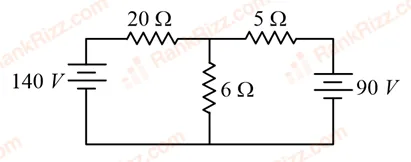
The value of current in the 6 resistance is:
4 A
8 A
10 A
6 A
Consider a galvanometer shunted with 5 resistance and 2% of current passes through it. What is the resistance of the given galvanometer?
245
344
300
226
OTHER PHYSICS CHAPTERS