JEE MAIN 2024 · 29 JAN S2Kirchhoff's laws and circuit analysisTRANSCRIBED
In the given circuit, the current in resistance is:
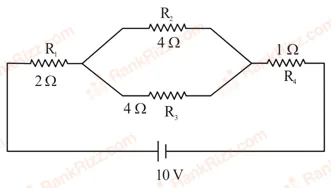
- A
A
- B
A
- C
A
- D
A
Every Current Electricity question JEE Main has set, grouped by the idea it tests rather than the order of the syllabus. 386 questions across 10 distinct ideas. Free to read, answer key on every one.
Questions
386
Distinct ideas
10
Share of marks
5.6%
Difficulty
MEDIUM
A chapter is not one subject — it is a handful of procedures the examiner reuses. These are the ones Current Electricity questions actually test.
61–80 OF 386 · NEWEST FIRST
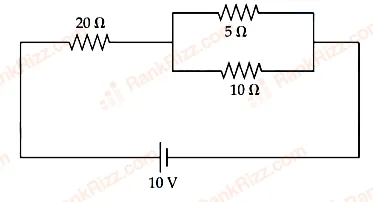
In the given circuit, the current in resistance is:
A
A
A
A
An electric toaster has resistance of at room temperature . The toaster is connected to a supply. If the current flowing through it reaches , the temperature attained by toaster is around: (if )
The resistance per centimeter of a meter bridge wire is , with resistance in left gap. Balancing length from left end is at 40 cm with 25 resistance in right gap. Now the wire is replaced by another wire of resistance per centimeter. The new balancing length for same settings will be at
20 cm
10 cm
80 cm
40 cm
An electric bulb rated W V is connected across a V supply. The power dissipation of the bulb is:
W
W
W
W
The ratio of heat dissipated per second through the resistors and in the circuit given below is
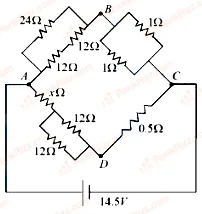
The value of unknown resistance for which the potential difference between and will be zero in the arrangement shown, is :
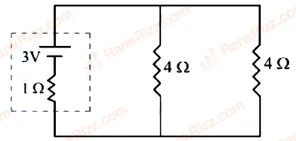
In the given circuit, the terminal potential difference of the cell is :
Water boils in an electric kettle in 20 minutes after being switched on. Using the same main supply, the length of the heating element should be _____ to _____ times of its initial length if the water is to be boiled in 15 minutes.
decreased, 3/4
increased, 4/3
decreased, 4/3
increased, 3/4
A galvanometer has a coil of resistance with a full scale deflection at . The value of resistance to be added to use it as an ammeter of range mA is :
To measure the internal resistance of a battery, potentiometer is used. For R = 10Ω, the balance point is observed at l = 500 cm and for R = 1Ω the balance point is observed at l = 400 cm. The internal resistance of the battery is approximately:
A galvanometer has a resistance of and it allows maximum current of mA. It can be converted into voltmeter to measure upto V by connecting in series a resistor of resistance.
In an ammeter, 5% of the main current passes through the galvanometer. If resistance of the galvanometer is G, the resistance of ammeter will be:
199 G
200 G
Three voltmeters, all having different internal resistances are joined as shown in figure. When some potential difference is applied across A and B, their readings are , and . Choose the correct option.
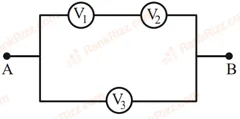
V_1 + V_2 > V_3
The electric current through a wire varies with time as , where A and A s. The amount of electric charge crossed through a section of the wire in s is:
C
C
C
C
In the given figure and . Battery is ideal with emf . Equivalent resistance of the circuit and current supplied by battery are respectively :
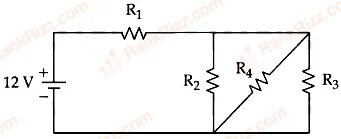
and
and
and
and
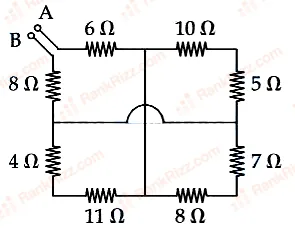
The equivalent resistance between A and B is :
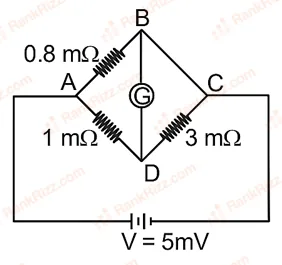
To measure the temperature coefficient of resistivity of a semiconductor, an electrical arrangement shown in the figure is prepared. The arm BC is made up of the semiconductor. The experiment is being conducted at 25°C and resistance of the semiconductor arm is . Arm BC is cooled at a constant rate of . If the galvanometer G shows no deflection after 10 s, then is
A galvanometer having coil resistance shows a full scale deflection for a current of mA. For it to measure a current of A, the value of the shunt should be:
The deflection in moving coil galvanometer falls from divisions to division when a shunt of is applied. The resistance of galvanometer coil will be:
At room temperature , the resistance of a heating element is . The temperature coefficient of the material is . The temperature of the element, when its resistance is , is ______ °C.
OTHER PHYSICS CHAPTERS