Voltage rating of a parallel plate capacitor is 500 V. Its dielectric can withstand a maximum electric field of V/m. The plate area is m. What is the dielectric constant if the capacitance is 15 pF? (given C/Nm)
- A
3.8
- B
8.5
- C
4.5
- D
6.2
Every JEE Main question on Capacitors with dielectrics, one of the ideas inside Capacitance: 55 questions from 2007–2026, 29 of them in the last five years. Newest first, answer key on every one. Free to read.
Questions
55
Years asked
13
Since
2007
Of the chapter
32%
41–55 OF 55 · NEWEST FIRST
Voltage rating of a parallel plate capacitor is 500 V. Its dielectric can withstand a maximum electric field of V/m. The plate area is m. What is the dielectric constant if the capacitance is 15 pF? (given C/Nm)
3.8
8.5
4.5
6.2
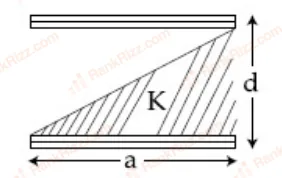
A parallel plate capacitor is made of two square plates of side , separated by a distance (). The lower triangular portion filled with a dielectric of dielectric constant , as shown in the figure. Capacitance of this capacitor is:

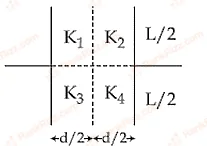
A parallel plate capacitor with square plates is filled with four dielectrics of dielectric constants , , , arranged as shown in the figure. The effective dielectric constant will be:

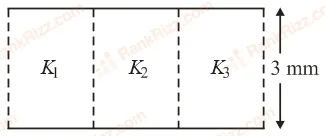
A parallel plate capacitor is of area 6 cm and a separation 3 mm. The gap is filled with three dielectric materials of equal thickness (see figure) with dielectric constant , and . The dielectric constant of a material which when fully inserted in above capacitor, gives same capacitance would be:

4
36
14
12
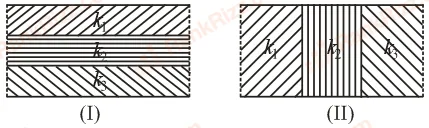
Two identical parallel plate capacitors, of capacitance C each, have plates of area A, separated by a distance d. The space between the plates of the two capacitors, is filled with three dielectrics, of equal thickness and dielectric constants K, K and K. The first capacitor is filled as shown in figure I, and the second one is filled as shown in figure II.
If these two modified capacitors are charged by the same potential V, the ratio of the energy stored in the two, would be (E refers to capacitor I and E to capacitor II):
The parallel combination of two air filled parallel plate capacitors of capacitance C and nC is connected to a battery of voltage, V. When the capacitors are fully charged, the battery is removed and after that a dielectric material of dielectric constant K is placed between the two plates of the first capacitor. The new potential difference of the combined system is:
V
A parallel plate capacitor having capacitance 12 pF is charged by a battery to a potential difference of 10 V between its plates. The charging battery is now disconnected and a porcelain slab of dielectric constant 6.5 is slipped between the plates. The work done by the capacitor on the slab is:
560 pJ
600 pJ
508 pJ
692 pJ
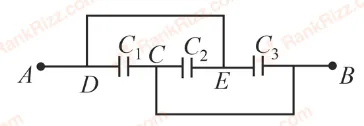
A combination of parallel plate capacitors is maintained at a certain potential difference.
When a 3 mm thick slab is introduced between all the plates, in order to maintain the same potential difference, the distance between the plates is increased by 2.4 mm. Find the dielectric constant of the slab.
6
4
3
5
A parallel plate capacitor is made of two circular plates separated by a distance of 5 mm and with a dielectric of dielectric constant 2.2 between them. When the electric field in the dielectric is V/m, the charge density of the positive plate will be close to:
C/m
C/m
C/m
C/m
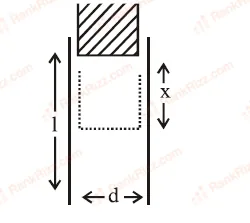
A parallel plate capacitor is made of two plates of length l, width w and separated by a distance d. A dielectric slab (dielectric constant K) that fits exactly between the plates is held near the edge of the plates. It is pulled into the capacitor by a force , where U is the energy of the capacitor when dielectric is inside the capacitor up to distance x (see the figure). If the charge on the capacitor is Q then the force on the dielectric when it is near the edge is:

The space between the plates of a parallel plate capacitor is filled with a 'dielectric' whose 'dielectric constant' varies with distance as per the relation: ( = a constant). The capacitance C, of the capacitor, would be related to its vacuum capacitance C for the relation:
The gap between the plates of a parallel plate capacitor of area A and distance between plates d, is filled with a dielectric whose relative permittivity varies linearly from at one plate to at the other. The capacitance of the capacitor is:
A parallel plate capacitor having a separation between the plates d, plate area A and material with dielectric constant K has capacitance . Now one-third of the material is replaced by another material with dielectric constant 2K, so that effectively there are two capacitors one with area A, dielectric constant 2K and another with area A and dielectric constant K. If the capacitance of this new capacitor is C then is
1
A parallel plate capacitor with air between the plates has a capacitance of 9 pF. The separation between its plates is ''. The space between the plates is now filled with two dielectrics. One of the dielectrics has dielectric constant and thickness while the other one has dielectric constant and thickness . Capacitance of the capacitor is now
1.8 pF
45 pF
40.5 pF
20.25 pF
A parallel plate condenser with a dielectric of dielectric constant between the plates has a capacity and is charged to a potential volts. The dielectric slab is slowly removed from between the plates and then reinserted. The net work done by the system in this process is
zero
RELATED CAPACITANCE TOPICS