RankRizz

Capacitance of isolated conductors and spherical/cylindrical capacitors — JEE Main Previous Year Questions

Every JEE Main question on Capacitance of isolated conductors and spherical/cylindrical capacitors, one of the ideas inside Capacitance: 13 questions from 2012–2026, 7 of them in the last five years. Newest first, answer key on every one. Free to read.

Questions

13

Years asked

10

Since

2012

Of the chapter

7%

When JEE Main asked it

Questions on Capacitance of isolated conductors and spherical/cylindrical capacitors in each year it was asked.

20261
20252
20241
20231
20222
20202
20191
20181
20131
20121

Every Capacitance of isolated conductors and spherical/cylindrical capacitors question

1–13 OF 13 · NEWEST FIRST

JEE MAIN 2026 · 28 JAN S2Capacitance of isolated conductors and spherical/cylindrical capacitorsTRANSCRIBED

Identify the correct statements:
A. Effective capacitance of a series combination of capacitors is always smaller than the smallest capacitance of the capacitor in the combination.
B. When a dielectric mediwn is placed between the charged plates of a capacitor, displacement of charges cannot occurdue to insulation property of dielectric.
C. Increasing of area of capacitor plate or decreasing of thickness of dielectric is an alternate method to increase the capacitance.
D. For a point charge, concentric spherical shells centered at the location of the charge are equipotential surfaces.
Choose the correct answer from the options given below :

  1. A

    B and D Only

  2. B

    A, B and C Only

  3. C

    C and D Only

  4. D

    A, C and D Only

JEE MAIN 2025 · 29 JAN S1Capacitance of isolated conductors and spherical/cylindrical capacitorsTRANSCRIBED
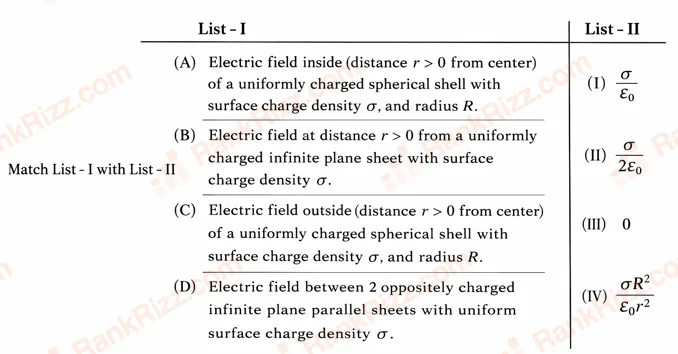
Figure for JEE Main 2025 Physics question on Capacitance of isolated conductors and spherical/cylindrical capacitors


Choose the correct answer from the options given below :

  1. A

    (A)-(III), (B)-(II), (C)-(IV), (D)-(I)

  2. B

    (A)-(IV), (B)-(II), (C)-(III), (D)-(I)

  3. C

    (A)-(II), (B)-(I), (C)-(IV), (D)-(III)

  4. D

    (A)-(IV), (B)-(I), (C)-(III), (D)-(II)

JEE MAIN 2025 · 24 JAN S2Capacitance of isolated conductors and spherical/cylindrical capacitorsTRANSCRIBED
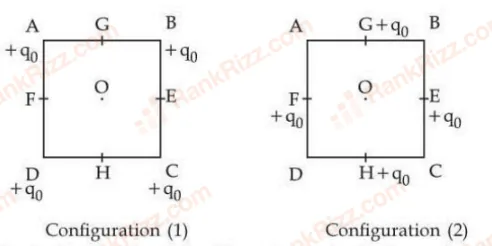
page7_img1

Work done in rearranging the four charges from configuration (1) to configuration (2) is

  1. A

    K102a(4−22)\frac{K1_0^2}{a}(4-2\sqrt{2})

  2. B

    K102a(3−2)\frac{K1_0^2}{a}(3-\sqrt{2})

  3. C

    K102a(42)−2\frac{K1_0^2}{a}(4\sqrt{2})-2

  4. D

    K102a(32−2)\frac{K1_0^2}{a}(3\sqrt{2}-2)

JEE MAIN 2024 · 09 APR S1Capacitance of isolated conductors and spherical/cylindrical capacitorsTRANSCRIBED

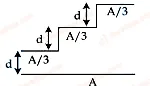
A capacitor is made of a flat plate of area A and a second plate having a stair-like structure as shown in figure. If the area of each stair is A3\frac{A}{3} and the height is dd, the capacitance of the arrangement is 

page2_img1
  1. A

    13ϵ0A17d\frac{13\epsilon_0 A}{17d}

  2. B

    11ϵ0A18d\frac{11\epsilon_0 A}{18d}

  3. C

    18ϵ0A11d\frac{18\epsilon_0 A}{11d}

  4. D

    11ϵ0A20d\frac{11\epsilon_0 A}{20d}

JEE MAIN 2023 · 01 FEB S2Capacitance of isolated conductors and spherical/cylindrical capacitorsTRANSCRIBED

Given below are two statements: One is labelled as Assertion A and the other is labelled as Reason R.
Assertion A: Two metallic spheres are charged to the same potential. One of them is hollow and another is solid, and both have the same radii. Solid sphere will have lower charge than the hollow one.
Reason R: Capacitance of metallic spheres depend on the radii of spheres.
In the light of the above statements, choose the correct answer from the options given below.

  1. A

    A is false but R is true

  2. B

    Both A and R are true and R is the correct explanation of A

  3. C

    A is true but R is false

  4. D

    Both A and R are true but R is not the correct explanation of A

JEE MAIN 2022 · 25 JUL S1Capacitance of isolated conductors and spherical/cylindrical capacitorsTRANSCRIBED

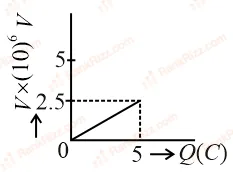
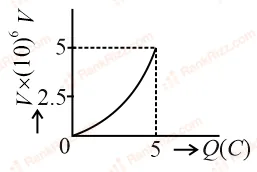
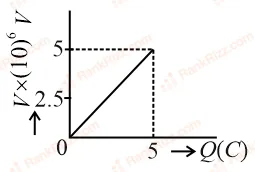
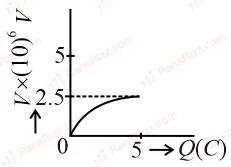
A condenser of 2μF2 \mu F capacitance is charged steadily from 00 to 5 C5 \text{ C}. Which of the following graph represents correctly the variation of potential difference VV across its plates with respect to the charge QQ on the condenser?

  1. A
    Figure for JEE Main 2022 Physics question on Capacitance of isolated conductors and spherical/cylindrical capacitors
  2. B
    Figure for JEE Main 2022 Physics question on Capacitance of isolated conductors and spherical/cylindrical capacitors
  3. C
    Figure for JEE Main 2022 Physics question on Capacitance of isolated conductors and spherical/cylindrical capacitors
  4. D
    Figure for JEE Main 2022 Physics question on Capacitance of isolated conductors and spherical/cylindrical capacitors
JEE MAIN 2022 · 25 JUL S2Capacitance of isolated conductors and spherical/cylindrical capacitorsTRANSCRIBED

Capacitance of an isolated conducting sphere of radius R1R_1 becomes nn times when it is enclosed by a concentric conducting sphere of radius R2R_2 connected to earth. The ratio of their radii  (R2R1)\left(\dfrac{R_2}{R_1}\right) is:

  1. A

    nn−1\dfrac{n}{n-1}

  2. B

    2n2n+1\dfrac{2n}{2n+1}

  3. C

    n+1n\dfrac{n+1}{n}

  4. D

    2n+1n\dfrac{2n+1}{n}

JEE MAIN 2020 · 02 SEP S2Capacitance of isolated conductors and spherical/cylindrical capacitorsTRANSCRIBED

A 10 μ\muF capacitor is fully charged to a potential difference of 50 V. After removing the source voltage it is connected to an uncharged capacitor in parallel. Now the potential difference across them becomes 20 V. The capacitance of the second capacitor is:

  1. A

    15 μ\muF

  2. B

    30 μ\muF

  3. C

    20 μ\muF

  4. D

    10 μ\muF

JEE MAIN 2020 · 08 JAN S2Capacitance of isolated conductors and spherical/cylindrical capacitorsTRANSCRIBED

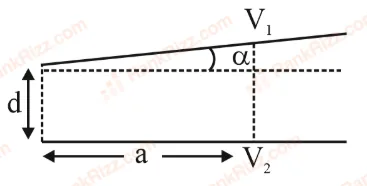
A capacitor is made of two square plates each of side 'a' making a very small angle α\alpha between them, as shown in figure. The capacitance will be close to:

Figure for JEE Main 2020 Physics question on Capacitance of isolated conductors and spherical/cylindrical capacitors
  1. A

    ε0a2d(1−αa2d)\frac{\varepsilon_0 a^2}{d}\left(1 - \frac{\alpha a}{2d}\right)

  2. B

    ε0a2d(1−αa4d)\frac{\varepsilon_0 a^2}{d}\left(1 - \frac{\alpha a}{4d}\right)

  3. C

    ε0a2d(1+αad)\frac{\varepsilon_0 a^2}{d}\left(1 + \frac{\alpha a}{d}\right)

  4. D

    ε0a2d(1−3αa2d)\frac{\varepsilon_0 a^2}{d}\left(1 - \frac{3\alpha a}{2d}\right)

JEE MAIN 2019 · 12 JAN S2Capacitance of isolated conductors and spherical/cylindrical capacitorsTRANSCRIBED

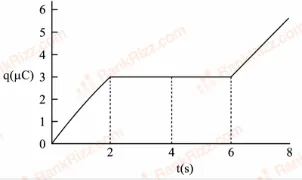
The charge on a capacitor plate in a circuit, as a function of time, is shown in the figure. What is the value of current at t=4t = 4 s?

Figure for JEE Main 2019 Physics question on Capacitance of isolated conductors and spherical/cylindrical capacitors
  1. A

    1.5μA1.5 \mu A

  2. B

    2μA2\mu A

  3. C

    Zero

  4. D

    3μA3\mu A

JEE MAIN 2018 · 08 APR OFFLINECapacitance of isolated conductors and spherical/cylindrical capacitorsTRANSCRIBED

A parallel plate capacitor of capacitance 90 pF is connected to a battery of EMF 20 V. If a dielectric material of dielectric constant K=53K = \frac{5}{3} is inserted between the plates, the magnitude of the induced charge will be:

  1. A

    0.9 nC

  2. B

    1.2 nC

  3. C

    0.3 nC

  4. D

    2.4 nC

JEE MAIN 2013 · 22 APR ONLINECapacitance of isolated conductors and spherical/cylindrical capacitorsTRANSCRIBED

To establish an instantaneous current of 2 A through a 1μ\muF capacitor; the potential difference across the capacitor plates should be changed at the rate of:

  1. A

    2×1042 \times 10^4 V/s

  2. B

    4×1064 \times 10^6 V/s

  3. C

    2×1062 \times 10^6 V/s

  4. D

    4×1044 \times 10^4 V/s

JEE MAIN 2012Capacitance of isolated conductors and spherical/cylindrical capacitorsTRANSCRIBED

This question has Statement 1 and Statement 2. Of the four choices given after the Statements, choose the one that best describes the two Statements. Statement 1: It is not possible to make a sphere of capacity 1 farad using a conducting material. Statement 2: It is possible for earth as its radius is 6.4×1066.4 \times 10^6 m.

  1. A

    Statement 1 is true, Statement 2 is true, Statement 2 is the correct explanation of Statement 1.

  2. B

    Statement 1 is false, Statement 2 is true.

  3. C

    Statement 1 is true, Statement 2 is true, Statement 2 is not the correct explanation of Statement 1.

  4. D

    Statement 1 is true, Statement 2 is false.