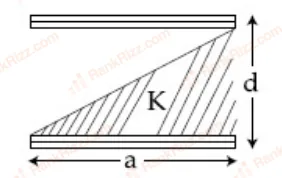
Consider a small element of width dx at a distance x from the left edge[cite: 1].
The total distance between the plates is d, and the side of the square plate is a[cite: 1].
The thickness of the dielectric medium at distance x is given by:
y=adx$
The remaining thickness of air/vacuum above the dielectric is:
d−y=d−adx=d(1−ax)$
The elemental strip consists of two capacitors in series:
1. Air section of thickness d−y with capacitance dC1:
dC1=d−yε0adx=d(1−ax)ε0adx$
2. Dielectric section of thickness y with dielectric constant K and capacitance dC2[cite: 1]:
dC2=yKε0adx=adxKε0adx$
The equivalent capacitance dC of this elemental section (in series) is:
dC1=dC11+dC21$
dC1=ε0adxd(1−ax)+Kε0adxadx$
dC1=ε0a2dxd[a−x+Kx]$
dC1=ε0a2dxd[a−x(1−K1)]$
Inverting to find dC:
dC=d[a−x(1−K1)]ε0a2dx=d[Ka−x(K−1)]Kε0a2dx$
To find the total capacitance C, integrate dC from x=0 to x=a:
C=∫0ad[Ka−x(K−1)]Kε0a2dx$
Using the standard integral formula ∫A−Bxdx=−B1ln∣A−Bx∣:
C=dKε0a2⋅[−K−11ln∣Ka−x(K−1)∣]0a$
C=d(K−1)Kε0a2⋅[ln(Ka)−ln(Ka−a(K−1))]$
C=d(K−1)Kε0a2⋅[ln(Ka)−ln(a)]$
C=d(K−1)Kε0a2ln(K)$
Thus, the capacitance of the given capacitor is:
C=d(K−1)Kε0a2lnK$