RankRizz

Series and parallel combinations of capacitors — JEE Main Previous Year Questions

Every JEE Main question on Series and parallel combinations of capacitors, one of the ideas inside Capacitance: 29 questions from 2005–2026, 15 of them in the last five years. Newest first, answer key on every one. Free to read.

Questions

29

Years asked

13

Since

2005

Of the chapter

17%

Every Series and parallel combinations of capacitors question

21–29 OF 29 · NEWEST FIRST

JEE MAIN 2019 · 10 APR S1Series and parallel combinations of capacitorsTRANSCRIBED

Figure shows charge (q) versus voltage (V) graph for series and parallel combination of two given capacitors. The capacitances are:
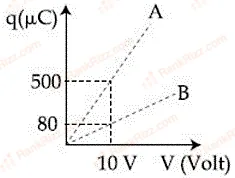
Figure for JEE Main 2019 Physics question on Series and parallel combinations of capacitors
  1. A

    60 μF and 40 μF

  2. B

    50 μF and 30 μF

  3. C

    20 μF and 30 μF

  4. D

    40 μF and 10 μF

JEE MAIN 2019 · 12 JAN S2Series and parallel combinations of capacitorsTRANSCRIBED

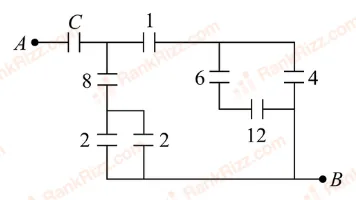
In the circuit shown, find C if the effective capacitance of the whole circuit is to be 0.5 μF\mu F. All values in the circuit are in μF\mu F.

Figure for JEE Main 2019 Physics question on Series and parallel combinations of capacitors
  1. A

    710\frac{7}{10} μF\mu F

  2. B

    4μF4\mu F

  3. C

    711\frac{7}{11} μF\mu F

  4. D

    65\frac{6}{5} μF\mu F

JEE MAIN 2019 · 11 JAN S2Series and parallel combinations of capacitorsTRANSCRIBED

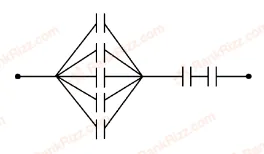
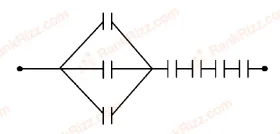
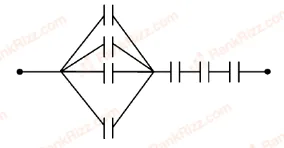
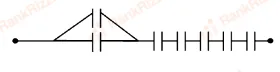
Seven capacitors, each of capacitance 2μF2\mu F, are to be connected in a configuration to obtain an effective capacitance of (613)μF\left(\frac{6}{13}\right)\mu F. Which of the combinations, shown in figures below, will achieve the desired value?

  1. A
    Figure for JEE Main 2019 Physics question on Series and parallel combinations of capacitors
  2. B
    Figure for JEE Main 2019 Physics question on Series and parallel combinations of capacitors
  3. C
    Figure for JEE Main 2019 Physics question on Series and parallel combinations of capacitors
  4. D
    Figure for JEE Main 2019 Physics question on Series and parallel combinations of capacitors
JEE MAIN 2018 · 15 APR S1Series and parallel combinations of capacitorsTRANSCRIBED

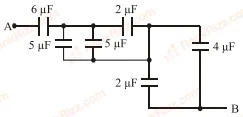
The equivalent capacitance between A and B in the circuit given below is:

Figure for JEE Main 2018 Physics question on Series and parallel combinations of capacitors
  1. A

    4.9 μ\muF

  2. B

    3.6 μ\muF

  3. C

    5.4 μ\muF

  4. D

    2.4 μ\muF

JEE MAIN 2016 · 09 APR ONLINESeries and parallel combinations of capacitorsTRANSCRIBED

Three capacitors each of 4 μ\muF are to be connected in such a way that the effective capacitance is 6 μ\muF. This can be done by connecting them

  1. A

    all in series

  2. B

    all in parallel

  3. C

    two in parallel and one in series

  4. D

    two in series and one in parallel

JEE MAIN 2016 · 10 APR ONLINESeries and parallel combinations of capacitorsTRANSCRIBED

The figure shows a network of capacitors where the number indicates capacitances in micro Farad. The value of capacitance C if the equivalent capacitance between point A and B is to be 1 μF\mu F is:

Figure for JEE Main 2016 Physics question on Series and parallel combinations of capacitors
  1. A

    3223\frac{32}{23} μF\mu F

  2. B

    3123\frac{31}{23} μF\mu F

  3. C

    3323\frac{33}{23} μF\mu F

  4. D

    3423\frac{34}{23} μF\mu F

JEE MAIN 2014 · 09 APR ONLINESeries and parallel combinations of capacitorsTRANSCRIBED

Three capacitances, each of 3 μ\muF, are provided. These cannot be combined to provide the resultant capacitance of:

  1. A

    2 μ\muF

  2. B

    6 μ\muF

  3. C

    4.5 μ\muF

  4. D

    1 μ\muF

JEE MAIN 2013 · 07 APR ONLINESeries and parallel combinations of capacitorsTRANSCRIBED

Two capacitors C1C_1 and C2C_2 are charged to 120 V and 200 V respectively. It is found that by connecting them together the potential on each one can be made zero. Then:

  1. A

    3C1+5C2=03C_1 + 5C_2 = 0

  2. B

    9C1=4C29C_1 = 4C_2

  3. C

    5C1=3C25C_1 = 3C_2

  4. D

    3C1=5C23C_1 = 5C_2

JEE MAIN 2005Series and parallel combinations of capacitorsTRANSCRIBED

A parallel plate capacitor is made by stacking nn equally spaced plates connected alternatively. If the capacitance between any two adjacent plates is CC then the resultant capacitance is

  1. A

    (n−1)C(n - 1)C

  2. B

    (n+1)C(n + 1)C

  3. C

    CC

  4. D

    nCnC