JEE MAIN 2023 · 30 JAN S1Hydrogen spectrum and spectral seriesTRANSCRIBED
Speed of an electron in Bohr's orbit for Hydrogen atom is m s. The corresponding speed of the electron in orbit, in m s is:
- A
- B
- C
- D
Every Atoms & Nuclei question JEE Main has set, grouped by the idea it tests rather than the order of the syllabus. 304 questions across 6 distinct ideas. Free to read, answer key on every one.
Questions
304
Distinct ideas
6
Share of marks
4.8%
Difficulty
EASY
A chapter is not one subject — it is a handful of procedures the examiner reuses. These are the ones Atoms & Nuclei questions actually test.
101–120 OF 304 · NEWEST FIRST
Speed of an electron in Bohr's orbit for Hydrogen atom is m s. The corresponding speed of the electron in orbit, in m s is:
A radio active material is reduced to of its original amount in 3 days. If kg of the material is left after 5 days the initial amount of the material is
40 g
32 g
64 g
256 g
The mass of proton, neutron and helium nucleus are respectively 1.0073 u, 1.0087 u and 4.0015u. The binding energy of helium nucleus is:
14.2 MeV
28.4 MeV
56.8 MeV
7.1 MeV
The angular momentum for the electron in Bohr's orbit is . If the electron is assumed to revolve in second orbit of hydrogen atom, then the change in angular momentum will be
Zero
For a nucleus having mass number A and atomic number Z
A. The surface energy per nucleon .
B. The Coulomb contribution to the binding energy .
C. The volume energy
D. Decrease in the binding energy is proportional to surface area.
E. While estimating the surface energy, it is assumed that each nucleon interacts with 12 nucleons.
( and are constants)
Choose the most appropriate answer from the options given below:
B, C, E only
B, C, D only
A, B, C, D only
B, C only
Two radioactive elements A and B initially have same number of atoms. The half life of A is same as the average life of B. If and are decay constants of A and B respectively, then choose the correct relation from the given options.
The energy of He ion in its first state is, (The ground state energy for the Hydrogen atom eV):
eV
eV
eV
eV
The energy levels of an atom is shown in figure.
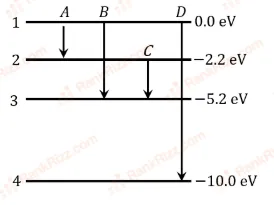
Which one of these transitions will result in the emission of a photon of wavelength 124.1 nm?
Given ( J s)
B
A
C
D
The half-life of a radioactive nucleus is 5 years. The fraction of the original sample that would decay in 15 years is :
A nucleus disintegrates into two smaller parts, which have their velocities in the ratio 3 : 2. The ratio of their nuclear sizes will be . The value of '' is:
A nucleus disintegrates into two nuclear parts, in such a way that ratio of their nuclear sizes is . Their respective speed have a ratio of . The value of is _______
Experimentally it is found that 12.8 eV energy is required to separate a hydrogen atom into a proton and an electron. So the orbital radius of the electron in a hydrogen atom is m. The value of the is ______.
(1 eV = J, and electronic charge = C)
A radioactive element X emits two -particles, one electron and two positrons. The product nucleus is represented by Y. The value of is ______.
The radius of 2 orbit of He of Bohr's model is and that of fourth orbit of Be is represented as . Now the ratio is . The value of is _____.
Assume that protons and neutrons have equal masses. Mass of a nucleon is kg and radius of nucleus is m. The approximate ratio of the nuclear density and water density is . The value of n is _____.
Assume that protons and neutrons have equal masses. Mass of a nucleon is kg and radius of nucleus is m. The approximate ratio of the nuclear density and water density is . The value of is _____.
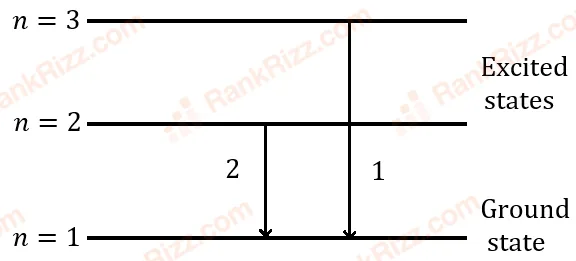
For hydrogen atom, and are the wavelengths corresponding to the transitions 1 and 2 respectively as shown in figure. The ratio of and is . The value of is ______.
Nucleus A having and equal number of protons and neutrons has MeV binding energy per nucleon. Another nucleus of has total 26 nucleons and MeV binding energy per nucleons. The difference of binding energy of and will be ______ MeV.
A common example of alpha decay is U Th He
Given:
U u
Th u
He u and u
The energy released during the alpha decay of U is _____ MeV.
The energy released per fission of nucleus of X is 200 MeV. The energy released if all the atoms in 120 g of pure X undergo fission is _____ MeV.
(Given )
OTHER PHYSICS CHAPTERS