RankRizzStart free

Atoms & Nuclei — JEE Main Previous Year Questions

Every Atoms & Nuclei question JEE Main has set, grouped by the idea it tests rather than the order of the syllabus. 304 questions across 6 distinct ideas. Free to read, answer key on every one.

Questions

304

Distinct ideas

6

Share of marks

4.8%

Difficulty

EASY

The ideas inside Atoms & Nuclei

A chapter is not one subject — it is a handful of procedures the examiner reuses. These are the ones Atoms & Nuclei questions actually test.

01Alpha-particle scattering and Rutherford modelset 11×
02Bohr model of hydrogen-like atomsset 13×
03Hydrogen spectrum and spectral seriesset 117×
04X-rays: continuous and characteristic spectra, Moseley's lawPractice questions coming soon
05Nuclear size, mass defect and binding energyset 54×
06Nuclear fission, fusion and Q-valueset 5×
07Radioactivity: decay law, half-life and decay modesset 104×

Every Atoms & Nuclei question

21–40 OF 304 · NEWEST FIRST

JEE MAIN 2026 · 06 APR S1Nuclear size, mass defect and binding energyTRANSCRIBED

The energy released when kg of Li is converted into He by proton bombardment is eV. The value of is _______. (Nearest integer)
(Mass of Li = 7.0183 u, mass of He = 4.004 u, mass of proton = 1.008 u and 1 u = 931 MeV/c and Avogadro number = )
JEE MAIN 2026 · 23 JAN S2Nuclear size, mass defect and binding energyTRANSCRIBED

The average energy released per fission for the nucleus of is 190 MeV.
When all the atoms of 47g pure undergo fission process, the energy released is MeV. The value of is ______.
(Avogadro Number = 6 per mole)

JEE MAIN 2026 · 02 APR S2Nuclear size, mass defect and binding energyTRANSCRIBED

The binding energy per nucleon of is _________ MeV. [Take u, u, u, u MeV/c]

  1. A

  2. B

  3. C

  4. D

JEE MAIN 2026Radioactivity: decay law, half-life and decay modesTRANSCRIBED

The activity of a radioactive sample decreases to one tenth of the original activity  in a period of one year. After 9 more years its activity would be

  1. A

  2. B

  3. C

  4. D

JEE MAIN 2025 · 24 JAN S1Hydrogen spectrum and spectral seriesTRANSCRIBED

During the transition of electron from state A to state C of a Bohr atom,  the wavelength of emitted radiation is  2000 A˚  and it becomes  6000 A˚  when the electron jumps from state B to state C.  Then the wavelength of the radiation emitted during the transition of electrons  from state A to state B is:

  1. A

    4000A˚

  2. B

    2000A˚

  3. C

    3000A˚

  4. D

    6000A˚

JEE MAIN 2025 · 04 APR S2Radioactivity: decay law, half-life and decay modesTRANSCRIBED

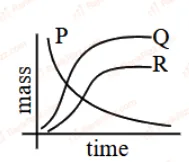
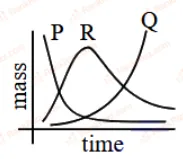
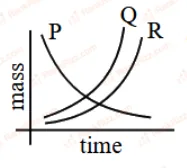
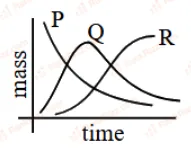
A radioactive material P first decays into Q and then Q decays to non-radioactive material R. Which of the following figure represents time dependent mass of P, Q and R?

  1. A
    image
  2. B
    image
  3. C
    image
  4. D
    image
JEE MAIN 2025 · 07 APR S2Radioactivity: decay law, half-life and decay modesTRANSCRIBED

Given below are two statements : one is labelled as Assertion (A) and the other is labelled as Reason (R).
Assertion (A) : The density of the copper nucleus is greater than that of the carbon nucleus.
Reason (R) : The nucleus of mass number A has a radius proportional to .
In the light of the above statements, choose the most appropriate answer from the options given below :

  1. A

    (A) is correct but (R) is not correct

  2. B

    (A) is not correct but (R) is correct

  3. C

    Both (A) and (R) are correct and (R) is the correct explanation of (A)

  4. D

    Both (A) and (R) are correct but (R) is not the correct explanation of (A)

JEE MAIN 2025 · 04 APR S2Bohr model of hydrogen-like atomsTRANSCRIBED

Given below are two statements :
Statement (I) : The dimensions of Planck's constant and angular momentum are same.
Statement (II) : In Bohr's model electron revolve around the nucleus only in those orbits for which angular momentum is integral multiple of Planck's constant.
In the light of the above statements, choose the most appropriate answer from the options given below :

  1. A

    Both Statement I and Statement II are correct

  2. B

    Statement I is incorrect but Statement II is correct

  3. C

    Statement I is correct but Statement II is incorrect

  4. D

    Both Statement I and Statement II are incorrect

JEE MAIN 2025 · 28 JAN S1Radioactivity: decay law, half-life and decay modesTRANSCRIBED

Choose the correct nuclear process from the below options [p: proton, n : neutron, :electron, : positron, : neutrino, : antineutrino]

  1. A

  2. B

  3. C

  4. D

JEE MAIN 2025 · 03 APR S2Hydrogen spectrum and spectral seriesTRANSCRIBED

Given below are two statements: one is labelled as Assertion A and the other is labelled as Reason R.
Assertion A: The Bohr model is applicable to hydrogen and hydrogen-like atoms only.
Reason R: The formulation of Bohr model does not include repulsive force between electrons.
In the light of the above statements, choose the correct answer from the options given below:

  1. A

    Both A and R are true but R is NOT the correct explanation of A.

  2. B

    A is false but R is true.

  3. C

    Both A and R are true and R is the correct explanation of A.

  4. D

    A is true but R is false.

JEE MAIN 2025 · 03 APR S1Nuclear size, mass defect and binding energyTRANSCRIBED

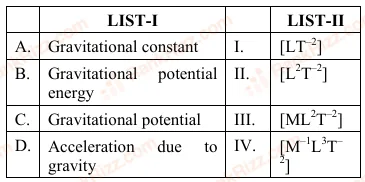
Match the LIST-I with LIST-II.

image


Choose the correct answer from the options given below :

  1. A

    A-IV, B-III, C-II, D-I

  2. B

    A-III, B-II, C-I, D-IV

  3. C

    A-II, B-IV, C-III, D-I

  4. D

    A-I, B-III, C-IV, D-II

JEE MAIN 2025 · 29 JAN S2Hydrogen spectrum and spectral seriesTRANSCRIBED

The number of spectral lines emitted by atomic hydrogen that is in the energy level, is

  1. A

    3

  2. B

    1

  3. C

    6

  4. D

    0

JEE MAIN 2025 · 02 APR S2Hydrogen spectrum and spectral seriesTRANSCRIBED

Assuming the validity of Bohr's atomic model for hydrogen like ions the radius of ion in its ground state is given by , where ________. (Where is the first Bohr's radius.)

  1. A

  2. B

  3. C

  4. D

JEE MAIN 2025 · 02 APR S2Nuclear size, mass defect and binding energyTRANSCRIBED

Energy released when two deuterons fuse to form a helium nucleus is :
(Given : Binding energy per nucleon of MeV and binding energy per nucleon of MeV)

  1. A

    MeV

  2. B

    MeV

  3. C

    MeV

  4. D

    MeV

JEE MAIN 2025 · 23 JAN S2Nuclear size, mass defect and binding energyTRANSCRIBED

Given below are two statements. One is labelled as Assertion (A) and the other is labelled as Reason (R). Assertion (A) : The binding energy per nucleon is found to be practically independent of the atomic number A, for nuclei with mass numbers between 30 and 170. Reason (R): Nuclear force is long range. In the light of the above statements, choose the correct answer from the options given below :

  1. A

    (A) is true but (R) is false

  2. B

    (A) is false but (R) is true

  3. C

    Both (A) and (R) are true and (R) is the correct explanation of (A)

  4. D

    Both (A) and (R) are true but (R) is NOT the correct explanation of (A)

JEE MAIN 2025 · 23 JAN S1Radioactivity: decay law, half-life and decay modesTRANSCRIBED

A radioactive nucleus has 3 times the decay constant as compared to the decay constant of another radioactive nucleus . If initial number of both nuclei are the same, what is the ratio of number of nuclei of to the number of nuclei of , after one half-life of ?

  1. A

    1/8

  2. B

    8

  3. C

    4

  4. D

    1/4

JEE MAIN 2025 · 02 APR S1Hydrogen spectrum and spectral seriesTRANSCRIBED

Considering Bohr's atomic model for hydrogen atom:
(A) the energy of H atom in ground state is same as energy of He ion in its first excited state.
(B) the energy of H atom in ground state is same as that for Li ion in its second excited state.
(C) the energy of H atom in ground state is same as that of He ion for its ground state.
(D) the energy of He ion in its first excited state is same as that for Li ion in its ground state.
Choose the correct answer from the options below:

  1. A

    (B), (D) only

  2. B

    (A), (B) only

  3. C

    (A), (D) only

  4. D

    (A), (C) only

JEE MAIN 2025 · 07 APR S1Hydrogen spectrum and spectral seriesTRANSCRIBED

In a hydrogen like ion, the energy difference between the 2nd excitation energy state and ground state is 108.8 eV. The atomic number of the ion is

  1. A

    4

  2. B

    2

  3. C

    1

  4. D

    3

JEE MAIN 2025 · 07 APR S1Hydrogen spectrum and spectral seriesTRANSCRIBED

For a hydrogen atom, the ratio of the largest wavelength of Lyman series to that of the Balmer series is

  1. A

    5 : 36

  2. B

    5 : 27

  3. C

    3 : 4

  4. D

    27 : 5

JEE MAIN 2025 · 28 JAN S2Hydrogen spectrum and spectral seriesTRANSCRIBED

The frequency of revolution of the electron in Bohr's orbit varies with , the principal quantum number as

  1. A

  2. B

  3. C

  4. D