The decay of a proton to neutron is :
- A
not possible as proton mass is less than the neutron mass
- B
possible only inside the nucleus
- C
not possible but neutron to proton conversion is possible
- D
always possible as it is associated only with decay
Every Atoms & Nuclei question JEE Main has set, grouped by the idea it tests rather than the order of the syllabus. 304 questions across 6 distinct ideas. Free to read, answer key on every one.
Questions
304
Distinct ideas
6
Share of marks
4.8%
Difficulty
EASY
A chapter is not one subject — it is a handful of procedures the examiner reuses. These are the ones Atoms & Nuclei questions actually test.
181–200 OF 304 · NEWEST FIRST
The decay of a proton to neutron is :
not possible as proton mass is less than the neutron mass
possible only inside the nucleus
not possible but neutron to proton conversion is possible
always possible as it is associated only with decay
There are radioactive nuclei in a given radioactive element. Its half-life time is 1 min. How many nuclei will remain after 30 s?
If denotes the ratio of the number of nuclei decayed to the number of nuclei at , then for a collection of radioactive nuclei, the rate of change of with respect to time is given as: [ is the radioactive decay constant]
A nucleus of mass emits -ray photon of frequency . The loss of internal energy by the nucleus is: [Take as the speed of electromagnetic wave]
0
Consider the following statements:
A. Atoms of each element emit characteristics spectrum.
B. According to Bohr's Postulate, an electron in a hydrogen atom revolves in a certain stationary orbit.
C. The density of nuclear matter depends on the size of the nucleus.
D. A free neutron is stable but a free proton decay is possible.
E. Radioactivity is an indication of the instability of nuclei. Choose the correct answer from the options given below.
and
and only.
and only
and only
The half life period of a radioactive element is same as the mean life time of another radioactive element . Initially they have the same number of atoms. Then:
and decay at the same rate always.
-will decay faster than .
and have same decay rate initially and later on different decay rate.
A radioactive sample is undergoing decay. At any time , its activity is and another time , the activity is . What is the average life time for the sample?
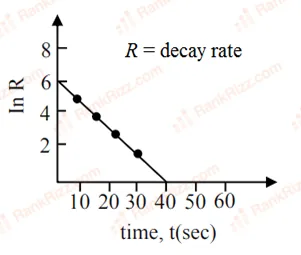
For a certain radioactive process, the graph between ln R and (sec) is obtained as shown in the figure. Then the value of half life for the unknown radioactive material is approximately:

9.15 sec
6.93 sec
2.62 sec
4.62 sec
From the given data, the amount of energy required to break the nucleus of aluminium Al is _________ J
Mass of neutron = 1.00866 u
Mass of proton = 1.00726 u
Mass of Aluminium nucleus = 27.18846 u
(Assume 1 u corresponds to J of energy)
(Round off to the nearest integer)
In Bohr's atomic model, the electron is assumed to revolve in a circular orbit of radius 0.5 . If the speed of electron is m s. Then the current associated with the electron will be _________ mA. [Take as ]
The nuclear activity of a radioactive element becomes of its initial value in 30 years. The half-life of radioactive element is _________ years.
The first three spectral lines of H-atom in the Balmer series are given considering the Bohr atomic model, the wave lengths of first and third spectral lines are related by a factor of approximately . The value of , to the nearest integer, is ________.
A radioactive sample has an average life of 30 ms and is decaying. A capacitor of capacitance 200 F is first charged and later connected with resistor . If the ratio of the charge on the capacitor to the activity of the radioactive sample is fixed with respect to time then the value of should be _________ .
A radioactive substance decays to of its initial activity in 80 days. The half life of the radioactive substance expressed in days is ___.
different wavelength may be observed in the spectrum from a hydrogen sample if the atoms are excited to states with principal quantum number ? The value of is _________.
The X-ray of molybdenum has wavelength 0.071 nm. If the energy of a molybdenum atom with a electron knocked out is 27.5 keV, the energy of this atom when an electron is knocked out will be _________ keV. (Round off to the nearest integer) [ eV s, m s]
A particle of mass moves in a circular orbit in a central potential field . If Bohr's quantization conditions are applied, radii of possible orbitals vary with , where is ________.
In a reactor, 2 kg of fuel is fully used up in 30 days. The energy released fission is 200 MeV. Given that the Avogadro number, per kilo mole and J. The power output of the reactor is close to:
35 MW
60 MW
125 MW
54 MW
In a radioactive material, a fraction of active material remaining after the time is . The fraction that was remaining after the time is:
You are given that , Mass of and Mass of . When of is converted into by proton capture, the energy liberated, (in kWh), is: [Mass of nucleon ]
OTHER PHYSICS CHAPTERS