RankRizzStart free

Atoms & Nuclei — JEE Main Previous Year Questions

Every Atoms & Nuclei question JEE Main has set, grouped by the idea it tests rather than the order of the syllabus. 304 questions across 6 distinct ideas. Free to read, answer key on every one.

Questions

304

Distinct ideas

6

Share of marks

4.8%

Difficulty

EASY

The ideas inside Atoms & Nuclei

A chapter is not one subject — it is a handful of procedures the examiner reuses. These are the ones Atoms & Nuclei questions actually test.

01Alpha-particle scattering and Rutherford modelset 11×
02Bohr model of hydrogen-like atomsset 13×
03Hydrogen spectrum and spectral seriesset 117×
04X-rays: continuous and characteristic spectra, Moseley's lawPractice questions coming soon
05Nuclear size, mass defect and binding energyset 54×
06Nuclear fission, fusion and Q-valueset 5×
07Radioactivity: decay law, half-life and decay modesset 104×

Every Atoms & Nuclei question

201–220 OF 304 · NEWEST FIRST

JEE MAIN 2020 · 07 JAN S1Hydrogen spectrum and spectral seriesTRANSCRIBED

The time period of revolution of electron in its ground state orbit in a hydrogen atom is s. The frequency of revolution of the electron in its first excited state (in s) is:

  1. A

  2. B

  3. C

  4. D

JEE MAIN 2020 · 05 SEP S1Radioactivity: decay law, half-life and decay modesTRANSCRIBED

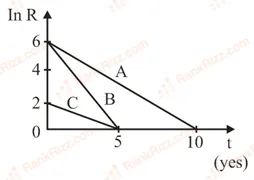
Activities of three radioactive substances , and are represented by the curves , and , in the figure. Then their half-lives are in the ratio:

  1. A

  2. B

  3. C

  4. D

JEE MAIN 2020 · 09 JAN S2Hydrogen spectrum and spectral seriesTRANSCRIBED

The energy required to ionise a hydrogen like ion in its ground state is 9 Rydbergs. What is the wavelength of the radiation emitted when the electron in this ion jumps from the second excited state to the ground state?

  1. A

    24.2 nm

  2. B

    11.4 nm

  3. C

    35.8 nm

  4. D

    8.6 nm

JEE MAIN 2020 · 05 SEP S2Radioactivity: decay law, half-life and decay modesTRANSCRIBED

A radioactive nucleus decays by two different processes. The half-life for the first process is and that for the second is . The effective half-life of the nucleus is close to:

  1. A

    9 s

  2. B

    6 s

  3. C

    55 s

  4. D

    12 s

JEE MAIN 2020 · 03 SEP S2Radioactivity: decay law, half-life and decay modesTRANSCRIBED

The radius R of a nucleus of mass number A can be estimated by the formula m. It follows that the mass density of n nucleus is of the order of: kg)

  1. A

    kg m

  2. B

    kg m

  3. C

    kg m

  4. D

    kg m

JEE MAIN 2020 · 08 JAN S1Alpha-particle scattering and Rutherford modelTRANSCRIBED

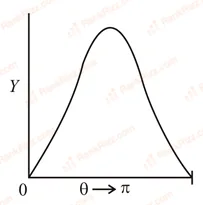
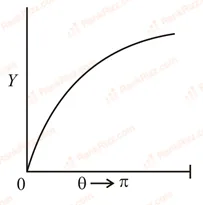
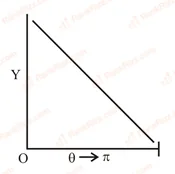
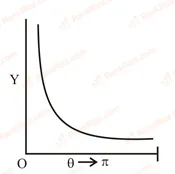
The graph which depicts the results of Rutherford gold foil experiment with -particles is:
: Scattering angle
Y: Number of scattered -particles detected
(Plots are schematic and not to scale)

  1. A
  2. B
  3. C
  4. D
JEE MAIN 2020 · 02 SEP S2Hydrogen spectrum and spectral seriesTRANSCRIBED

In a hydrogen atom the electron makes a transition from level to the level. If n >> 1, the frequency of radiation emitted is proportional to:

  1. A

  2. B

  3. C

  4. D

JEE MAIN 2020 · 06 SEP S2Radioactivity: decay law, half-life and decay modesTRANSCRIBED

Given the masses of various atomic particles , , , , , where p = proton, n = neutron, e = electron, = antineutrino and d = deuteron. Which of the following process is allowed by momentum and energy conservation:

  1. A

    deuterium atom (electron bound to the nucleus)

  2. B

  3. C

  4. D

JEE MAIN 2020 · 04 SEP S2Nuclear size, mass defect and binding energyTRANSCRIBED

Find the Binding energy per nucleon for . Mass of proton U, mass of neutron U and mass of tin nucleus U. (take 1U = 931 MeV)

  1. A

    7.5 MeV

  2. B

    9.0 MeV

  3. C

    8.0 MeV

  4. D

    8.5 MeV

JEE MAIN 2020 · 07 JAN S2Radioactivity: decay law, half-life and decay modesTRANSCRIBED

The activity of a radioactive sample falls from 700 s to 500 s in 30 minutes. Its half life is close to:

  1. A

    72 min

  2. B

    62 min

  3. C

    66 min

  4. D

    52 min

JEE MAIN 2020 · 05 SEP S1Hydrogen spectrum and spectral seriesTRANSCRIBED

A particle of mass collides with a hydrogen atom at rest. Soon after the collision, the particle comes to rest, and the atom recoils and goes to its first excited state. The initial kinetic energy of the particle (in eV) is . The value of is: (Given the mass of the hydrogen atom to be )........

JEE MAIN 2020 · 04 SEP S1Hydrogen spectrum and spectral seriesTRANSCRIBED

In the line spectra of hydrogen atom, difference between the largest and the shortest wavelengths of the Lyman series is 305 . The corresponding difference for the Paschan series in is __________ (nearest integer)

JEE MAIN 2020 · 08 JAN S2Hydrogen spectrum and spectral seriesTRANSCRIBED

The first member of the Balmer series of hydrogen atom has a wavelength of 6561 . The wavelength of the second member of the Balmer series (in nm) is

JEE MAIN 2019 · 12 APR S2Hydrogen spectrum and spectral seriesTRANSCRIBED

Consider an electron in a hydrogen atom, revolving in its second excited state (having radius 4.65 Å). The de-Broglie wavelength of this electron is:

  1. A

    12.9 Å

  2. B

    6.6 Å

  3. C

    9.7 Å

  4. D

    3.5 Å

JEE MAIN 2019 · 12 JAN S1Hydrogen spectrum and spectral seriesTRANSCRIBED

A particle of mass m moves in a circular orbit in a central potential field . If Bohr's quantization conditions are applied, radii of possible orbitals and energy levels vary with quantum number n as:

  1. A

    ,

  2. B

    ,

  3. C

    ,

  4. D

    ,

JEE MAIN 2019 · 12 APR S2Hydrogen spectrum and spectral seriesTRANSCRIBED

The electron in a hydrogen atom first jumps from the third excited state to the second excited state and subsequently to the first excited state. The ratio of the respective wavelengths, , of the photons emitted in this process is:

  1. A

  2. B

  3. C

  4. D

JEE MAIN 2019 · 11 JAN S1Hydrogen spectrum and spectral seriesTRANSCRIBED

A hydrogen atom, initially in the ground state is excited by absorbing a photon of wavelength 980 . The radius of the atom in the excited state, in terms of Bohr radius , will be:

  1. A

  2. B

  3. C

  4. D

    None of the above

JEE MAIN 2019 · 10 APR S1Radioactivity: decay law, half-life and decay modesTRANSCRIBED

Two radioactive materials A and B have decay constants and , respectively. If initially they have the same number of nuclei, then the ratio of the number of nuclei of A to that of B will be 1/e after a time:

  1. A

  2. B

  3. C

  4. D

JEE MAIN 2019 · 09 JAN S2Radioactivity: decay law, half-life and decay modesTRANSCRIBED

At a given instant, say , two radioactive substance A and B have equal activities. The ratio of their activities after time itself decays with time as . If the half-life of A is , the half-life of B is:

  1. A

  2. B

  3. C

  4. D

JEE MAIN 2019 · 11 JAN S2Hydrogen spectrum and spectral seriesTRANSCRIBED

In a hydrogen like atom, when an electron jumps from the M-shell to the L-shell, the wavelength of emitted radiation is . If an electron jumps from N-shell to the L-shell, the wavelength of emitted radiation will be:

  1. A

  2. B

  3. C

  4. D