JEE Main 2025 Physics question — Nuclear size, mass defect and binding energy
Match the LIST-I with LIST-II.
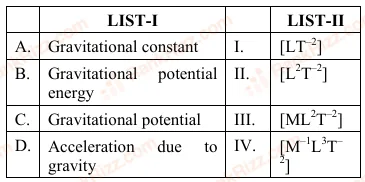
Choose the correct answer from the options given below :
SOLUTION
The four physical quantities are gravitational constant , gravitational potential energy , gravitational potential and acceleration due to gravity . We first write the defining equations for each quantity and then extract their dimensional formulas.
Case A : Gravitational constant
Newton’s law gives the gravitational force between two masses and separated by distance as
Re-arranging,
Force has dimensions . Hence
Case B : Gravitational potential energy
Potential energy near Earth’s surface is .
Mass has , has and height has . Therefore
Case C : Gravitational potential
Potential is energy per unit mass: .
Divide the dimensions of obtained above by :
Case D : Acceleration due to gravity
Acceleration is rate of change of velocity: .
Velocity has , so acceleration has
Now compare with LIST-II:
I. II. III. IV.
Matching each quantity with its dimensional formula:
A. IV B. III C. II D. I
Thus the correct set is A-IV, B-III, C-II, D-I, which corresponds to Option A.
Tagged Nuclear size, mass defect and binding energy. Machine-assigned, so read it as a strong shortlist rather than a verdict.