For 1 mol of gas, the plot of pV vs p is shown below. p is the pressure and V is the volume of the gas.
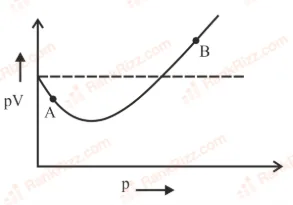
What is the value of compressibility factor at point A?
- A
- B
- C
- D

Every JEE Main question on Real gases, compressibility factor and van der Waals equation, one of the ideas inside States of Matter: Gases and Liquids: 17 questions from 2004–2023, 9 of them in the last five years. Newest first, answer key on every one. Free to read.
Questions
17
Years asked
11
Since
2004
Of the chapter
24%
Questions on Real gases, compressibility factor and van der Waals equation in each year it was asked.
1–17 OF 17 · NEWEST FIRST
For 1 mol of gas, the plot of pV vs p is shown below. p is the pressure and V is the volume of the gas.
What is the value of compressibility factor at point A?
Arrange the following gases in increasing order of van der Waals constant 'a'
(A) Ar
(B) CH
(C) HO
(D) CH
Choose the correct option from the following.
D, C, B and A
B, C, D and A
C, D, B and A
A, B, C and D
A certain quantity of real gas occupies a volume of dm at atm and K when its compressibility factor is . Its volume at atm and K (When its compressibility factor is ) is _____ dm (Nearest integer)
For a real gas at temperature and high pressure (99 bar) the value of compressibility factor is 2, so the value of Van der Waal's constant 'b' should be _____ L mol. (Given L bar K mol)
The unit of the van der Waals gas equation parameter 'a' in is:
dm mol
kg ms
atm dm mol
kg ms
The volume of gas A is twice than that of gas B. The compressibility factor of gas A is thrice than that of gas B at same temperature. What are the pressures of the gases for equal number of moles?
At a given temperature T, gases Ne, Ar, Xe and Kr are found to deviate from ideal gas behaviour. Their equation of state is given as at T. Here, b is the van der Waals constant. Which gas will exhibit steepest increase in the plot of Z (compression factor) vs p?
Ne
Kr
Ar
Xe
Consider the following table:
Gas a/(kPa dm mol) b/(dm mol)
A 642.32 0.05196
B 155.21 0.04136
C 431.91 0.05196
D 155.21 0.4382
a and b are van der Waals constants. The correct statement about the gases is:
Gas C will occupy more volume than gas A; gas B will be lesser compressible than gas D
Gas C will occupy lesser volume than gas A; gas B will be lesser compressible than gas D
Gas C will occupy more volume than gas A; gas B will be more compressible than gas D
Gas C will occupy lesser volume than gas A; gas B will be more compressible than gas D
Consider the van der Waal's constants, a and b, for the following gases.
Which gas is expected to have the highest critical temperature?
Kr
Ar
Xe
Ne
Among the following, the incorrect statement is:
at low pressure, real gases show ideal behaviour.
at very low temperature, real gases show ideal behaviour.
at Boyle's temperature, real gases show ideal behaviour.
at very large volume, real gases show ideal behaviour.
At very high pressures, the compressibility factor of one mole of a gas is given by:
When does a gas deviate the most from its ideal behavior?
At low pressure and high temperature
At high pressure and high temperature
At low pressure and low temperature
At high pressure and low temperature
If Z is the compressibility factor, then Van der Waal's equation at low pressure can be written as:
Van der Waal's equation for a gas is stated as, . This equation reduces to the perfect gas equation, When,
temperature is sufficiently high and pressure is low
both temperature and pressure are very low
both temperature and pressure are very high
temperature is sufficiently low and pressure is high
The compressibility factor for a real gas at high pressure is :
'' and '' are van der Waals' constants for gases. Chlorine is more easily liquefied than ethane because:
and for and for
for for but for for
for for but for for
and for and for
In Vander Waals equation of state of the gas law, the constant '' is a measure of
intermolecular repulsions
intermolecular collisions per unit volume
Volume occupied by the molecules
intermolecular attraction
RELATED STATES OF MATTER: GASES AND LIQUIDS TOPICS