At K, the root mean square (rms) speed of gas X (molar mass ) is equal to the most probable speed of gas Y at K. The molar mass of the gas Y is _____ g mol. (Nearest integer)
Every JEE Main question on Kinetic theory of gases and molecular speeds, one of the ideas inside States of Matter: Gases and Liquids: 13 questions from 2004–2023, 3 of them in the last five years. Newest first, answer key on every one. Free to read.
Questions
13
Years asked
10
Since
2004
Of the chapter
19%
Questions on Kinetic theory of gases and molecular speeds in each year it was asked.
1–13 OF 13 · NEWEST FIRST
At K, the root mean square (rms) speed of gas X (molar mass ) is equal to the most probable speed of gas Y at K. The molar mass of the gas Y is _____ g mol. (Nearest integer)
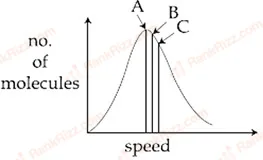
Identify the correct labels of A, B and C in the following graph from the options given below:
Root mean square speed (V); most probable speed (V); Average speed (V)
A = V; B = V; C = V
A = V; B = V; C = V
A = V; B = V; C = V
A = V; B = V; C = V
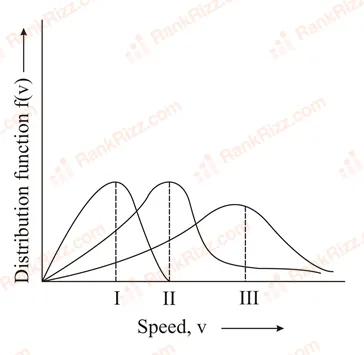
Points I, II and III in the following plot respectively correspond to (V: most probable velocity)

V of N 300 K; V of H 300 K; V of O 400 K;
V of H 300 K; V of N 300 K; V of O 400 K;
V of N 300 K; V of O 400 K; V of H 300 K;
V of O 400 K; V of N 300 K; V of H 300 K;
Initially, the root-mean-square (RMS) velocity of molecules at certain temperature is u. If this temperature is doubled and all the nitrogen molecules dissociate into nitrogen atoms, then the new RMS velocity will be:
2u
14u
4u
u/2
Which of the following is not an assumption of the kinetic theory of gases?
Collisions of gas particles are perfectly elastic.
A gas consists of many identical particles which are in continual motion.
At high pressure, gas particles are difficult to compress.
Gas particles have negligible volume.
The temperature at which oxygen molecules have the same root mean square speed as helium atoms have at 300 K is: (Atomic masses: He = 4 u, O = 16 u)
600 K
2400 K
1200 K
300 K
By how many folds the temperature of a gas would increase when the root mean square velocity of the gas molecules in a container of fixed volume is increased from cm/s to cm/s?
Two
Three
Six
Four
Which one of the following is the wrong assumption of kinetic theory of gases?
Momentum and energy always remain conserved.
Pressure is the result of elastic collision of molecules with the container's wall.
Molecules are separated by great distances compared to their sizes.
All the molecules move in straight line between collision and with same velocity.
For gaseous state, if most probable speed is denoted by , average speed by and root mean square speed by C, then for many molecules, what is the ratios of these speeds?
The relationship among most probable velocity, average velocity and root mean square velocity is respectively
, and represent most probable velocity, average velocity and root mean square velocity respectively of a gas at a particular temperature. The correct order among the following is
Which one of the following statements is NOT true about the effect of an increase in temperature on the distribution of molecular speeds in a gas?
The most probable speed increases
The fraction of the molecules with the most probable speed increases
The distribution becomes broader
The area under the distribution curve remains the same as under the lower temperature
As the temperature is raised from C to C, the average kinetic energy of neon atoms changes by a factor of which of the following?
RELATED STATES OF MATTER: GASES AND LIQUIDS TOPICS