RankRizz

Methods of purification of organic compounds — JEE Main Previous Year Questions

Every JEE Main question on Methods of purification of organic compounds, one of the ideas inside Purification and Characterisation of Organic Compounds: 70 questions from 2015–2026, 44 of them in the last five years. Newest first, answer key on every one. Free to read.

Questions

70

Years asked

12

Since

2015

Of the chapter

46%

Every Methods of purification of organic compounds question

21–40 OF 70 · NEWEST FIRST

JEE MAIN 2024 · 06 APR S1Methods of purification of organic compoundsTRANSCRIBED

Which of the following statements are correct?
A. Glycerol is purified by vacuum distillation because it decomposes at its normal boiling point.
B. Aniline can be purified by steam distillation as aniline is miscible in water.
C. Ethanol can be separated from ethanol water mixture by azeotropic distillation because it forms azeotrope.
D. An organic compound is pure, if mixed M.P. is remained same.
Choose the most appropriate answer from the options given below :

  1. A

    A, B, C only

  2. B

    A, C, D only

  3. C

    A, B, D only

  4. D

    B, C, D only

JEE MAIN 2024 · 01 FEB S1Methods of purification of organic compoundsTRANSCRIBED

In Kjeldahl's method for estimation of nitrogen, CuSO4CuSO_4 acts as :

  1. A

    Reducing agent

  2. B

    Catalytic agent

  3. C

    Hydrolysis agent

  4. D

    Oxidising agent

JEE MAIN 2024 · 06 APR S2Methods of purification of organic compoundsTRANSCRIBED

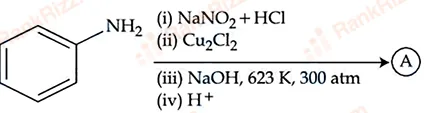
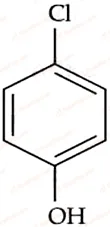
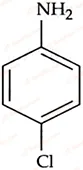
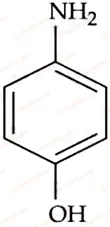
Identify the product (A) in the following reaction. 

Figure for JEE Main 2024 Chemistry question on Methods of purification of organic compounds
  1. A
    Figure for JEE Main 2024 Chemistry question on Methods of purification of organic compounds
  2. B
    Figure for JEE Main 2024 Chemistry question on Methods of purification of organic compounds
  3. C
    Figure for JEE Main 2024 Chemistry question on Methods of purification of organic compounds
  4. D
    Figure for JEE Main 2024 Chemistry question on Methods of purification of organic compounds
JEE MAIN 2024 · 05 APR S2Methods of purification of organic compoundsTRANSCRIBED

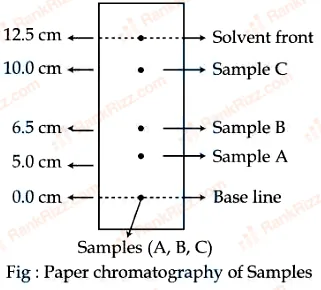
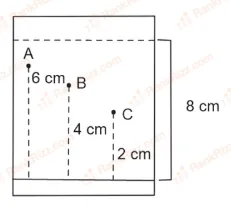
Using the given figure, the ratio of RfR_f values of sample A and sample C is x×10−2x \times 10^{-2}. Value of xx is _____

page9_img1
JEE MAIN 2024 · 09 APR S2Methods of purification of organic compoundsTRANSCRIBED
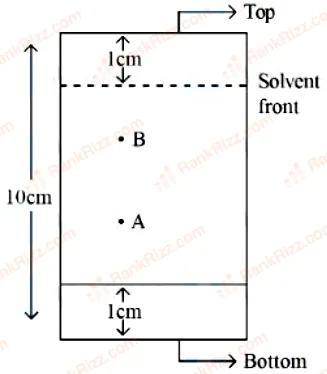
page9_img5


In the given TLC, the distance of spot A & B are 5 cm5 \text{ cm} & 7 cm7 \text{ cm}, from the bottom of TLC plate, respectively. RfR_f value of B is x×10−1x \times 10^{-1} times more than A. The value of xx is ______.

JEE MAIN 2024 · 30 JAN S1Methods of purification of organic compoundsTRANSCRIBED

On a thin layer chromatographic plate, an organic compound moved by 3.5 cm3.5 \text{ cm}, while the solvent moved by 5 cm5 \text{ cm}. The retardation factor of the organic compound is ____________ ×10−1\times 10^{-1}.

JEE MAIN 2023 · 31 JAN S1Methods of purification of organic compoundsTRANSCRIBED

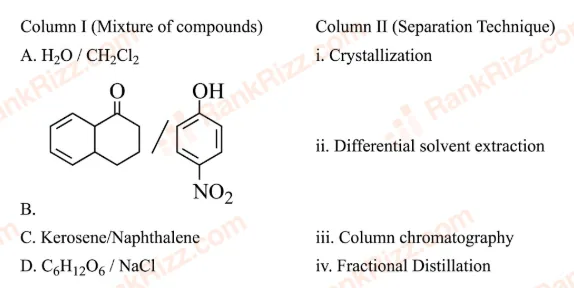
Match items of column I and II

Figure for JEE Main 2023 Chemistry question on Methods of purification of organic compounds
  1. A

    A - (iii), B - (iv), C - (ii), D - (i)

  2. B

    A - (ii), B - (iii), C - (iv), D - (i)

  3. C

    A - (i), B - (iii), C - (ii), D - (iv)

  4. D

    A - (ii), B - (iv), C - (i), D - (iii)

JEE MAIN 2023 · 15 APR S1Methods of purification of organic compoundsTRANSCRIBED

Which of the following statement is correct for paper chromatography?

  1. A

    Water present in the pores of the paper forms the stationary phase.

  2. B

    Paper sheet forms the stationary phase.

  3. C

    Water present in the mobile phase gets absorbed by the paper which then forms the stationary phase.

  4. D

    Paper and water present in its pores together form the stationary phase.

JEE MAIN 2023 · 06 APR S2Methods of purification of organic compoundsTRANSCRIBED
  1. A

    A, B and D only

  2. B

    A, B and C only

  3. C

    B and D only

  4. D

    B, C and D only

JEE MAIN 2023 · 10 APR S1Methods of purification of organic compoundsTRANSCRIBED

Using column chromatography, mixture of two compounds 'A' and 'B' was separated. 'A' eluted first, this indicates 'B' has

  1. A

    low Rf, stronger adsorption

  2. B

    high Rf, weaker adsorption

  3. C

    high Rf, stronger adsorption

  4. D

    low Rf, weaker adsorption

JEE MAIN 2023 · 11 APR S1Methods of purification of organic compoundsTRANSCRIBED

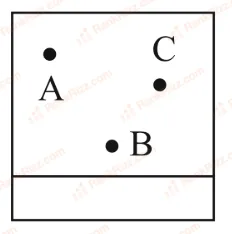
Thin layer chromatography of a mixture shows the following observation.

Figure for JEE Main 2023 Chemistry question on Methods of purification of organic compounds

The correct order of elution in the silica gel column chromatography is

  1. A

    B, A, C

  2. B

    B, C, A

  3. C

    A, C, B

  4. D

    C, A, B

JEE MAIN 2023 · 30 JAN S2Methods of purification of organic compoundsTRANSCRIBED

Match List I with List II:

List I (Mixture)List II (Separation Technique)
(A) CHCl3_3 + C6_6H5_5NH2_2I. Steam distillation
(B) C6_6H14_{14} + C5_5H12_{12}II. Differential extraction
(C) C6_6H5_5NH2_2 + H2_2OIII. Distillation
(D) Organic compound in H2_2OIV. Fractional distillation
  1. A

    A-IV, B-I, C-III, D-II

  2. B

    A-III, B-IV, C-I, D-II

  3. C

    A-II, B-I, C-III, D-IV

  4. D

    A-III, B-I, C-IV, D-II

JEE MAIN 2023 · 12 APR S1Methods of purification of organic compoundsTRANSCRIBED

Three organic compounds A, B and C were allowed to run in thin layer chromatography using hexane and gave the following result (see figure). The Rf_f value of the most polar compound is _____ ×10−2\times 10^{-2}

Figure for JEE Main 2023 Chemistry question on Methods of purification of organic compounds
JEE MAIN 2023 · 29 JAN S1Methods of purification of organic compoundsTRANSCRIBED

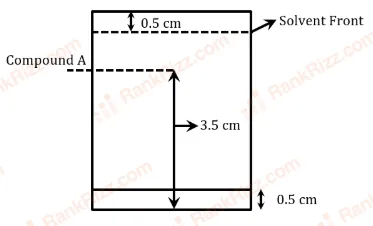
Following chromatogram was developed by adsorption of compound 'A' on a 6 cm TLC glass plate. Retardation factor of the compound 'A' is ______ ×10−1\times 10^{-1}.

Figure for JEE Main 2023 Chemistry question on Methods of purification of organic compounds
JEE MAIN 2022 · 28 JUN S1Methods of purification of organic compoundsTRANSCRIBED

Which one of the following techniques is not used to spot components of a mixture separated on thin layer chromatographic plate?

  1. A

    I2I_2 (Solid)

  2. B

    U.V. Light

  3. C

    Visualisation agent as a component of mobile phase

  4. D

    Spraying of an appropriate reagent

JEE MAIN 2022 · 25 JUN S1Methods of purification of organic compoundsTRANSCRIBED

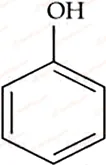
Phenol on reaction with dilute nitric acid, gives two products. Which method will be most efficient for large scale separation?

  1. A

    Chromatographic separation

  2. B

    Steam distillation

  3. C

    Fractional Crystallisation

  4. D

    Sublimation

JEE MAIN 2022 · 25 JUN S2Methods of purification of organic compoundsTRANSCRIBED

Given below are two statements: one is labelled as Assertion and the other is labelled as Reason.
Assertion: A mixture contains benzoic acid and naphthalene. The pure benzoic acid can be separated out by the use of benzene.
Reason: Benzoic acid is soluble in hot water.
In the light of the above statements, choose the most appropriate answer from the options given below.

  1. A

    Both Assertion and Reason are true and Reason is the correct explanation of Assertion.

  2. B

    Both Assertion and Reason are true but Reason is not the correct explanation of Assertion.

  3. C

    Assertion is true but Reason is false.

  4. D

    Assertion is false but Reason is true.

JEE MAIN 2022 · 26 JUL S1Methods of purification of organic compoundsTRANSCRIBED

Which technique among the following, is most appropriate in separation of a mixture of 100 mg100 \text{ mg} of pp-nitrophenol and picric acid?

  1. A

    Steam distillation

  2. B

    2−52-5 ft long column of silica gel

  3. C

    Sublimation

  4. D

    Preparative TLC (Thin Layer Chromatography)

JEE MAIN 2022 · 27 JUL S2Methods of purification of organic compoundsTRANSCRIBED

Match List-I with List-II

List-I (Mixture)List-II (Purification Process)
A. Chloroform & AnilineI. Steam distillation
B. Benzoic acid & NaphthaleneII. Sublimation
C. Water & AnilineIII. Distillation
D. Naphthalene & Sodium chlorideIV. Crystallisation
  1. A

    A-IV, B-III, C-I, D-II

  2. B

    A-III, B-I, C-IV, D-II

  3. C

    A-III, B-IV, C-II, D-I

  4. D

    A-III, B-IV, C-I, D-II

JEE MAIN 2022 · 28 JUL S2Methods of purification of organic compoundsTRANSCRIBED

Given below are two statements: One is labelled as Assertion A and the other is labelled as Reason R
Assertion A: Thin layer chromatography is an adsorption chromatography.
Reason R: A thin layer of silica gel is spread over a glass plate of suitable size in thin layer chromatography which acts as an adsorbent.
In the light of the above statements, choose the correct answer from the options given below

  1. A

    Both A and R are true and R is the correct explanation of A

  2. B

    Both A and R are true but R is NOT the correct explanation of A

  3. C

    A is true but R is false

  4. D

    A is false but R is true