JEE MAIN 2023 · 31 JAN S1+4 / −1TRANSCRIBED
JEE Main 2023 Chemistry question — Methods of purification of organic compounds
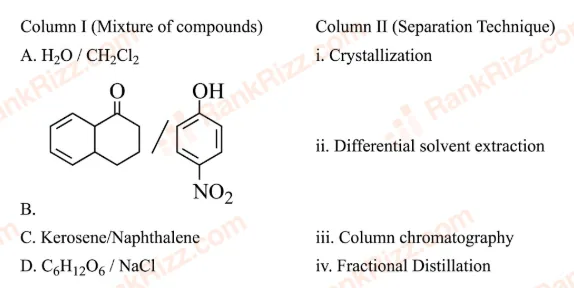
Match items of column I and II
SOLUTION
- Analysis: Water () and dichloromethane () are immiscible liquids that form two distinct layers due to their differing densities and polarities.
- Technique: They are separated using a separating funnel via Differential solvent extraction (or simple liquid-liquid extraction).
- Match: A (ii)
- Analysis: The image shows two structurally distinct organic compounds (a ketone and a substituted phenol) with different polarities and adsorption tendencies.
- Technique: Stationary phases like silica gel absorb these components differently, making Column chromatography the ideal method to separate them.
- Match: B (iii)
- Analysis: Kerosene is a mixture of liquid hydrocarbons, while naphthalene is a volatile solid compound. Alternatively, mixtures of liquids with sufficient differences in boiling points or components that can be fractionated are separated by distillation.
- Technique: Fractional Distillation is used here to separate them based on boiling point differences.
- Match: C (iv)
- Analysis: Glucose () and sodium chloride () have vastly different solubilities in hot versus cold solvents (like alcohol/water mixtures).
- Technique: They can be separated cleanly by Crystallization, where one component forms crystals out of the solution while the other remains dissolved.
- Match: D (i)
Hence,
A - (ii), B - (iii), C - (iv), D - (i)
Tagged Methods of purification of organic compounds. Machine-assigned, so read it as a strong shortlist rather than a verdict.