JEE Main 2025 Chemistry question — Electrode potentials, electrochemical series and cell EMF
1 Faraday electricity was passed through (1.5 M, 1 L)/Cu and 0.1 Faraday was passed through (0.2 M, 1 L)/Ag electrolytic cells. After this the two cells were connected as shown below to make an electrochemical cell. The emf of the cell thus formed at 298 K is ______. (Given: V, V, V)
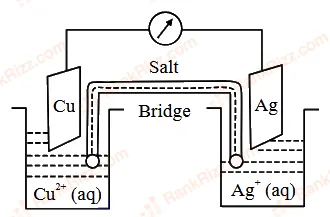
SOLUTION
Initial data (volume of each solution = 1 L):
•
•
Step 1 : Effect of electrolysis on the half-cell
Reaction at cathode:
1 F = 1 mol e⁻, therefore 1 F deposits of .
Remaining moles:
New concentration:
Step 2 : Effect of electrolysis on the half-cell
Reaction at cathode:
0.1 F = 0.1 mol e⁻, therefore 0.1 mol of is removed.
Remaining moles:
New concentration:
Step 3 : Construction of the galvanic cell
Standard reduction potentials:
Hence Ag⁺/Ag will act as the cathode and Cu/Cu²⁺ as the anode:
Cell:
Step 4 : Standard emf of the cell
Step 5 : Emf under the given concentrations (Nernst equation)
Overall cell reaction:
Number of electrons transferred, .
Reaction quotient:
Nernst equation (298 K):
Using the given value :
Since ,
Answer: The emf of the cell is , i.e. .
Tagged Electrode potentials, electrochemical series and cell EMF. Machine-assigned, so read it as a strong shortlist rather than a verdict.