The decreasing order of electrical conductivity of the following aqueous solutions is:
(A) 0.1 M Formic acid,
(B) 0.1 M Acetic acid,
(C) 0.1 M Benzoic acid.
- A
(A) > (B) > (C)
- B
(A) > (C) > (B)
- C
(C) > (B) > (A)
- D
(C) > (A) > (B)
Every JEE Main question on Conductance, conductivity and molar conductivity, one of the ideas inside Electrochemistry: 70 questions from 2005–2026, 42 of them in the last five years. Newest first, answer key on every one. Free to read.
Questions
70
Years asked
14
Since
2005
Of the chapter
31%
61–70 OF 70 · NEWEST FIRST
The decreasing order of electrical conductivity of the following aqueous solutions is:
(A) 0.1 M Formic acid,
(B) 0.1 M Acetic acid,
(C) 0.1 M Benzoic acid.
(A) > (B) > (C)
(A) > (C) > (B)
(C) > (B) > (A)
(C) > (A) > (B)
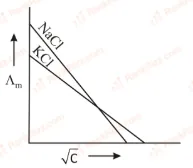
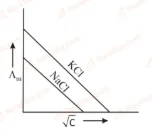
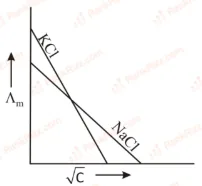
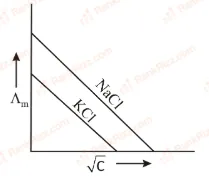
Which one of the following graphs between molar conductivity versus is correct?


When 9.65 ampere current was passed for 1.0 hour into nitrobenzene in acidic medium, the amount of p-aminophenol produced is:
109.0 g
98.1 g
9.81 g
10.9 g
When an electric current is passes through acidified water, 112 mL of hydrogen gas at N.T.P. was collected at the cathode in 965 seconds. The current passed, in ampere, is:
2.0
0.1
0.5
1.0
Oxidation of succinate ion produces ethylene and carbon dioxide gases. On passing 0.2 Faraday electricity through an aqueous solution of potassium succinate, what is the total volume of gases (at both cathode and anode) at STP (1 atm and 273 K)?
8.96 L
4.48 L
6.72 L
2.24 L
Two Faraday of electricity is passed through a solution of . The mass of copper deposited at the cathode is: (Atomic mass of Cu = 63.5 amu)
127 g
0 g
63.5 g
2 g
Resistance of 0.2 M solution of an electrolyte is 50 . The specific conductance of the solution is 1.4 S m. The resistance of 0.5 M solution of the same electrolyte is 280 . The molar conductivity of 0.5 M solution of the electrolyte in S m mol is:
The equivalent conductance of NaCl at concentration C and at infinite dilution are and , respectively. The correct relationship between and is given as: (where the constant B is positive)
Resistance of a conductivity cell filled with a solution of an electrolyte of concentration is . The conductivity of this solution is . Resistance of the same cell when filled with of the same solution is . The molar conductivity of solution of the electrolyte will be
The highest electrical conductivity of the following aqueous solutions is of
M acetic acid
M chloroacetic acid
M fluoroacetic acid
M difluoroacetic acid