JEE Main 2025 Chemistry question — Conductance, conductivity and molar conductivity
40 mL of a mixture of and HCl (aqueous solution) is titrated against 0.1 M NaOH conductometrically. Which of the following statement is correct?
SOLUTION
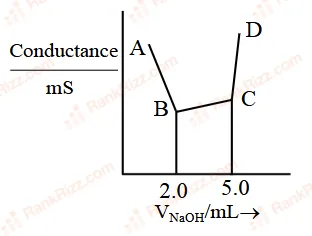
The conductometric titration curve represents the titration of a mixture of a strong acid (HCl) and a weak acid () with a strong base (NaOH).
The conductance of the solution depends on the number of ions present and their ionic mobility. Since the mobility of ions is exceptionally high, the conductance changes characteristically during the titration.
Initially, in segment AB, HCl is neutralized first because it is completely dissociated in solution. The highly mobile ions are replaced by the comparatively less mobile ions from NaOH, causing a sharp decrease in conductance.
Point B, corresponding to of NaOH added, represents the equivalence point of HCl.
Beyond point B, in segment BC, NaOH starts neutralizing acetic acid:
Since acetic acid is only weakly ionized whereas sodium acetate is completely dissociated, the number of ions in solution increases, producing a gradual increase in conductance.
Point C, corresponding to of NaOH added, represents the complete neutralization of acetic acid.
After point C, any additional NaOH contributes free ions to the solution. Because ions possess high mobility, the conductance rises sharply in segment CD.
Hence:
- Option (C) is incorrect because HCl is neutralized before .
- Option (D) is incorrect because point C corresponds to the equivalence point of , while HCl is neutralized at point B.
Now calculate the concentrations.
Given,
For HCl,
so
For acetic acid, the volume of NaOH consumed is
Therefore,
giving
Thus,
Hence, the correct statement is that the concentration of HCl is
so the correct answer is option (B).
Tagged Conductance, conductivity and molar conductivity. Machine-assigned, so read it as a strong shortlist rather than a verdict.