Q26Mole concept, atomic and molar massTRANSCRIBED
The correct order of total number of atoms in: (A) 2 moles of cyclohexane, (B) 684 g of sucrose, (C) 90.8 L of dihydrogen at STP, is :
- A
C > A > B
- B
C > B > A
- C
B > C > A
- D
B > A > C
The 25 Chemistry questions of JEE Main 04 Apr 2026, Shift 2, numbered across the whole paper. Pick an answer on any question to check it against the key. Free to read, nothing to download.
The correct order of total number of atoms in: (A) 2 moles of cyclohexane, (B) 684 g of sucrose, (C) 90.8 L of dihydrogen at STP, is :
C > A > B
C > B > A
B > C > A
B > A > C
The species having identical radii according to the Bohr's theory are:
A. H (first orbit)
B. He (first orbit)
C. He (Second orbit)
D. Li (first orbit)
E. Be (Second orbit)
Choose the correct answer from the options given below:
A, C Only
A, E Only
B, E Only
C, D Only
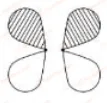
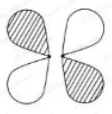
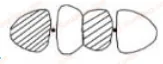
Which of the following pictorial diagram most correctly represents the ( - antibonding) molecular orbital between two atoms if the internuclear axis is taken to be in the z-direction ?

At 27 °C, 0.1 M, 1 L K[Fe(CN)] aqueous solution and 0.1 M, 1 L FeCl aqueous solution are placed in a container separated by a semi permeable membrane AB. Assume complete dissociation of both the solutes. Which of the following statement is correct?
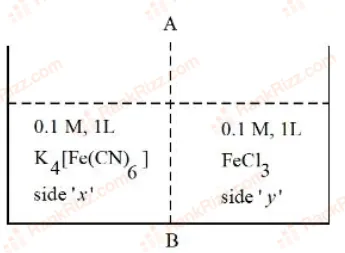
Blue colour is formed on both sides
Ionic solutes in the aqueous solution can pass through the semi-permeable membrane.
Solution on side 'y' is hypotonic
To cause the reverse flow of solvent during osmosis, external pressure (any value) should be applied to side 'x'
20 mL of a solution of acetic acid required 28.4 mL of 0.1 M NaOH for its neutralization. A solution (X) was prepared by mixing 20 mL of the above acetic acid and 14.2 mL of 0.1 M NaOH solution. What is the pH of the solution (X)? (pK value of acetic acid is 4.75).
Match the List I with List II:
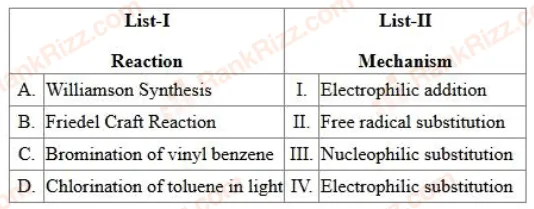
Choose the correct answer from the options given below
A-III, B-I, C-II, D-IV
A-III, B-IV, C-II, D-I
A-III, B-IV, C-I, D-II
A-I, B-III, C-IV, D-II
The 1 ionization enthalpy for Mg is +737 kJ/mol. The most probable estimated value of the 2 ionization enthalpy of Mg is ______.
The electronegativity of a group 13 element 'E' is same as that of Ge (on Pauling scale and upto one decimal point). The CORRECT statements about E are
A. It can act as a reducing agent.
B. It can act as an oxidizing agent.
C. E is more stable than E.
D. The standard electrode potential value for E/E is positive.
choose the correct answer from the options given below
A, C Only
B, C Only
B, D Only
A, D Only
Pairs of elements with the same number of electrons in their respective 4f orbital are
[Atomic number. Eu-63, Gd-64, Dy-66, Ho-67, Tm-69, Yb-70, Lu-71, Hf-72]
A. (Eu and Gd)
B. (Dy and Ho)
C. (Yb and Hf)
D. (Lu and Tm)
choose the correct answer from the options given below
B, C Only
A, B Only
A, D Only
A, C Only
Consider the metal complexes (A), (B) and (C). Choose the CORRECT option by considering the number of unpaired electrons present in (A), (B) and (C) respectively and the order of frequency of absorption
2, 2, 2 and (A) > (C) > (B)
0, 2, 0 and (A) > (C) > (B)
2, 2, 0 and (B) > (C) > (A)
2, 2, 2 and (C) > (A) > (B)
Consider the following molecules/species:
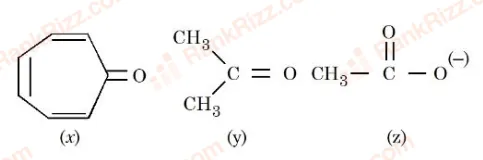
The correct order of carbon-oxygen double bond length is:
x > y > z
y > z > x
z > x > y
x > z > y
Consider is the difference in oxidation states of Mn in highest manganese fluoride and highest manganese oxide. The ions with number of unpaired electrons from the following are:
A. Sc
B. Zn
C. V
D. Fe
E. Co
choose the correct answer from the options given below :
A, B Only
C, D, E Only
C, E Only
B, E Only
Consider the given graph showing variation of reactant concentration with time. Three different reactions were started with identical initial concentration of reactants. Which of the following statement is correct?
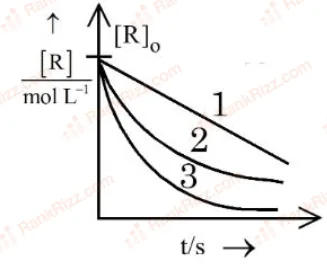
The order of all the three reactions is same.
The rate constant of reaction 3 is larger than the rate constant of reaction 2 if the order of reaction is same for both.
The SI unit of rate constant of reaction 1 is s.
Thermal decomposition of HI on gold surface is an example of reaction 2.
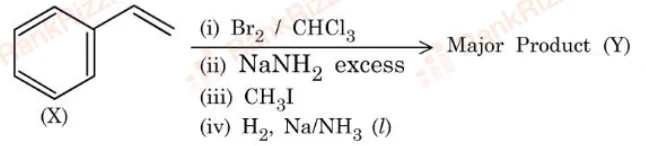
Compound (X) is subjected to the sequence of reactions as shown above:
Molar mass of the major product (Y) formed is ______ g mol.
(Given molar mass in g mol C:12, H: 1, O: 16)
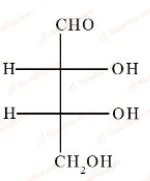
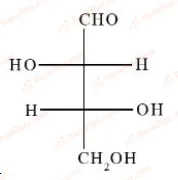
The following structures are
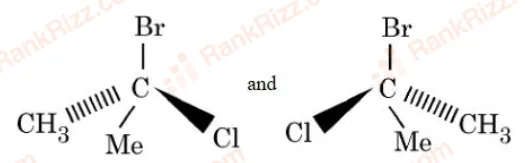
Enantiomers
Identical molecules
Diastereomers
Meso compounds
The descending order of acidity among the following compounds is:
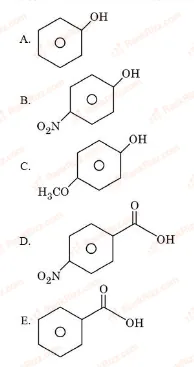
choose the correct answer from the options given below:
B > D > E > A > C
D > B > E > A > C
C > A > B > D > E
D > E > B > A > C
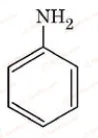
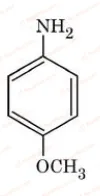
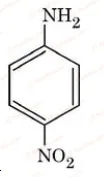
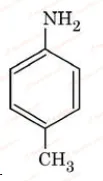
The strongest conjugate acid will result from:
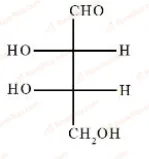
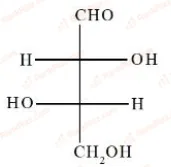
A D-aldotetrose on oxidation with concentrated HNO resulted in optically inactive dicarboxylic acid. The structure of the D-aldotetrose is:
Among Fe, Pb, Cu and Mn, identify the one that gets precipitated out while passing HS in presence of NHOH as group reagent. The highest possible oxidation state of the corresponding metal is
Match the List I with List II:
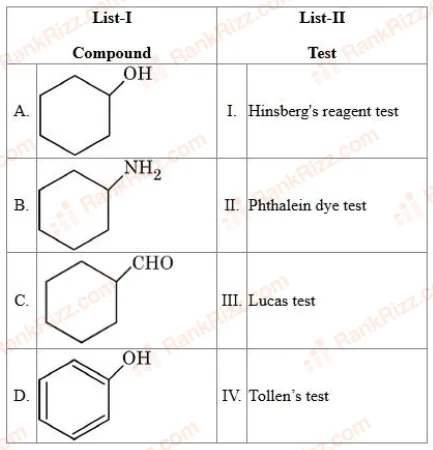
choose the correct answer from the options given below
A-III, B-I, C-IV, D-II
A-III, B-IV, C-I, D-II
A-I, B-III, C-II, D-IV
A-I, B-II, C-III, D-IV
If 3.365 g of ethanol (l) is burnt completely in a bomb calorimeter at 298.15 K, the heat produced is 99.472 kJ. The of ethanol at 298.15 K is _________ kJ mol. (Nearest integer)
Given: Standard enthalpy for combustion of graphite = kJ mol
Standard enthalpy of formation of water (l) = kJ mol
Molar mass in g mol of C, H, O are 12, 1 and 16 respectively
For the following reaction at 50 °C and at 2 atm pressure,
NO is 50% dissociated.
The magnitude of standard free energy change at this temperature is .
= _________ J mol [Nearest integer].
Given: J mol K, , , , °C + 273 = K
An electrochemical cell, consist of the following two redox couples, M(aq)/M(s) [ V] and Fe(aq)/Fe(s) [ V]. The cell EMF (E) is recorded to be 0.2057 V. If the reaction quotient of the electrochemical reaction is found to be , then the value of is __________. (Nearest integer)
[Given: M is a p-block metal and V]
For a first order reaction A B
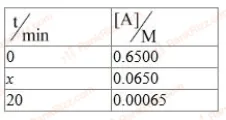
= _________ min. (Nearest integer)
In sulphur estimation, mol of an organic compound (X) (molar mass 76 g mol) gave 0.4813 g of barium sulphate (molar mass 233 g mol). The percentage of sulphur in the compound (X) is _________ % (Nearest integer)