JEE Main 2026 Chemistry question — Reactions of alkynes
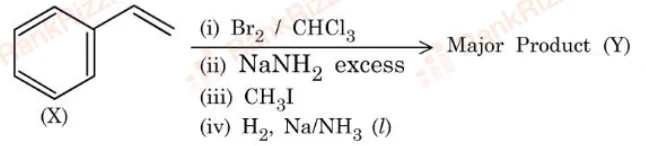
Compound (X) is subjected to the sequence of reactions as shown above:
Molar mass of the major product (Y) formed is ______ g mol.
(Given molar mass in g mol C:12, H: 1, O: 16)
SOLUTION
Step-1 Identification of the starting alkyne X
The product Y finally obtained after the dissolving-metal reduction must be a trans (E)-alkene because converts an internal alkyne into a trans-alkene without disturbing an aromatic ring if present.
A molar mass of 118 g mol-1 corresponds to the molecular formula ( ). Such a formula suggests the presence of a benzene ring ( ) attached to a three-carbon side chain ( ).
Therefore, compound Y is most plausibly trans-1-phenyl-1-propene (trans-β-methyl-styrene): .
Step-2 Retracing the sequence from Y to X
(i) The immediate precursor of this alkene in the given sequence must be the corresponding internal alkyne, , because dissolving-metal reduction adds two hydrogens across a C≡C bond to give the trans-C=C product.
(ii) This alkyne is obtained by alkylating the sodium acetylide of a terminal alkyne with . Hence the terminal alkyne just before step (iii) is phenylacetylene, , whose acidic proton has been removed by excess to give .
(iii) That sodium acetylide itself is produced from the vic-dibromoalkene obtained in step (i) by double dehydro-bromination with excess .
(iv) Finally, the vic-dibromoalkene arises from the addition of one equivalent of to the starting alkyne X.
Thus the only alkyne that fits all the steps is phenylacetylene, .
Step-3 Verification of the whole sequence
Case 1: trans-1,2-dibromostyrene.
Case 2: trans-1,2-dibromostyrene phenylacetylene (regenerated) and then .
Case 3: 1-phenyl-1-butyne, .
Case 4: 1-phenyl-1-butyne trans-1-phenyl-1-propene (compound Y), .
Step-4 Molar-mass calculation of Y
Number of atoms in Y: 9 C and 10 H.
Molar mass .
Hence, the molar mass of compound Y is 118 g mol-1.
Option B which is: 118
Tagged Reactions of alkynes. Machine-assigned, so read it as a strong shortlist rather than a verdict.