JEE Main 2026 Chemistry question — Osmosis and osmotic pressure
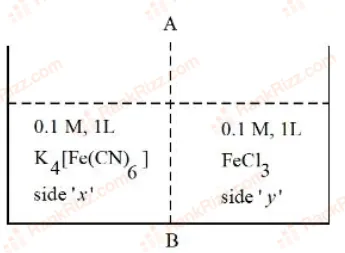
At 27 °C, 0.1 M, 1 L K[Fe(CN)] aqueous solution and 0.1 M, 1 L FeCl aqueous solution are placed in a container separated by a semi permeable membrane AB. Assume complete dissociation of both the solutes. Which of the following statement is correct?
SOLUTION
Osmotic pressure of a dilute solution is given by the van’t Hoff relation
where
is the van’t Hoff factor (total ions produced per formula unit),
is the molarity,
is the gas constant and
is the absolute temperature.
At the same temperature and with equal volumes, the solution having the larger value of possesses the larger osmotic pressure and is called hypertonic; the other one is hypotonic.
Step 1 : Dissociation and van’t Hoff factors
For :
Total ions =
For :
Total ions =
Step 2 : Particle (osmotic) concentrations
Both solutions have the same molarity M.
Side x (containing ):
Side y (containing ):
Step 3 : Comparison of osmotic pressures
Because at the same ,
Therefore side x is hypertonic (higher osmotic pressure) and side y is hypotonic (lower osmotic pressure).
Step 4 : Verification of the given options
A. Prussian blue forms only if meets . The semipermeable membrane blocks solute ions, so no mixing, no precipitate.
B. By definition, ionic solutes cannot pass through a semipermeable (osmotic) membrane — only the solvent moves.
C. As shown above, the side (solution y) has the lower osmotic pressure, hence it is hypotonic — this statement is correct.
D. Reverse osmosis would require pressure on the hypertonic side (side x). Whether this matches the wording depends on the diagram, but only Option C is unambiguously correct from the data given.
Hence, the correct choice is:
Option C which is: Solution y is hypotonic.
Tagged Osmosis and osmotic pressure. Machine-assigned, so read it as a strong shortlist rather than a verdict.