Q26Reactions of phenolsTRANSCRIBED
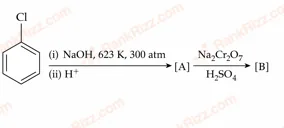
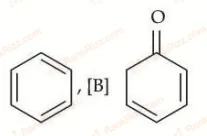
Identify the products [A] and [B], respectively in the following reaction :
- A
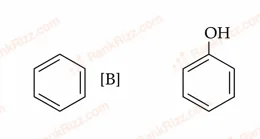
- B
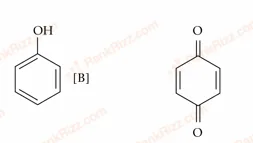
- C
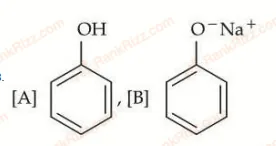
- D
The 25 Chemistry questions of JEE Main 23 Jan 2025, Shift 2, numbered across the whole paper. Pick an answer on any question to check it against the key. Free to read, nothing to download.
Identify the products [A] and [B], respectively in the following reaction :
Consider the following reactions The products [A] and [B], respectively are :
The effect of temperature on spontaneity of reactions are represented as :
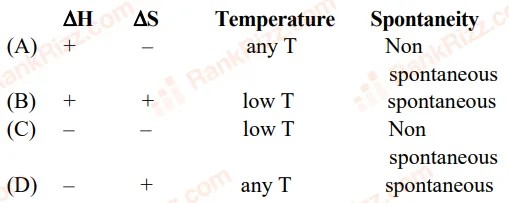
(B) and (C) only
(B) and (D) only
(A) and (D) only
(A) and (C) only
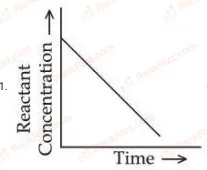
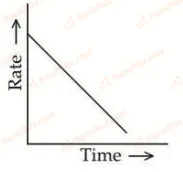
Which of the following graphs most appropriately represents a zero order reaction ?
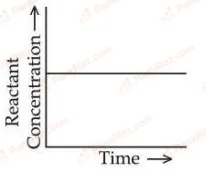
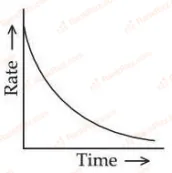
Consider the reaction The equation representing correct relationship between the degree of dissociation (x) of with its equilibrium constant Kp is ______ . Assume x to be very very small.
Given below are two statements : Consider the following reaction
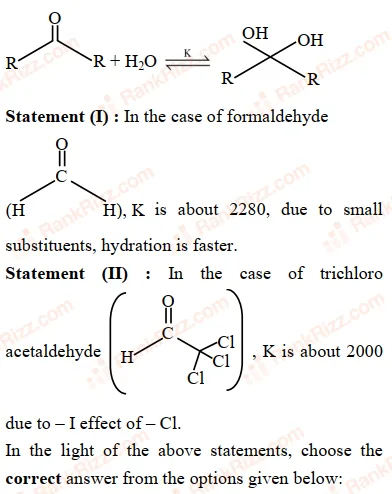
Both Statement I and Statement II are false
Statement I is true but Statement II is false
Statement I is false but Statement II is true
Both Statement I and Statement II are true
Given below are two statements : Statement (I) : For a given shell, the total number of allowed orbitals is given by . Statement (II) : For any subshell, the spatial orientation of the orbitals is given by -l to +l values including zero. In the light of the above statements, choose the correct answer from the options given below :
Both Statement I and Statement II are false
Statement I is true but Statement II is false
Both Statement I and Statement II are true
Statement I is false but Statement II is true
Standard electrode potentials for a few half cells are mentioned below :
Which one of the following cells gives the most negative value of ?
The -Helix and - Pleated sheet structure of protein are associated with its :
tertiary structure
quaternary structure
secondary structure
Primary structure
Given below are the atomic numbers of some group 14 elements. The atomic number of the element with lowest melting point is :
6
82
14
50
Given below are two statements about X-ray spectra of elements : Statement (I) : A plot of ( = frequency of -rays emitted) vs atomic mass is a straight line. Statement (II) : A plot of = frequency of -rays emitted) vs atomic number is a straight line. In the light of the above statements, choose the correct answer from the options given below :
Both Statement I and Statement II are true
Statement I is false but Statement II is true
Both Statement I and Statement II are false
Statement I is true but Statement II is false
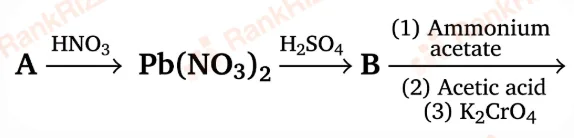
Identify A,B and C in the given below reaction sequence
Given below are two statements : Statement (I) : The boiling points of alcohols and phenols increase with increase in the number of C-atoms. Statement (II) : The boiling points of alcohols and phenols are higher in comparison to other class of compounds such as ethers, haloalkanes. In the light of the above statements, choose the correct answer from the options given below :
Both Statement I and Statement II are false
Both Statement I and Statement II are true
Statement I is false but Statement II is true
Statement I is true but Statement II is false
Consider a binary solution of two volatile liquid components 1 and 2. and are the mole fractions of component 1 in liquid and vapour phase, respectively. The slope and intercept of the linear plot of vs are given respectively as:
The ascending order of relative rate of solvolysis of following compounds is :
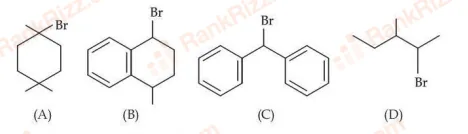
(C) < (B) < (A) < (D)
(D) < (A) < (B) < (C)
(D) < (B) < (A) < (C)
(C) < (D) < (B) < (A)
Match List - I with List - II.
List -I List - II
(A) Bronze (I) Cu, Ni
(B) Brass (II) Fe, Cr, Ni, C
(C) UK Silver coin (III) Cu, Zn
(D) Stainless Steel (IV) Cu, Sn
Choose the correct answer from the options given below :
(A)-(IV), (B)-(II), (C)-(III), (D)-(I)
(A)-(IV), (B)-(III), (C)-(I), (D)-(II)
(A)-(III), (B)-(IV), (C)-(II), (D)-(I)
(A)-(III), (B)-(I), (C)-(IV), (D)-(II)
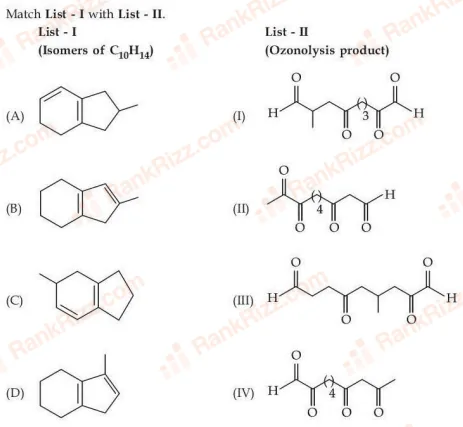
Choose the correct answer from the options given below :
(A)-(I), (B)-(IV), (C)-(III), (D)-(II)
(A)-(III), (B)-(II), (C)-(I), (D)-(IV)
(A)-(III), (B)-(IV), (C)-(I), (D)-(II)
(A)-(II), (B)-(III), (C)-(I), (D)-(IV)
pH of water is 7 at .If water is heated to .,it's pH will :
Decrease
concentration increases, concentration decreases
Remains the same
Increase
Identify the coordination complexes in which the central metal ion has configuration.
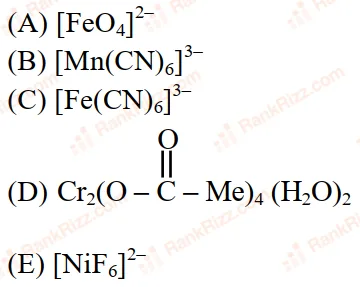
Choose the correct answer from the options given below :
(B), (C) and (D) only
(C) and (E) only
(B) and (D) only
(A), (B) and (E) only
When a non-volatile solute is added to the solvent, the vapour pressure of the solvent decreases by 10 mm of Hg . The mole fraction of the solute in the solution is 0.2 . What would be the mole fraction of the solvent if decrease in vapour pressure is 20 mm of Hg ?
0.8
0.4
0.2
0.6
0.01 mole of an organic compound (X) containing 10% hydrogen, on complete combustion produced . Molar mass of (X) is_____.
A compound 'X' absorbs 2 moles of hydrogen and 'X' upon oxidation with gives

The total number of bonds present in the compound 'X' is ________.
When 81.0 g of aluminium is allowed to react with 128.0 g of oxygen gas, the mass of aluminium oxide produced in grams is_______ - (Nearest integer) Given : Molar mass of Al is 27.0 g Molar mass of O is 16.0 g .
The bond dissociation enthalpy of (ΔHbond) calculated from the given data is ____________ . (Nearest integer)
[Given: () is a pure ionic compound and X forms a diatomic molecule () in gaseous state]
Consider the following sequence of reactions.
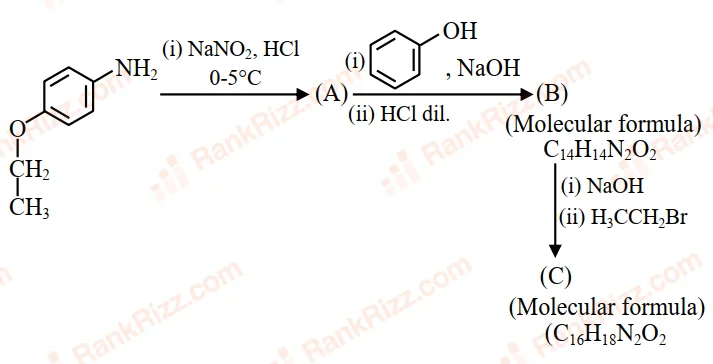
Total number of hybridised carbon atoms in the major product C formed is________