JEE Main 2025 Chemistry question — Nucleophilic addition reactions of carbonyl compounds
Given below are two statements : Consider the following reaction
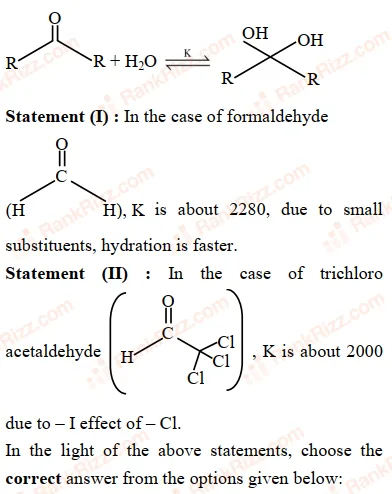
SOLUTION
The reaction shown is the classical “cyanohydrin formation” in which hydrogen cyanide adds to the carbonyl group of an aldehyde or a ketone:
Here the substrate is (ethanal). Hence the product is .
Statement I: “The product obtained in the above reaction possesses a chiral centre.”
• In the carbon marked with an asterisk below is attached to four different groups: and .
• Because the four substituents are different, that carbon is a stereogenic (asymmetric) centre, making the molecule chiral.
Therefore Statement I is true.
Statement II: “HCN adds to the carbonyl group by a nucleophilic-addition mechanism in which first attacks the electrophilic carbonyl carbon and the resulting alkoxide is then protonated.”
• Mechanism steps:
1. Generation of the nucleophile: (in the presence of a base such as ).
2. Nucleophilic attack: attacks the partially positive carbon of the bond, giving an alkoxide ion.
3. Protonation: the alkoxide abstracts a proton (from or another source) to yield the cyanohydrin.
• These are the standard steps of nucleophilic addition to a carbonyl, so Statement II is also true.
Since both statements correctly describe the reaction and its product, the correct choice is:
Option D which is: Both Statement I and Statement II are true
Tagged Nucleophilic addition reactions of carbonyl compounds. Machine-assigned, so read it as a strong shortlist rather than a verdict.