JEE Main 2025 Chemistry question — Nucleophilic substitution (SN1 and SN2)
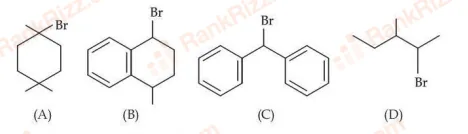
The ascending order of relative rate of solvolysis of following compounds is :
SOLUTION
Solvolysis of an alkyl (or aryl-alkyl) chloride in a polar protic solvent generally follows the pathway whenever the intermediate carbocation is reasonably stable. Hence the relative rate is dictated almost completely by the relative stability of the carbocation that forms after leaves.
Case D: Compound (D) is a primary alkyl chloride. Loss of would generate a primary carbocation, which is highly unstable because it lacks both resonance and extensive hyperconjugation. Therefore (D) undergoes solvolysis extremely slowly.
Case A: Compound (A) is a tertiary alkyl chloride (for example, ). The resulting tertiary carbocation is stabilised by three electron-releasing alkyl groups through the inductive effect and hyperconjugation. Thus (A) reacts faster than the primary chloride (D) but still lacks any resonance stabilisation.
Case B: Compound (B) is a benzylic chloride. When departs, the benzylic carbocation is generated; it is resonance-stabilised by the adjoining aromatic ring, spreading the positive charge over several carbon atoms. A benzylic (even though formally “primary”) carbocation is considerably more stable than a purely aliphatic tertiary carbocation, so (B) solvolyses faster than (A).
Case C: Compound (C) is an even more highly stabilised benzylic system (e.g. diphenylmethyl chloride or a benzylic chloride bearing an additional electron-donating substituent). Its carbocation is delocalised over two phenyl rings or over an ether-substituted ring, giving it the maximum resonance stabilisation among the four substrates. Consequently, (C) shows the highest rate of solvolysis.
Summarising the stability (and therefore the rate):
primary aliphatic < tertiary aliphatic < benzylic < highly resonance-stabilised benzylic.
Hence the ascending order of the relative rate of solvolysis is
Option B which is: (D) < (A) < (B) < (C)
Tagged Nucleophilic substitution (SN1 and SN2). Machine-assigned, so read it as a strong shortlist rather than a verdict.