JEE Main 2025 Chemistry question — Electrophilic addition to alkenes
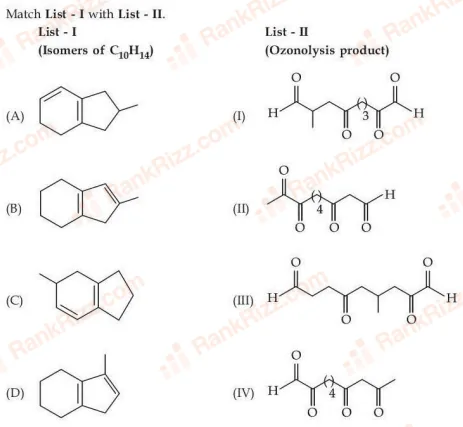
Choose the correct answer from the options given below :
SOLUTION
For every cyclic, conjugated ring the nature of delocalisation is decided by Hückel’s rule.
Hückel’s rule (for a planar, completely conjugated ring):
• If the number of π‐electrons is the system is aromatic (very stable).
• If the number of π‐electrons is and the ring is planar, the system is anti-aromatic (highly unstable).
• If the ring is not planar (or conjugation is broken) the compound is simply non-aromatic, irrespective of electron count.
With that in mind, examine each species.
Case A: Cyclooctatetraene,
It contains eight π-electrons (formal count ). However cyclooctatetraene is not planar: it adopts a shallow “tub” conformation that prevents continuous overlap of the p orbitals. Hence conjugation is interrupted and the molecule is non-aromatic.
(A) (III)
Case B: Cyclobutadiene,
It possesses four π-electrons, , and the tiny four-membered ring is essentially planar, so conjugation is complete. Therefore it satisfies the anti-aromatic condition.
(B) (IV)
Case C: Benzene,
Benzene has six π-electrons, , is perfectly planar and fully conjugated. It is the prototypical aromatic molecule.
(C) ( I )
Case D: Tropylium cation,
The ion has seven carbon atoms, each contributing one p electron except the positively charged carbon which lacks one. Total π-electrons = 6, again . The cation is planar and conjugated, so it is aromatic. (Although aromatic like benzene, it is treated separately here because it is a carbocation.)
(D) (II)
Collecting the matches:
(A)-(III), (B)-(IV), (C)-(I), (D)-(II)
Hence the correct choice is
Option C which is: (A)-(III), (B)-(IV), (C)-(I), (D)-(II).
Tagged Electrophilic addition to alkenes. Machine-assigned, so read it as a strong shortlist rather than a verdict.