RankRizz

JEE Main 08 Jan 2020, Shift 1: Chemistry

The 25 Chemistry questions of JEE Main 08 Jan 2020, Shift 1, numbered across the whole paper. Pick an answer on any question to check it against the key. Free to read, nothing to download.

Chemistry

Q26Hydrogen spectrum and spectral seriesTRANSCRIBED

For the Balmer series, in the spectrum of H atom, vˉ=RH{1n12−1n22}\bar{v} = R_H\left\{\frac{1}{n_1^2} - \frac{1}{n_2^2}\right\}, the correct statements among (I) to (IV) are,
(I) As wavelength decreases, the lines in the series converge.
(II) The integer n1n_1 is equal to 2.
(III) The lines of the longest wavelength correspond to n2=3n_2 = 3.
(IV) The ionization energy of hydrogen can be calculated from the wave number of these lines.

  1. A

    (I), (III), (IV)

  2. B

    (I), (II), (III)

  3. C

    (I), (II), (IV)

  4. D

    (II), (III), (IV)

Q27Ionisation enthalpyTRANSCRIBED

The first ionization energy (in kJ/mol) of Na, Mg, Al and Si respectively are:

  1. A

    496, 737, 577, 786

  2. B

    496, 577, 737, 786

  3. C

    786, 737, 577, 496

  4. D

    496, 577, 786, 737

Q28Ionisation enthalpyTRANSCRIBED

The third ionization enthalpy is minimum for:

  1. A

    Co

  2. B

    Fe

  3. C

    Ni

  4. D

    Mn

Q29Hydrogen bonding and intermolecular forcesTRANSCRIBED

The predominant intermolecular forces present in ethyl acetate, a liquid, are:

  1. A

    London dispersion and dipole-dipole

  2. B

    hydrogen bonding and London dispersion

  3. C

    Dipole-dipole and hydrogen bonding

  4. D

    London dispersion, dipole-dipole and hydrogen bonding

Q30Solubility product and common ion effectTRANSCRIBED

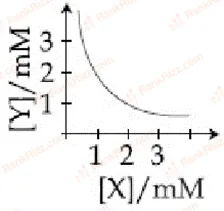
The stoichiometry and solubility product of a salt with the solubility curve given below is, respectively:

Figure for JEE Main 2020 Chemistry question on Solubility product and common ion effect
  1. A

    X2_2Y, 2×10−92 \times 10^{-9} M3^3

  2. B

    XY2_2, 4×10−94 \times 10^{-9} M3^3

  3. C

    XY2_2, 1×10−91 \times 10^{-9} M3^3

  4. D

    XY, 2×10−62 \times 10^{-6} M3^3

Q31Acid-base indicators and titration curvesTRANSCRIBED

The strength of an aqueous NaOH solution is most accurately determined by titrating: (Note: consider that an appropriate indicator is used)

  1. A

    Aq. NaOH in a pipette and aqueous oxalic acid in a burette

  2. B

    Aq. NaOH in a burette and aqueous oxalic acid in a conical flask

  3. C

    Aq. NaOH in a burette and concentrate H2_2SO4_4 in a conical flask

  4. D

    Aq. NaOH in a volumetric flask and concentrated H2_2SO4_4 in a conical flask

Q32Compounds of alkaline earth metalsTRANSCRIBED

When gypsum is heated to 393K, it forms:

  1. A

    Anhydrous CaSO4_4

  2. B

    CaSO4_4 . 5H2_2O

  3. C

    CaSO4_4 . 0.5H2_2O

  4. D

    Dead burnt plaster

Q33Reactions of phenolsTRANSCRIBED

Arrange the following compounds in increasing order of C-OH bond length: methanol, phenol, p-ethoxyphenol

  1. A

    methanol < p-ethoxyphenol < phenol

  2. B

    phenol < methanol < p-ethoxyphenol

  3. C

    phenol < p-ethoxyphenol < methanol

  4. D

    methanol < phenol < p-ethoxyphenol

Q34Methods of purification of organic compoundsTRANSCRIBED

A flask contains a mixture of isohexane and 3-methylpentane. One of the liquids boils at 63∘^\circC while the other boils at 60∘^\circC. What is the best way to separate the two liquids and which one will be distilled out first?

  1. A

    fractional distillation, isohexane

  2. B

    simple distillation, 3-methylpentane

  3. C

    simple distillation, isohexane

  4. D

    fractional distillation, 3-methylpentane

Q35Air pollution: tropospheric pollutants, smog, acid rain and greenhouse effectTRANSCRIBED

Among the gases (a) - (e), the gases that cause greenhouse effect are:
(a) CO2_2
(b) H2_2O
(c) CFCs
(d) O2_2
(e) O3_3

  1. A

    (a), (b), (c) and (d)

  2. B

    (a), (b), (c) and (e)

  3. C

    (a) and (d)

  4. D

    (a), (c), (d) and (e)

Q36Solubility of gases and Henry's lawTRANSCRIBED

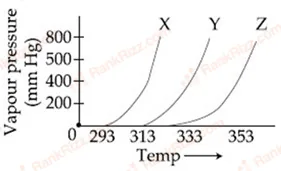
A graph of vapour pressure and temperature for three different liquids X, Y and Z is shown below:

Figure for JEE Main 2020 Chemistry question on Solubility of gases and Henry's law


The following inferences are made:
(A) X has higher intermolecular interactions compared to Y.
(B) X has lower intermolecular interactions compared to Y.
(C) Z has lower intermolecular interactions compared to Y.
The correct inferences is/are:

  1. A

    (A) and (C)

  2. B

    (A)

  3. C

    (B)

  4. D

    (C)

Q37Arrhenius equation and activation energyTRANSCRIBED

The rate of a certain biochemical reaction at physiological temperature (T) occurs 10610^6 times faster with enzyme than without. The change in the activation energy upon adding enzyme is:

  1. A

    −6(2.303)RT-6(2.303)RT

  2. B

    −6RT-6RT

  3. C

    +6(2.303)RT+6(2.303)RT

  4. D

    +6RT+6RT

Q38Properties of colloids and coagulationTRANSCRIBED

As per Hardy-Schulze formulation, the flocculation values of the following for ferric hydroxide sol are in the order:

  1. A

    K3_3[Fe(CN)6_6] < K2_2CrO4_4 < KBr = KNO3_3 = AlCl3_3

  2. B

    K3_3[Fe(CN)6_6] < K2_2CrO4_4 < AlCl3_3 < KBr < KNO3_3

  3. C

    AlCl3_3 > K3_3[Fe(CN)6_6] > K2_2CrO4_4 > KBr = KNO3_3

  4. D

    K3_3[Fe(CN)6_6] > AlCl3_3 > K2_2CrO4_4 > KBr > KNO3_3

Q39Group 16: trends, dioxygen, ozone and oxidesTRANSCRIBED

The number of bonds between sulphur and oxygen atoms in S2_2O82−_8^{2-} and the number of bonds between sulphur and sulphur atoms in rhombic sulphur, respectively are:

  1. A

    4 and 6

  2. B

    8 and 8

  3. C

    8 and 6

  4. D

    4 and 8

Q40Structural isomerism in complexesTRANSCRIBED

The complex that can show fac- and mer-isomers is:

  1. A

    [Co(NH3_3)4_4Cl2_2]+^+

  2. B

    [Pt(NH3_3)2_2Cl2_2]

  3. C

    [CoCl2_2(en)2_2]

  4. D

    [Co(NH3_3)3_3(NO2_2)3_3]

Q41Nucleophilic substitution (SN1 and SN2)TRANSCRIBED

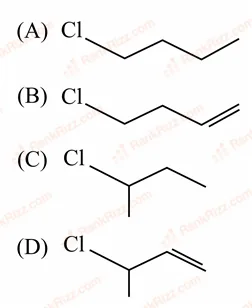
The decreasing order of reactivity towards dehydrohalogenation (E1_1) reaction of the following compounds is:

Figure for JEE Main 2020 Chemistry question on Nucleophilic substitution (SN1 and SN2)
  1. A

    D > B > C > A

  2. B

    B > D > A > C

  3. C

    B > D > C > A

  4. D

    B > A > D > C

Q42Reactions of phenolsTRANSCRIBED

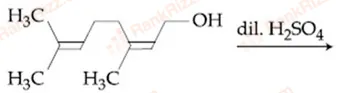
The major product of the following reaction is:

Figure for JEE Main 2020 Chemistry question on Reactions of phenols
  1. A
    Figure for JEE Main 2020 Chemistry question on Reactions of phenols
  2. B
    Figure for JEE Main 2020 Chemistry question on Reactions of phenols
  3. C
    Figure for JEE Main 2020 Chemistry question on Reactions of phenols
  4. D
    Figure for JEE Main 2020 Chemistry question on Reactions of phenols
Q43Reactions of carboxylic acidsTRANSCRIBED

The most suitable reagent for the given conversion is:

Figure for JEE Main 2020 Chemistry question on Reactions of carboxylic acids Figure for JEE Main 2020 Chemistry question on Reactions of carboxylic acids
  1. A

    B2_2H6_6

  2. B

    NaBH4_4

  3. C

    LiAlH4_4

  4. D

    H2_2/Pd

Q44Reactions and tests of aminesTRANSCRIBED

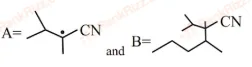
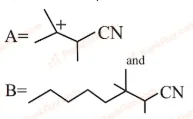
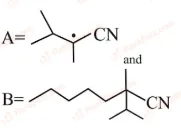
The major products A and B in the following reactions are

Figure for JEE Main 2020 Chemistry question on Reactions and tests of amines
  1. A
    Figure for JEE Main 2020 Chemistry question on Reactions and tests of amines
  2. B
    Figure for JEE Main 2020 Chemistry question on Reactions and tests of amines
  3. C
    Figure for JEE Main 2020 Chemistry question on Reactions and tests of amines
  4. D
    Figure for JEE Main 2020 Chemistry question on Reactions and tests of amines
Q45Carbohydrates: classification and monosaccharidesTRANSCRIBED

Which of the following statement is not true for glucose?

  1. A

    Glucose exists in two crystalline forms α\alpha and β\beta

  2. B

    Glucose gives Schiff's test for aldehyde

  3. C

    Glucose reacts with hydroxylamine to form oxime

  4. D

    The pentaacetate of glucose does not react with hydroxylamine to give oxime

Q46Stoichiometry, limiting reagent and percentage yieldTRANSCRIBED

The volume (in mL) of 0.125 M AgNO3_3 required to quantitatively precipitate chloride ions in 0.3 g of [Co(NH3_3)6_6]Cl3_3 is __________.
M[Co(NH3_3)6_6]Cl3_3 = 267.46 g/mol
M AgNO3_3 = 169.87 g/mol
Report the nearest integer as the answer.

Q47First law: work, heat and internal energyTRANSCRIBED

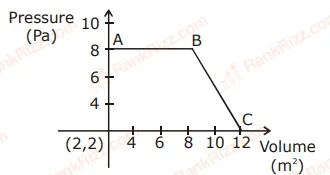
The magnitude of work done by a gas that undergoes a reversible expansion along the path ABC shown in the figure is __________.

Figure for JEE Main 2020 Chemistry question on First law: work, heat and internal energy
Q48Concentration terms and their interconversionTRANSCRIBED

Ferrous sulphate heptahydrate is used to fortify foods with iron. The amount (in grams) of the salt required to achieve 10 ppm of iron in 100 kg of wheat is __________.
Atomic weight: Fe = 55.85; S = 32.00; O = 16.00. (Round off answer to nearest integer)

Q49Electrode potentials, electrochemical series and cell EMFTRANSCRIBED

What would be the electrode potential for the given half-cell reaction at pH = 5?
2H2_2O →\rightarrow O2_2 + 4H+^+ + 4e−^-; Ered0=1.23_{red}^0 = 1.23 V
(R = 8.314 J mol−1^{-1} K−1^{-1}; Temp = 298K; oxygen under standard atm. pressure of 1 bar)

Q50Drugs and medicinesTRANSCRIBED

The number of chiral centres in penicillin is __________.

NEXT IN THIS PAPER →Maths, Q51 onwards