JEE Main 2020 Chemistry question — Nucleophilic substitution (SN1 and SN2)
The decreasing order of reactivity towards dehydrohalogenation (E) reaction of the following compounds is:
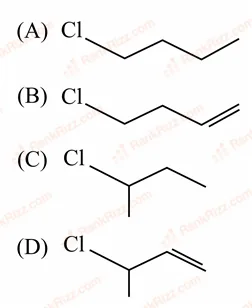
SOLUTION
An elimination reaction proceeds via a two-step mechanism where the first and rate-determining step (RDS) is the loss of the leaving group () to form a carbocation intermediate:
The general order of carbocation stability is: Allylic / Benzylic (resonance stabilized) > Tertiary () > Secondary () > Primary ().
Step-by-Step Analysis of the Generated Carbocations:
-
Compound (B): Primary Allylic Chloride
Loss of yields a primary allylic carbocation ( or similar chain system). This carbocation is highly stable because the positive charge is directly delocalized via resonance with the adjacent carbon-carbon double bond. Hence, it is exceptionally reactive.
-
Compound (D): Secondary Allylic Chloride
Loss of forms a secondary allylic-like carbocation. While it has resonance stability, it undergoes minor structural or steric constraint compared to the primary unhindered linear conjugation of B, making it slightly less favored than B but far more stable than non-conjugated carbocations.
-
Compound (C): Secondary Alkyl Chloride
Loss of creates a simple secondary () carbocation (). It is stabilized purely by hyperconjugation and inductive effects, which are weaker than resonance. It is less reactive than the allylic systems (B and D).
-
Compound (A): Primary Alkyl Chloride
Loss of yields a primary () carbocation (). Primary carbocations are extremely unstable and difficult to form under standard conditions. Thus, it is the least reactive compound.
Conclusion:
Arranging the compounds based on the stability profile of their respective carbocations yields the following decreasing order of reactivity:
Answer: Option — B > D > C > A
Tagged Nucleophilic substitution (SN1 and SN2). Machine-assigned, so read it as a strong shortlist rather than a verdict.