RankRizz

JEE Main 07 Jan 2020, Shift 1: Chemistry

The 25 Chemistry questions of JEE Main 07 Jan 2020, Shift 1, numbered across the whole paper. Pick an answer on any question to check it against the key. Free to read, nothing to download.

Chemistry

Q26Units, significant figures and laws of chemical combinationTRANSCRIBED

Amongst the following statements, that which was not proposed by Dalton was:

  1. A

    chemical reactions involve reorganization of atoms. These are neither created nor destroyed in a chemical reaction.

  2. B

    all the atoms of a given element have identical properties including identical mass. Atoms of different elements differ in mass.

  3. C

    when gases combine or reproduced in a chemical reaction they do so in a simple ratio by volume provided all gases are at the same T & P.

  4. D

    matter consists of indivisible atoms.
Q27Quantum numbers and shapes of orbitalsTRANSCRIBED

The number of orbitals associated with quantum numbers n=5n = 5, ms=+12m_s = +\frac{1}{2} is:

  1. A

    11

  2. B

    25

  3. C

    50

  4. D

    15

Q28Electron gain enthalpyTRANSCRIBED

The electron gain enthalpy (in kJ/mol) of fluorine, chlorine, bromine and iodine, respectively, are

  1. A

    −296,−325,−333-296, -325, -333 and −349-349

  2. B

    −349,−333,−325-349, -333, -325 and −296-296

  3. C

    −333,−349,−325-333, -349, -325 and −296-296

  4. D

    −333,−325,−349-333, -325, -349 and −296-296

Q29Dipole moment and molecular polarityTRANSCRIBED

The dipole moments of CCl4_4, CHCl3_3 and CH4_4 are in the order

  1. A

    CHCl3_3 < CH4_4 = CCl4_4

  2. B

    CCl4_4 < CH4_4 < CHCl3_3

  3. C

    CH4_4 < CCl4_4 < CHCl3_3

  4. D

    CH4_4 = CCl4_4 < CHCl3_3

Q30Hydrogen bonding and intermolecular forcesTRANSCRIBED

The relative strength of the interionic/ intermolecular forces in a decreasing order is:

  1. A

    dipole-dipole > ion-dipole > ion-ion

  2. B

    ion-dipole > ion-ion > dipole-dipole

  3. C

    ion-dipole > dipole-dipole > ion-ion

  4. D

    ion-ion > ion-dipole > dipole-dipole

Q31Oxidation numberTRANSCRIBED

Oxidation number of potassium in K2_2O, K2_2O2_2 and KO2_2, respectively, is:

  1. A

    +2,+1+2, +1 and +12+\frac{1}{2}

  2. B

    +1,+1+1, +1 and +1+1

  3. C

    +1,+4+1, +4 and +2+2

  4. D

    +1,+2+1, +2 and +4+4

Q32Hardness of water and its removalTRANSCRIBED

In comparison to the zeolite process for the removal of permanent hardness, the synthetic resin method is

  1. A

    less efficient as it exchanges only anions.

  2. B

    more efficient as it can exchange both cations as well as anions.

  3. C

    less efficient as the resins cannot be regenerated.

  4. D

    more efficient as it can exchange only cations.

Q33Methods of purification of organic compoundsTRANSCRIBED

A solution of m-chloroaniline, m-chlorophenol and m-chlorobenzoic acid in ethyl acetate was extracted initially with a saturated solution of NaHCO3_3 to give fraction A. The left over organic phase was extracted with dilute NaOH solution to give fraction B. The final organic layer was labelled as fraction C. Fractions A, B and C, contain respectively:

  1. A

    m-chlorobenzoic acid, m-chloroaniline and m-chlorophenol

  2. B

    m-chlorobenzoic acid, m-chlorophenol and m-chloroaniline

  3. C

    m-chlorophenol, m-chlorobenzoic acid and m-chloroaniline

  4. D

    m-chloroaniline, m-chlorobenzoic acid and m-chlorophenol

Q34Acidity and basicity of organic compoundsTRANSCRIBED

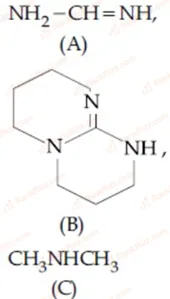
The increasing order of pKb_b for the following compounds will be:

Figure for JEE Main 2020 Chemistry question on Acidity and basicity of organic compounds
  1. A

    (B) < (C) < (A)

  2. B

    (A) < (B) < (C)

  3. C

    (C) < (A) < (B)

  4. D

    (B) < (A) < (C)

Q35Alkenes: preparation and stabilityTRANSCRIBED

Consider the following reactions:
(a) (CH3)3CCH(OH)CH3→conc.H2SO4(CH_3)_3CCH(OH)CH_3 \xrightarrow{\text{conc.} H_2SO_4}
(b) (CH3)2CHCH(Br)CH3→alc. KOH(CH_3)_2CHCH(Br)CH_3 \xrightarrow{\text{alc. KOH}}
(c) (CH3)2CHCH(Br)CH3→(CH3)3O⊖K⊕(CH_3)_2CHCH(Br)CH_3 \xrightarrow{(CH_3)_3O^\ominus K^\oplus}
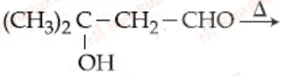
(d)

Figure for JEE Main 2020 Chemistry question on Alkenes: preparation and stability


Which of the reaction(s) will not produce Saytzeff product?

  1. A

    (a), (c) and (d)

  2. B

    (d) only

  3. C

    (c) only

  4. D

    (b) and (d)

Q36Relative lowering of vapour pressureTRANSCRIBED

At 35 ∘^\circC, the vapour pressure of CS2_2 is 512 mmHg and that of acetone is 144 mmHg. A solution of CS2_2 in acetone has a total vapour pressure of 600 mmHg. The false statement amongst the following is:

  1. A

    Raoult's law is not obeyed by this system

  2. B

    a mixture of 100 mL CS2_2 and 100 mL acetone has a volume < 200 mL

  3. C

    CS2_2 and acetone are less attracted to each other than to themselves

  4. D

    heat must be absorbed in order to produce the solution at 35∘^\circC

Q37Electrode potentials, electrochemical series and cell EMFTRANSCRIBED

Given that the standard potentials (E∘^\circ) of Cu2+^{2+}/Cu and Cu+^+/Cu are 0.34V and 0.522V respectively, the E∘^\circ of Cu2+^{2+}/Cu+^+ is:

  1. A

    0.182V

  2. B

    +0.158V

  3. C

    -0.182V

  4. D

    -0.158V

Q38Extraction of Fe, Cu, Zn, Al, Ag and AuTRANSCRIBED

The purest form of commercial iron is:

  1. A

    pig iron

  2. B

    wrought iron

  3. C

    cast iron

  4. D

    scrap iron and pig iron

Q39Lanthanoids and lanthanoid contractionTRANSCRIBED

The atomic radius of Ag is closest to

  1. A

    Au

  2. B

    Ni

  3. C

    Cu

  4. D

    Hg

Q40IUPAC nomenclature of coordination compoundsTRANSCRIBED

The IUPAC name of the complex [Pt(NH3_3)2_2Cl(NH2_2CH3_3)]Cl is

  1. A

    Diamminechlorido (methanamine) platinum (II) chloride

  2. B

    Diammine(methanamine)chlorido platinum (II) chloride

  3. C

    Diamminechlorido (aminomethane) platinum (II) chloride

  4. D

    Bisammine (methanamine) chlorido platinum (II) chloride

Q41Colour and magnetic behaviour of complexes from CFTTRANSCRIBED

The theory that can completely/properly explain the nature of bonding in [Ni(CO)4_4] is:

  1. A

    Werner's theory

  2. B

    Molecular orbital theory

  3. C

    Crystal field theory

  4. D

    Valence bond theory

Q42Nucleophilic substitution (SN1 and SN2)TRANSCRIBED

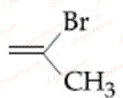
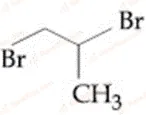
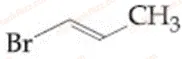
1-methyl ethylene oxide when treated with an excess of HBr produces

  1. A
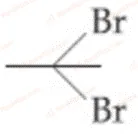
    Figure for JEE Main 2020 Chemistry question on Nucleophilic substitution (SN1 and SN2)
  2. B
    Figure for JEE Main 2020 Chemistry question on Nucleophilic substitution (SN1 and SN2)
  3. C
    Figure for JEE Main 2020 Chemistry question on Nucleophilic substitution (SN1 and SN2)
  4. D
    Figure for JEE Main 2020 Chemistry question on Nucleophilic substitution (SN1 and SN2)
Q43Reactions of carboxylic acidsTRANSCRIBED

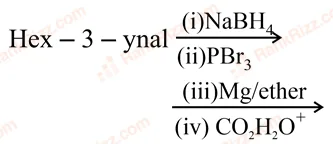
What is the product of the following reaction?

Figure for JEE Main 2020 Chemistry question on Reactions of carboxylic acids
  1. A
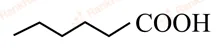
    Figure for JEE Main 2020 Chemistry question on Reactions of carboxylic acids
  2. B
    Figure for JEE Main 2020 Chemistry question on Reactions of carboxylic acids
  3. C
    Figure for JEE Main 2020 Chemistry question on Reactions of carboxylic acids
  4. D
    Figure for JEE Main 2020 Chemistry question on Reactions of carboxylic acids
Q44Diazonium saltsTRANSCRIBED

Consider the following reaction:

Figure for JEE Main 2020 Chemistry question on Diazonium salts


The product 'X' is used:

  1. A

    in protein estimation as an alternative to ninhydrin

  2. B

    in acid base titration as an indicator

  3. C

    as food grade colourant

  4. D

    in laboratory test for phenols

Q45Vitamins and hormonesTRANSCRIBED

Match the following:
(i) Riboflavin            (a) Beriberi
(ii) Thiamine            (b) Scurvy
(iii) Pyridoxine        (c) Cheilosis
(iv) Ascorbic acid    (d) Convulsions

  1. A

    (i)-(a), (ii)-(d), (iii)-(c), (iv)-(b)

  2. B

    (i)-(c), (ii)-(d), (iii)-(a), (iv)-(b)

  3. C

    (i)-(c), (ii)-(a), (iii)-(d), (iv)-(b)

  4. D

    (i)-(d), (ii)-(b), (iii)-(a), (iv)-(c)

Q46Gibbs energy and spontaneityTRANSCRIBED

For the reaction:
A(l) →\rightarrow 2B(g)
ΔU=2.1\Delta U = 2.1 kcal, ΔS=20\Delta S = 20 cal K−1^{-1} at 300K.
Hence ΔG\Delta G in kcal is

Q47pH of acids, bases and their mixturesTRANSCRIBED

Two solutions, A and B, each of 100L was made by dissolving 4g of NaOH and 9.8g of H2_2SO4_4 in water, respectively. The pH of the resultant solution obtained from mixing 40L of solution A and 10L of solution B is (log 2 = 0.3)

Q48Radioactivity and nuclear reactionsTRANSCRIBED

During the nuclear explosion, one of the products is 90^{90}Sr with half life of 6.93 years. If 1μ\mug of 90^{90}Sr was absorbed in the bones of a newly born baby in place of Ca, how much time, in years, is required to reduce it by 90% if it is not lost metabolically

Q49Resonance and bond parametersTRANSCRIBED

Chlorine reacts with hot and concentrated NaOH and produces compounds (X) and (Y). Compound (X) gives white precipitate with silver nitrate solution. The average bond order between Cl and O atoms in (Y) is

NEXT IN THIS PAPER →Maths, Q51 onwards