JEE Main 2020 Chemistry question — Nucleophilic substitution (SN1 and SN2)
1-methyl ethylene oxide when treated with an excess of HBr produces
SOLUTION
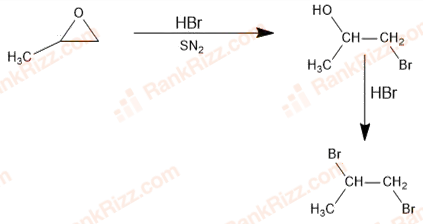
-
Step 1: Epoxide Ring Opening under Acidic Conditions (, )
When 1-methyl ethylene oxide is treated with , the oxygen atom of the epoxide ring is first protonated by the strong acid to form a highly reactive oxonium ion intermediate. This protonation increases the electrophilicity of both ring carbon atoms.
Although the reaction follows an -like pathway where the bromide ion () attacks as a nucleophile, the bond-breaking in a protonated epoxide precedes bond-making. This builds up significant partial positive charge () on the ring carbons. Because the more substituted secondary () carbon stabilizes this partial positive charge much better than the primary ($) carbon, the bromide ion selectively attacks the more substituted secondary carbon:
This regioselective ring opening yields 1-bromopropan-2-ol as the intermediate.
-
Step 2: Substitution of the Hydroxyl Group with Excess
Because the reaction mixture contains an excess of , the remaining secondary alcohol group () in 1-bromopropan-2-ol undergoes a subsequent nucleophilic substitution reaction:
- The hydroxyl group is protonated by another equivalent of to form an excellent leaving group ().
- A second bromide ion () then attacks the carbon, displacing the water molecule.
This converts the secondary alcohol into a vicinal dibromide: 1,2-dibromopropane.
Why Other Options Are Incorrect:
-
Halohydrin Intermediates (e.g., 1-bromopropan-2-ol or 2-bromopropan-1-ol):
Structures that contain a remaining hydroxyl group () alongside a single bromine atom only represent the intermediate species formed after the initial ring opening. They fail to account for the secondary substitution step driven by the specified excess reagent conditions.
-
Geminal Dibromides (e.g., 1,1-dibromopropane or 2,2-dibromopropane):
Geminal dibromides require both halogens to be added to the exact same carbon atom. The epoxide ring opening naturally distributes functional groups across adjacent carbons (carbons 1 and 2), making geminal placement chemically impossible here.
Conclusion:
The combination of regioselective acidic epoxide cleavage followed by acid-catalyzed substitution of the remaining alcohol transforms 1-methyl ethylene oxide completely into 1,2-dibromopropane.
Answer: Option B (1,2-dibromopropane)
Tagged Nucleophilic substitution (SN1 and SN2). Machine-assigned, so read it as a strong shortlist rather than a verdict.