Q31Concentration terms and their interconversionTRANSCRIBED
What would be the molality of 20% (mass/mass) aqueous solution of KI? (molar mass of KI = 166 g mol)
- A
1.35
- B
1.51
- C
1.08
- D
1.48
The 30 Chemistry questions of JEE Main 09 Apr 2019, Shift 2, numbered across the whole paper. Pick an answer on any question to check it against the key. Free to read, nothing to download.
What would be the molality of 20% (mass/mass) aqueous solution of KI? (molar mass of KI = 166 g mol)
1.35
1.51
1.08
1.48
Which one of the following about an electron occupying the 1s orbital in a hydrogen atom is incorrect? (The Bohr radius is represented by a).
The total energy of the electron is maximum when it is at a distance a from the nucleus.
The electron can be found at a distance 2a from the nucleus.
The probability density of finding the electron is maximum at the nucleus.
The magnitude of the potential energy is double that of its kinetic energy on an average.
Among the following species, the diamagnetic molecule is:
CO
B
O
NO
At a given temperature T, gases Ne, Ar, Xe and Kr are found to deviate from ideal gas behaviour. Their equation of state is given as at T. Here, b is the van der Waals constant. Which gas will exhibit steepest increase in the plot of Z (compression factor) vs p?
Ne
Kr
Ar
Xe
During compression of a spring the work done is 10 kJ and 2 kJ escaped to the surroundings as heat. The change in internal energy, (in kJ) is:
-8
8
12
-12
In an acid-base titration, 0.1 M HCl solution was added to the NaOH solution of unknown strength. Which of the following correctly shows the change of pH of the titration mixture in this experiment?
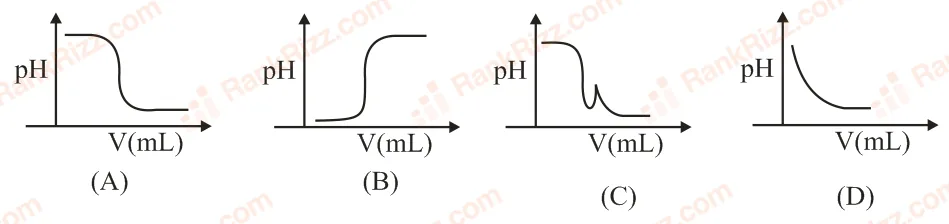
A
B
D
C
The structures of beryllium chloride in the solid state and vapour phase, respectively, are:
chain and chain
dimeric and chain
chain and dimeric
dimeric and dimeric
The correct statements among I to III regarding group 13 element oxides are,
(I) Boron trioxide is acidic.
(II) Oxides of aluminum and gallium are amphoteric.
(III) Oxides of indium and thallium are basic.
(I) and (III) only
(I) and (II) only
(I), (II) and (III)
(II) and (III) only
The amorphous form of silica is:
quartz
kieselguhr
tridymite
cristobalite
The layer of atmosphere between 10 km to 50 km above the sea level is called as:
stratosphere
troposphere
mesosphere
thermosphere
Molal depression constant for a solvent is 4.0 K kg mol. The depression in the freezing point of the solvent for 0.03 mol kg solution of KSO is: (Assume complete dissociation of the electrolyte)
0.36 K
0.24 K
0.18 K
0.12 K
A solution of Ni(NO) is electrolyzed between platinum electrode 0.1 Faraday electricity. How many mole of Ni will be deposited at the cathode?
0.10
0.15
0.05
0.20
Consider the given plot of enthalpy of the following reaction between A and B.
A + B C + D. Identify the incorrect statement.
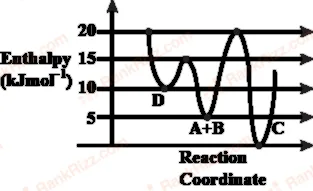
Formation of A and B from C has highest enthalpy of activation.
D is kinetically stable product.
C is the thermodynamically stable product.
Activation enthalpy to form C is 5 kJ mol less than that to form D.
10 mL of 1 mM surfactant solution forms a monolayer covering 0.24 cm on a polar substrate. If the polar head is approximated as a cube, what is its edge length?
1.0 pm
0.1 nm
2.0 pm
2.0 nm
The one that is not a carbonate ore is:
malachite
bauxite
calamine
siderite
Assertion: For the extraction of iron, haematite ore is used.
Reason: Haematite is a carbonate ore of iron.
Only the assertion is correct.
Only the reason is correct.
Both the assertion and reason are correct and the reason is the correct explanation for the assertion.
Both the assertion and reason are correct, but the reason is not the correct explanation for the assertion.
HF has highest boiling point among hydrogen halides, because it has:
lowest dissociation enthalpy
strongest van der Waals' interactions
strongest hydrogen bonding
lowest ionic character
The maximum number of possible oxidation states of actinoids are shown by:
nobelium (No) and lawrencium (Lr)
berkelium (Bk) and californium (Cf)
actinium (Ac) and thorium (Th)
neptunium (Np) and plutonium (Pu)
The maximum possible denticities of a ligand given below towards a common transition and inner-transition metal ion, respectively, are:
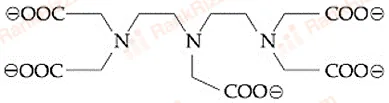
8 and 6
6 and 6
8 and 8
6 and 8
The correct statements among I to III are:
(I) Valence bond theory cannot explain the color exhibited by transition metal complexes.
(II) Valence bond theory can predict quantitatively the magnetic properties of transition metal complexes.
(III) Valence bond theory cannot distinguish ligands as weak and strong field ones.
(I) and (II) only
(II) and (III) only
(I) and (III) only
(I), (II) and (III)
Increasing order of reactivity of the following compounds for S1 substitution is:

B < C < D < A
B < A < D < C
A < B < D < C
B < C < A < D
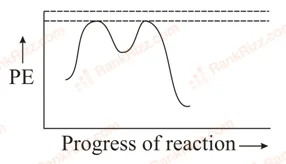
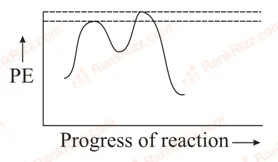
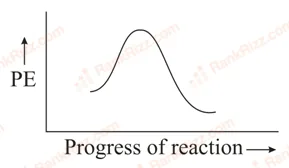
Which of the following potential energy (P.E.) diagrams represents the S1 reaction?
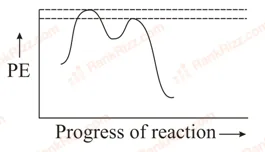
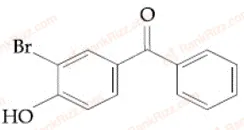
p-Hydroxybenzophenone upon reaction with bromine in carbon tetrachloride gives:
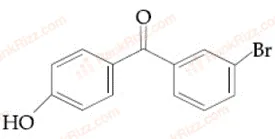
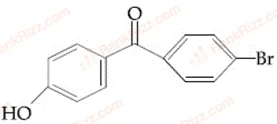
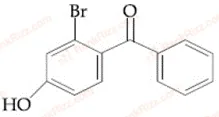
In the following reaction:
carbonyl compound + MeOH acetal
Rate of the reaction is the highest for:
Acetone as substrate and methanol in stoichiometric amount
Propanal as substrate and methanol in excess
Propanal as substrate and methanol in stoichiometric amount
Acetone as substrate and methanol in excess
The major product of the following reaction is:
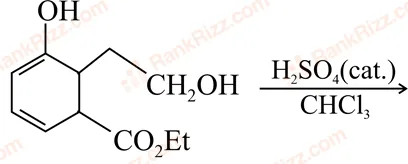
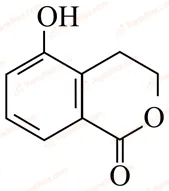
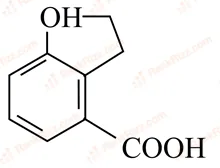
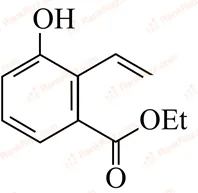
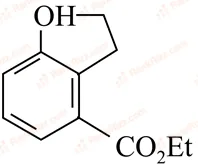
The major products A and B for the following reactions are, respectively:
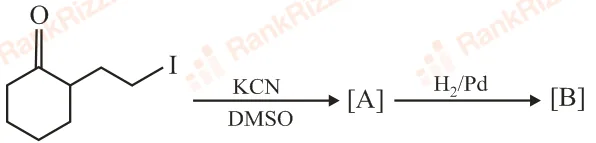
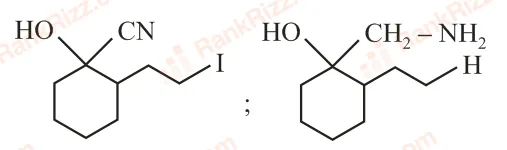
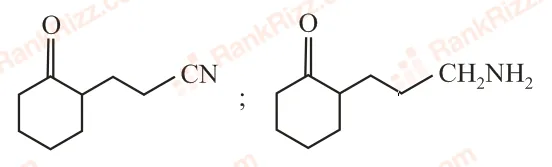
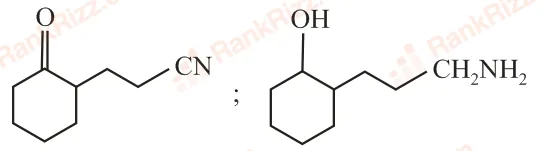
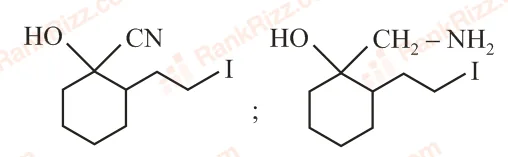
Hinsberg's reagent is:
CHSOCl
SOCl
(COCl)
CHCOCl
Which of the following compounds is a constituent of the polymer
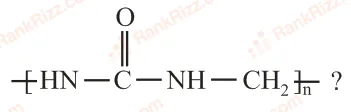
?
Methylamine
Ammonia
Formaldehyde
N-Methyl urea
Noradrenaline is a/an:
Antihistamine
Neurotransmitter
Antacid
Antidepressant
The peptide that gives positive ceric ammonium nitrate and carbylamine tests is:
Gln - Asp
Asp - Gln
Lys - Asp
Ser - Lys