RankRizz

JEE Main 12 Jan 2019, Shift 1: Chemistry

The 30 Chemistry questions of JEE Main 12 Jan 2019, Shift 1, numbered across the whole paper. Pick an answer on any question to check it against the key. Free to read, nothing to download.

Chemistry

Q31Electromagnetic radiation, Planck's quantum theory and photoelectric effectTRANSCRIBED

What is the work function of the metal if the light of wavelength 4000 A˚\mathring{A} generates photoelectrons of velocity 6×1056 \times 10^5 ms−1^{-1} from it? (Mass of electron =9×10−31= 9 \times 10^{-31} kg, velocity of light =3×108= 3 \times 10^8 ms−1^{-1}, Planck's constant =6.626×10−34= 6.626 \times 10^{-34} Js,1 eV=1.602×10⁻¹⁹ J1\ \text{eV} = 1.602 \times 10^{-19}\ \text{J})

  1. A

    0.9 eV

  2. B

    4.0 eV

  3. C

    3.1 eV

  4. D

    2.1 eV

Q32Modern periodic table and classification of elementsTRANSCRIBED

The element with Z = 120 (not yet discovered) will be a/an

  1. A

    transition metal

  2. B

    alkaline earth metal

  3. C

    alkali metal

  4. D

    inner-transition metal

Q33Classification, preparation and types of colloidsTRANSCRIBED

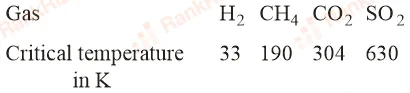
Given

Figure for JEE Main 2019 Chemistry question on Classification, preparation and types of colloids

On the basis of data given above, predict which of the following gases shows the least adsorption on a definite amount of charcoal?

  1. A

    CH4_4

  2. B

    CO2_2

  3. C

    SO2_2

  4. D

    H2_2

Q34Real gases, compressibility factor and van der Waals equationTRANSCRIBED

The volume of gas A is twice than that of gas B. The compressibility factor of gas A is thrice than that of gas B at same temperature. What are the pressures of the gases for equal number of moles?

  1. A

    2PA=3PB2P_A = 3P_B

  2. B

    PA=2PBP_A = 2P_B

  3. C

    3PA=2PB3P_A = 2P_B

  4. D

    PA=3PBP_A = 3P_B

Q35Heat capacity and calorimetryTRANSCRIBED

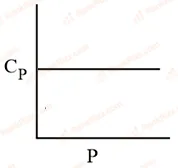
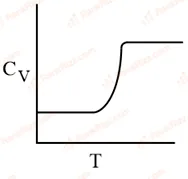
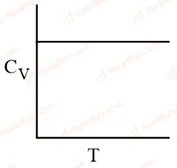
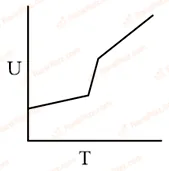
For a diatomic ideal gas in a closed system, which of the following plots does not correctly describe the relation between various thermodynamic quantities?

  1. A
    Figure for JEE Main 2019 Chemistry question on Heat capacity and calorimetry
  2. B
    Figure for JEE Main 2019 Chemistry question on Heat capacity and calorimetry
  3. C
    Figure for JEE Main 2019 Chemistry question on Heat capacity and calorimetry
  4. D
    Figure for JEE Main 2019 Chemistry question on Heat capacity and calorimetry
Q36Law of mass action and equilibrium constants Kc and KpTRANSCRIBED

In a chemical reaction, A+2B⇌K2C+DA + 2B \xrightleftharpoons{K} 2C + D, the initial concentration of B was 1.5 times the concentration of A, but the equilibrium concentrations of A and B were found to be equal. The equilibrium constant (K) for the chemical reaction is:

  1. A

    1

  2. B

    4

  3. C

    14\frac{1}{4}

  4. D

    16

Q37Law of mass action and equilibrium constants Kc and KpTRANSCRIBED

Two solids dissociate as follows: A(s)⇌B(g)+C(g)A(s) \rightleftharpoons B(g) + C(g); KP1=xK_{P_1} = x atm2^2, D(s)⇌C(g)+E(g)D(s) \rightleftharpoons C(g) + E(g); KP2=yK_{P_2} = y atm2^2. The total pressure when both the solids dissociate simultaneously is:

  1. A

    x+y\sqrt{x+y} atm

  2. B

    x2+y2x^2 + y^2 atm

  3. C

    (x + y) atm

  4. D

    2(x+y)2\left(\sqrt{x+y}\right) atm

Q38Equivalent weight, n-factor and law of equivalenceTRANSCRIBED

50 mL of 0.5 M oxalic acid is needed to neutralize 25 mL of sodium hydroxide solution. What is the amount of NaOH in 50 mL of the given sodium hydroxide solution?

  1. A

    2 g

  2. B

    4 g

  3. C

    1 g

  4. D

    8 g

Q39Equivalent weight, n-factor and law of equivalenceTRANSCRIBED

What is the hardness of a water sample (in terms of equivalents of CaCO3_3) containing 10−310^{-3} M CaSO4_4? (Molar mass of CaSO4_4 = 136 g mol−1^{-1})

  1. A

    90 ppm

  2. B

    50 ppm

  3. C

    10 ppm

  4. D

    100 ppm

Q40Compounds of alkali metalsTRANSCRIBED

A metal on combustion in excess air forms X. X upon hydrolysis with water yields H2O2H_2O_2 and O2O_2 along with another product. The metal is:

  1. A

    Na

  2. B

    Mg

  3. C

    Li

  4. D

    Rb

Q41AromaticityTRANSCRIBED

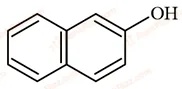
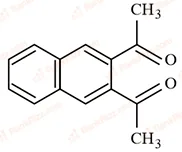
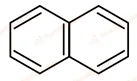
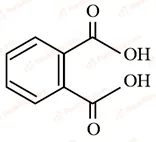
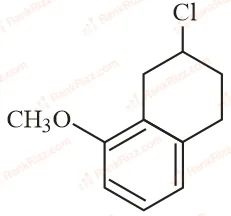
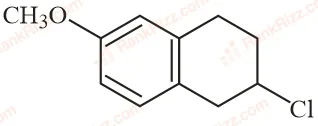
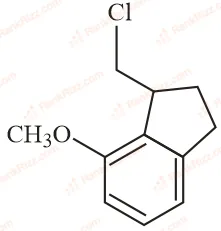
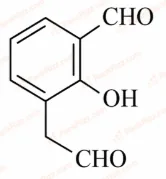
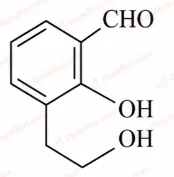
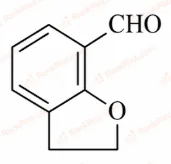
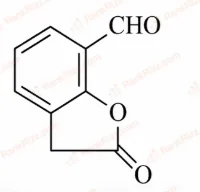
Among the following four aromatic compounds, which one will have the lowest melting point?

  1. A
    Figure for JEE Main 2019 Chemistry question on Aromaticity
  2. B
    Figure for JEE Main 2019 Chemistry question on Aromaticity
  3. C
    Figure for JEE Main 2019 Chemistry question on Aromaticity
  4. D
    Figure for JEE Main 2019 Chemistry question on Aromaticity
Q42Alkynes: preparation and acidityTRANSCRIBED

The correct order for acid strength of compounds CH≡CHCH \equiv CH, CH3−C≡CHCH_3 - C \equiv CH and CH2=CH2CH_2 = CH_2 is as follows:

  1. A

    CH3−C≡CH>CH≡CH>CH2=CH2CH_3 - C \equiv CH > CH \equiv CH > CH_2 = CH_2

  2. B

    HC≡CH>CH3−C≡CH>CH2=CH2HC \equiv CH > CH_3 - C \equiv CH > CH_2 = CH_2

  3. C

    CH≡CH>CH2=CH2>CH3−C≡CHCH \equiv CH > CH_2 = CH_2 > CH_3 - C \equiv CH

  4. D

    CH2−C≡CH>CH2=CH2>HC≡CHCH_2 - C \equiv CH > CH_2 = CH_2 > HC \equiv CH

Q43Electrophilic addition to alkenesTRANSCRIBED

The major product of the following reaction is:

Figure for JEE Main 2019 Chemistry question on Electrophilic addition to alkenes
  1. A
    Figure for JEE Main 2019 Chemistry question on Electrophilic addition to alkenes
  2. B
    Figure for JEE Main 2019 Chemistry question on Electrophilic addition to alkenes
  3. C
    Figure for JEE Main 2019 Chemistry question on Electrophilic addition to alkenes
  4. D
    Figure for JEE Main 2019 Chemistry question on Electrophilic addition to alkenes
Q44Water pollutionTRANSCRIBED

Water samples with BOD values of 4 ppm and 18 ppm, respectively, are:

  1. A

    Highly polluted and Highly polluted

  2. B

    Clean and Clean

  3. C

    Highly polluted and Clean

  4. D

    Clean and Highly polluted

Q45Stratospheric pollution and ozone depletionTRANSCRIBED

The molecule that has minimum or no role in the formation of photochemical smog, is:

  1. A

    N2N_2

  2. B

    O3O_3

  3. C

    H2C=OH_2C = O

  4. D

    NO

Q46Depression in freezing pointTRANSCRIBED

The freezing point of a 4% aqueous solution of X is equal to the freezing point of a 12% aqueous solution of Y. If the molecular weight of X is A, then the molecular weight of Y will be

  1. A

    2A

  2. B

    A

  3. C

    4A

  4. D

    3A

Q47Electrode potentials, electrochemical series and cell EMFTRANSCRIBED

The standard electrode potential E° and its temperature coefficient (dEdT)\left(\frac{dE}{dT}\right) for a cell are 2 V and −5×10⁻⁴-5 \times 10^{-4} V K−1^{-1} at 300 K, respectively. The reaction is Zn(s) + Cu2+^{2+}(aq) →\to Zn2+^{2+}(aq) + Cu(s). The standard reaction enthalpy (ΔrH−)(\Delta_r H^-) at 300 K in mol−1^{-1} is [Use R = 8 J K−1^{-1} mol−1^{-1} and F = 96,500 C mol−1^{-1}]

  1. A

    −412.8-412.8

  2. B

    206.4

  3. C

    −384.0-384.0

  4. D

    192.0

Q48Integrated rate laws and half-life (zero and first order)TRANSCRIBED

Decomposition of X exhibits a rate constant of 0.05 μ\mug/year. How many years are required for the decomposition of 5 μ\mug of X into 2.5 μ\mug?

  1. A

    20

  2. B

    40

  3. C

    25

  4. D

    50

Q49Extraction of Fe, Cu, Zn, Al, Ag and AuTRANSCRIBED

In the Hall-Heroult process, aluminium is formed at the cathode. The cathode is made out of:

  1. A

    Platinum

  2. B

    Carbon

  3. C

    Copper

  4. D

    Pure aluminium

Q50Group 17: halogens and hydrogen halidesTRANSCRIBED

Iodine reacts with concentrated HNO3HNO_3 to yield Y along with other products. The oxidation state of iodine in Y, is:

  1. A

    1

  2. B

    5

  3. C

    3

  4. D

    7

Q51Colour and magnetic behaviour of complexes from CFTTRANSCRIBED

The pair of metal ions that can give a spin only magnetic moment of 3.9 BM for the complex [M(H2O)6]Cl2[M(H_2O)_6]Cl_2, is:

  1. A

    Co2+Co^{2+} and Fe2+Fe^{2+}

  2. B

    V2+V^{2+} and Fe2+Fe^{2+}

  3. C

    Cr2+Cr^{2+} and Mn2+Mn^{2+}

  4. D

    V2+V^{2+} and Co2+Co^{2+}

Q52Valence bond theory of complexesTRANSCRIBED

The metal's d-orbitals that are directly facing the ligands in K3[Co(CN)6]K_3[Co(CN)_6] are:

  1. A

    dxy,dxzd_{xy}, d_{xz} and dyzd_{yz}

  2. B

    dx2−y2d_{x^2-y^2} and dz2d_{z^2}

  3. C

    dxyd_{xy} and dx2−y2d_{x^2-y^2}

  4. D

    dz2,dyzd_{z^2}, d_{yz} and dxzd_{xz}

Q53Stability and applications of coordination compoundsTRANSCRIBED

Mn2(CO)10Mn_2(CO)_{10} is an organometallic compound due to the presence of:

  1. A

    Mn - O bond

  2. B

    Mn - Mn bond

  3. C

    C - O bond

  4. D

    Mn - C bond

Q54Preparation of alcoholsTRANSCRIBED
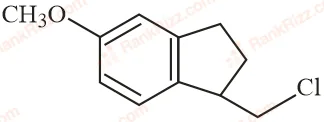
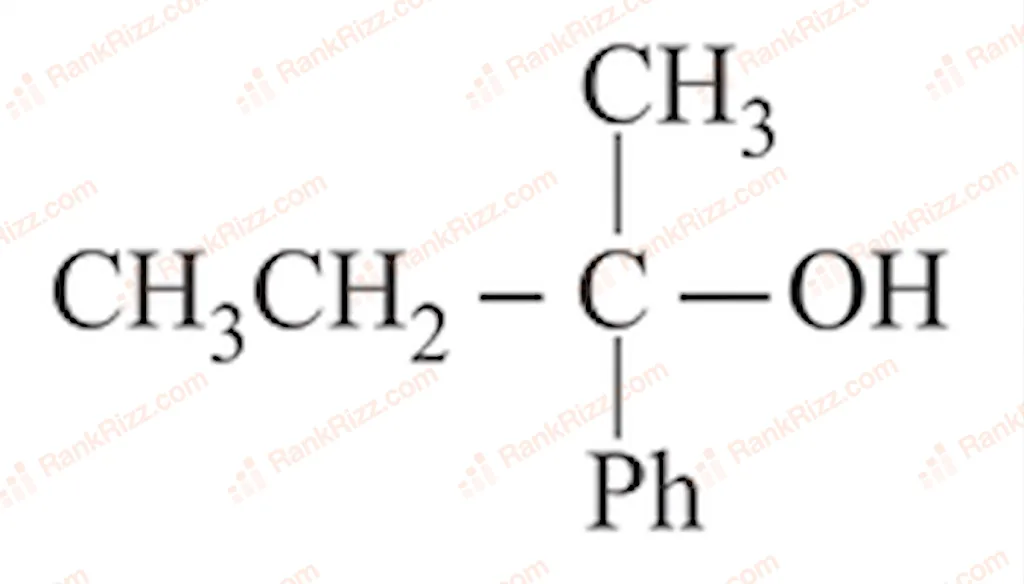
Figure for JEE Main 2019 Chemistry question on Preparation of alcohols

cannot be prepared by:

  1. A

    HCHO+PhCH(CH3)CH2MgXHCHO + PhCH(CH_3)CH_2MgX

  2. B

    PhCOCH2CH3+CH3MgXPhCOCH_2CH_3 + CH_3MgX

  3. C

    CH3CH2COCH3+PhMgXCH_3CH_2COCH_3 + PhMgX

  4. D

    PhCOCH3+CH3CH2MgXPhCOCH_3 + CH_3CH_2MgX

Q55Nucleophilic addition reactions of carbonyl compoundsTRANSCRIBED

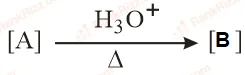
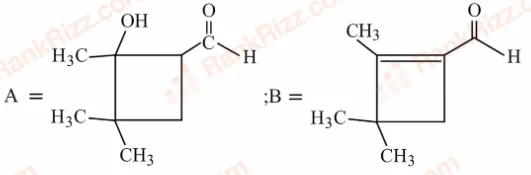
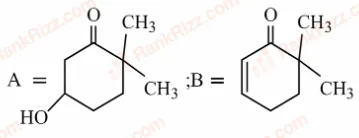
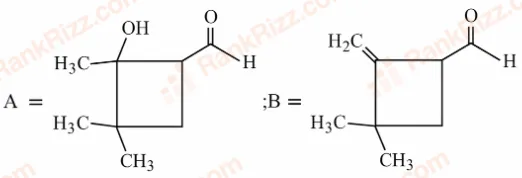
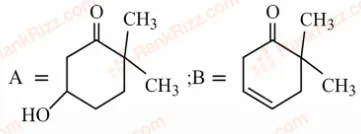
In the following reactions, products A and B are:

Figure for JEE Main 2019 Chemistry question on Nucleophilic addition reactions of carbonyl compounds Figure for JEE Main 2019 Chemistry question on Nucleophilic addition reactions of carbonyl compounds
  1. A
    Figure for JEE Main 2019 Chemistry question on Nucleophilic addition reactions of carbonyl compounds
  2. B
    Figure for JEE Main 2019 Chemistry question on Nucleophilic addition reactions of carbonyl compounds
  3. C
    Figure for JEE Main 2019 Chemistry question on Nucleophilic addition reactions of carbonyl compounds
  4. D
    Figure for JEE Main 2019 Chemistry question on Nucleophilic addition reactions of carbonyl compounds
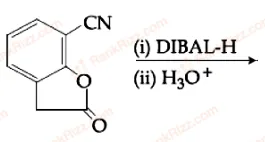
Q56Preparation of aldehydes and ketonesTRANSCRIBED

The major product of the following reaction is:

Figure for JEE Main 2019 Chemistry question on Preparation of aldehydes and ketones
  1. A
    Figure for JEE Main 2019 Chemistry question on Preparation of aldehydes and ketones
  2. B
    Figure for JEE Main 2019 Chemistry question on Preparation of aldehydes and ketones
  3. C
    Figure for JEE Main 2019 Chemistry question on Preparation of aldehydes and ketones
  4. D
    Figure for JEE Main 2019 Chemistry question on Preparation of aldehydes and ketones
Q57Nucleophilic addition reactions of carbonyl compoundsTRANSCRIBED

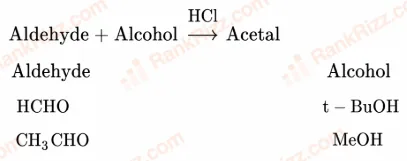
In the following reaction:

Figure for JEE Main 2019 Chemistry question on Nucleophilic addition reactions of carbonyl compounds

The best combination is:

  1. A

    HCHO and MeOH

  2. B

    CH3CH_3 CHO and t-BuOH

  3. C

    CH3CH_3 CHO and MeOH

  4. D

    HCHO and t-BuOH

Q58Electrophilic substitution of anilineTRANSCRIBED

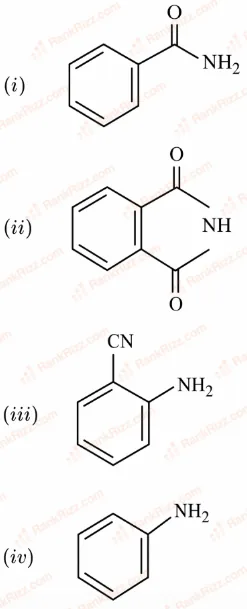
The increasing order of reactivity of the following compounds towards reaction with alkyl halides directly is:

Figure for JEE Main 2019 Chemistry question on Electrophilic substitution of aniline
  1. A

    (i) < (ii) < (iii) < (iv)

  2. B

    (ii) < (i) < (iii) < (iv)

  3. C

    (ii) < (i) < (iv) < (iii)

  4. D

    (i) < (iii) < (iv) < (ii)

Q59Important polymers and their monomersTRANSCRIBED

Poly-β\beta-hydroxybutyrate-co-β\beta-hydroxyvalerate (PHBV) is a copolymer of ____.

  1. A

    3-hydroxybutanoic acid and 4-hydroxypentanoic acid

  2. B

    3-hydroxybutanoic acid and 2-hydroxypentanoic acid

  3. C

    3-hydroxybutanoic acid and 3-hydroxypentanoic acid

  4. D

    2-hydroxybutanoic acid and 3-hydroxypentanoic acid

Q60Proteins and enzymesTRANSCRIBED

Among the following compounds most basic amino acid is:

  1. A

    Lysine

  2. B

    Asparagine

  3. C

    Serine

  4. D

    Histidine

NEXT IN THIS PAPER →Maths, Q61 onwards