JEE Main 2019 Chemistry question — Valence bond theory of complexes
The metal's d-orbitals that are directly facing the ligands in are:
SOLUTION
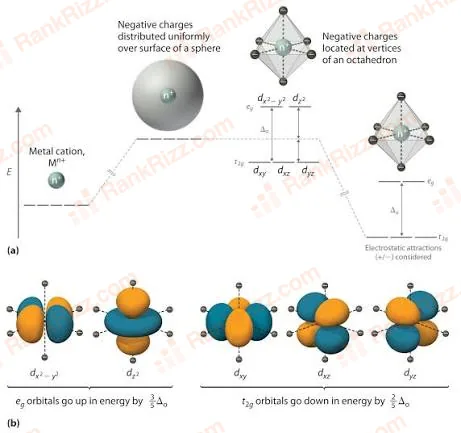
We start by identifying the geometry of the coordination entity that is present in the salt . With six monodentate ligands (the cyanide ions) around a single metal centre, the well-known VSEPR and crystal-field considerations tell us that such a species adopts an octahedral shape. In an octahedral arrangement every ligand comes in along one of the positive or negative coordinate axes, that is, along and directions.
Now we recall the basic crystal-field splitting picture for an octahedral field. First we state the result:
In an octahedral crystal field the five metal orbitals split into two sets:
The physical reason for this splitting can be described as follows. The incoming ligand electron pairs create regions of negative charge directly along the coordinate axes. Therefore any metal orbital that points its electron density right along those axes will experience a larger electrostatic repulsion and will be raised to a higher energy. Conversely, an orbital that points between the axes will experience a smaller repulsion and stay at lower energy.
Next we examine the orientation of each orbital. We write them explicitly to see their lobes:
- has four lobes that lie exactly along the and axes.
- has two major lobes along the axis and a torus in the plane, so its electron density also lies largely on an axis direction.
- each have four lobes situated between the axes; no lobe points straight at any ligand in an octahedral field.
Because in the ligands sit on the coordinate axes, the orbitals whose lobes coincide with those axes are said to be “directly facing” the ligands, receiving the strongest repulsion and hence belonging to the higher-energy set. As just established, those orbitals are and .
Therefore the pair of metal orbitals that directly face the cyanide ligands in are and .
Hence, the correct answer is Option B.
Tagged Valence bond theory of complexes. Machine-assigned, so read it as a strong shortlist rather than a verdict.