Q31Mole concept, atomic and molar massTRANSCRIBED
25 g of an unknown hydrocarbon upon burning produces 88 g of CO2 and 9 g of H2O. This unknown hydrocarbon contains:
- A
24 g of carbon and 1 g of hydrogen
- B
18 g of carbon and 7 g of hydrogen
- C
22 g of carbon and 3 g of hydrogen
- D
20 g carbon and 5 g of hydrogen
Q32Electronegativity, effective nuclear charge and shieldingTRANSCRIBED
Among the following, the energy of 2s orbital is lowest in:
- A
- B
- C
- D
Q33Ionisation enthalpyTRANSCRIBED
In comparison to boron, beryllium has:
- A
greater nuclear charge and lesser first ionisation enthalpy
- B
lesser nuclear charge and greater first ionisation enthalpy
- C
lesser nuclear charge and lesser first ionisation enthalpy.
- D
greater nuclear charge and greater first ionisation enthalpy.
Q34Reaction quotient, degree of dissociation and equilibrium calculationsTRANSCRIBED
The incorrect match in the following is:
- A
ΔG0<0,K>1
- B
ΔG0>0,K<1
- C
ΔG0=0,K=1
- D
ΔG0<0,K<1
Q35Law of mass action and equilibrium constants Kc and KpTRANSCRIBED
In which one of the following equilibria, Kp ≠ Kc?
- A
2HI(g) ⇌ H2(g) + I2(g)
- B
2C(s) + O2(g) ⇌ 2CO(g)
- C
2NO(g) ⇌ N2(g) + O2(g)
- D
NO2(g) + SO2(g) ⇌ NO(g) + SO3(g)
Q36Solubility product and common ion effectTRANSCRIBED
The molar solubility of Cd(OH)2 is 1.84×10⁻⁵ M in water. The expected solubility of Cd(OH)2 in a buffer solution of pH = 12 is:
- A
2.49×10⁻¹⁰ M
- B
1.842.49×10−9 M
- C
1.84×10⁻⁹ M
- D
6.23×10⁻¹¹ M
Q37Hardness of water and its removalTRANSCRIBED
The temporary hardness of a water sample is due to compound X. Boiling this sample converts X to compound Y. X and Y, respectively, are:
- A
Mg(HCO3)2 and MgCO3
- B
Ca(HCO3)2 and Ca(OH)2
- C
Mg(HCO3)2 and Mg(OH)2
- D
Ca(HCO3)2 and CaO
Q38Alkali metals: properties and trendsTRANSCRIBED
The incorrect statement is:
- A
LiNO3 decomposes on heating to give LiNO2 and O2.
- B
LiCl crystallises from aqueous solution as LiCl - 2H2O.
- C
Lithium is the strongest reducing agent among the alkali metals.
- D
Lithium is least reactive with water among the alkali metals.
Q39Group 14: trends and carbon allotropesTRANSCRIBED
The C - C bond length is maximum in:
- A
- B
- C
- D
Q40IUPAC nomenclature of organic compoundsTRANSCRIBED
The IUPAC name for the following compound is:
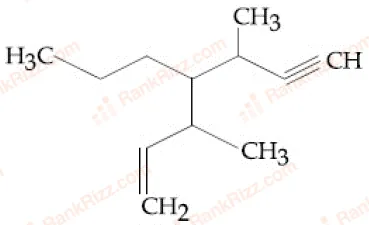
- A
3-methyl-4-(1-methylprop-2-ynyl)-1-heptene
- B
3, 5-dimethyl-4-propylhept-6-en-1-yne
- C
3, 5-dimethyl-4-propyl hept-1-en-6-yne
- D
3-methyl-4-(3-methylprop-1-enhyl)-1-heptyne
Q41Nucleophilic substitution (SN1 and SN2)TRANSCRIBED
Which one of the following is likely to give a precipitate with AgNO3 solution?
- A
- B
- C
- D
Q42Structural isomerismTRANSCRIBED
In the following skew conformation of ethane, H' - C - C - H'' dihedral angle is:
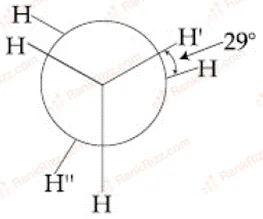
- A
- B
- C
- D
Q43Nucleophilic substitution (SN1 and SN2)TRANSCRIBED
Heating of 2-chloro-1-phenylbutane with EtOK/EtOH gives X as the major product. Reaction X with Hg(OAc)2/H2O followed by NaBH4 gives Y as the major product. Y is:
- A
- B
- C
- D
Q44Stratospheric pollution and ozone depletionTRANSCRIBED
The primary pollutant that leads to photochemical smog is:
- A
- B
- C
- D
Q45Crystal lattices, unit cells and densityTRANSCRIBED
The ratio of number of atoms present in a simple cubic, body centered cubic and face centered cubic structure are, respectively:
- A
- B
- C
- D
Q46Osmosis and osmotic pressureTRANSCRIBED
A solution is prepared by dissolving 0.6 g of urea (molar mass = 60 g mol−1) and 1.8 g of glucose (molar mass = 180 g mol−1) in 100 mL of water at 27°C. The osmotic pressure of the solution is:
(R = 0.08206 L atm K−1 mol−1)
- A
- B
- C
- D
Q47Conductance, conductivity and molar conductivityTRANSCRIBED
The decreasing order of electrical conductivity of the following aqueous solutions is:
(A) 0.1 M Formic acid,
(B) 0.1 M Acetic acid,
(C) 0.1 M Benzoic acid.
- A
- B
- C
- D
Q48Rate law, order and molecularityTRANSCRIBED
NO2 required for a reaction is produced by the decomposition of N2O5 in CCl4 as per the equation, 2N2O5(g) → 4NO2(g) + O2(g). The initial concentration of N2O5 is 3.00 mol L−1 and it is 2.75 mol L−1 after 30 minutes. The rate of formation of NO2 is:
- A
1.667×10⁻² mol L−1 min−1
- B
8.333×10⁻³ mol L−1 min−1
- C
4.167×10⁻³ mol L−1 min−1
- D
2.083×10⁻³ mol L−1 min−1
Q49Properties of colloids and coagulationTRANSCRIBED
Among the following, the incorrect statement about colloids is:
- A
They are larger than small molecules and have high molar mass.
- B
- C
The osmotic pressure of a colloidal solution is of higher order than the true solution at the same concentration.
- D
The range of diameters of colloidal particles is between 1 and 1000 nm.
Q50Extraction of Fe, Cu, Zn, Al, Ag and AuTRANSCRIBED
The correct statement is:
- A
Pig iron is obtained from cast iron.
- B
The Hall-Heroult process is used for the production of aluminium and iron.
- C
leaching of bauxite using concentrated NaOH solution gives sodium aluminate and sodium silicate.
- D
the blistered appearance of copper during metallurgical process is due to the evolution of CO2.
Q51General properties of transition elementsTRANSCRIBED
The pair that has similar atomic radii is:
- A
- B
- C
- D
Q52Other important compounds of transition metalsTRANSCRIBED
Thermal decomposition of a Mn compound (X) at 513 K results in compound Y, MnO2 and a gaseous product. MnO2 reacts with NaCl and concentrated H2SO4 to give a pungent gas Z. X, Y and Z, respectively, are:
- A
K3MnO4, K3MnO4 and Cl2
- B
K2MnO4, KMnO4 and Cl2
- C
K2MnO4, KMnO4 and SO2
- D
KMnO4, K2MnO4 and Cl2
Q53Werner's theory and coordination terminologyTRANSCRIBED
The coordination numbers of Co and Al in [Co(Cl)(en)2]Cl and K3[Al(C2O4)3], respectively are:
(en = ethane-1, 2-diamine)
- A
- B
- C
- D
Q54Stability and applications of coordination compoundsTRANSCRIBED
The compound used in the treatment of lead poisoning is:
- A
- B
- C
- D
Q55Nucleophilic substitution (SN1 and SN2)TRANSCRIBED
An 'Assertion' and a 'Reason' is given below. Choose the correct answer from the following options:
Assertion (A): Vinyl halides do not undergo nucleophilic substitution easily.
Reason (R): Even though the intermediate carbocation is stabilized by loosely held π-electrons, the cleavage is difficult because of the strong bonding.
- A
Both (A) and (R) are correct statements but (R) is not the correct explanation of (A).
- B
Both (A) and (R) are wrong statements.
- C
Both (A) and (R) are wrong statements and (R) is the correct explanation of (A).
- D
(A) is a correct statement but (R) is a wrong statement.
Q56Alkynes: preparation and acidityTRANSCRIBED
Consider the following reactions:
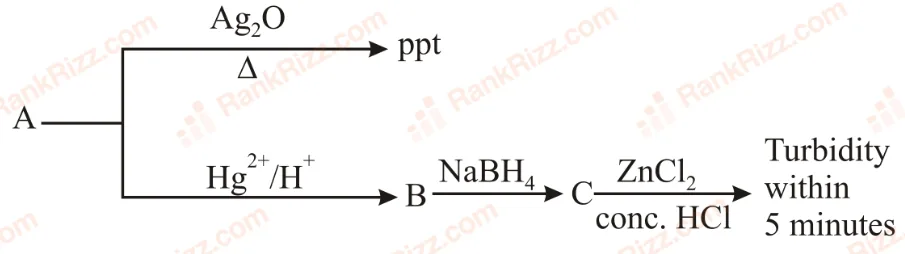
'A' is:
- A
- B
- C
CH3 - C ≡ C - CH3
- D
Q57Reactions of phenolsTRANSCRIBED
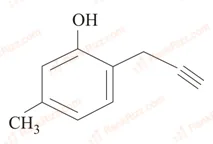
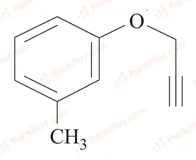
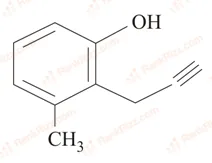
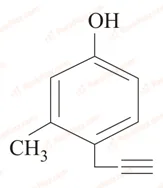
What will be the major product when m-cresol is reacted with propargyl bromide (HC ≡ C - CH2Br) in presence of K2CO3 in acetone?
- A
- B
- C
- D
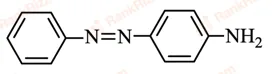
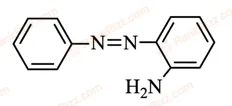
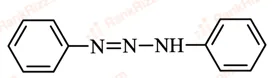
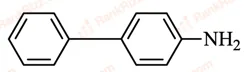
Q58Diazonium saltsTRANSCRIBED
Benzene diazonium chloride on reaction with aniline in the presence of dilute hydrochloric acid gives:
- A
- B
- C
- D
Q59Important polymers and their monomersTRANSCRIBED
The correct name of the following polymer is:
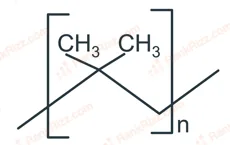
- A
- B
- C
- D
Q60Carbohydrates: classification and monosaccharidesTRANSCRIBED
Which of the given statements is incorrect about glycogen?
- A
It is present in animal cells.
- B
It is a straight chain polymer similar to amylose.
- C
It is present in some yeast and fungi
- D
Only α-linkages are present in the molecule.