JEE Main 2019 Chemistry question — Reactions of phenols
What will be the major product when m-cresol is reacted with propargyl bromide (HC ≡ C - CHBr) in presence of KCO in acetone?
SOLUTION
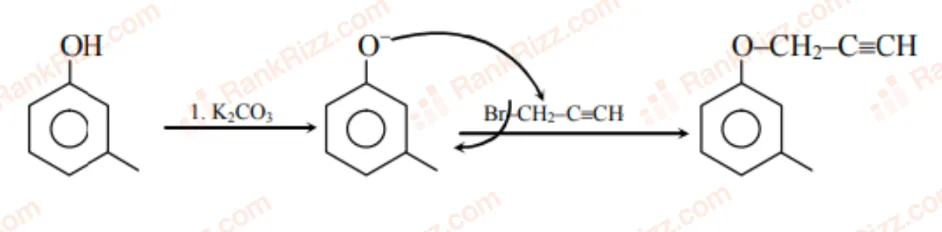
Williamson Ether Synthesis
This reaction follows the mechanism of a classic Williamson Ether Synthesis, which proceeds via an nucleophilic substitution pathway:
- Deprotonation: Potassium carbonate () acts as a mild base. It selectively removes the acidic phenolic proton () from m-cresol to generate a highly nucleophilic m-cresolate (phenoxide) anion.
- Nucleophilic Attack: The phenoxide oxygen atom attacks the electrophilic carbon attached to the bromine atom in propargyl bromide ().
- Leaving Group Departure: The bromide ion () leaves simultaneously, forming a new carbon-oxygen () ether linkage.
Detailed Evaluation of Each Option:
-
Option A: Electrophilic Ring Substitution Products
This statement is incorrect. Under these conditions, the base deprotonates the oxygen atom, making it the most nucleophilic site. Ring alkylation (Friedel-Crafts style) does not compete with the rapid displacement on oxygen.
-
Option B (Correct Matrix): Propargyl m-Tolyl Ether
This statement is correct. The nucleophilic phenoxide ion directly bonds with the propargyl group (), giving an ether product where the intact m-cresol ring skeleton is preserved with a newly appended propargyloxy side chain: .
-
Option C & D: Elimination or Alkyne Addition Products
These statements are incorrect. Mild bases like in acetone do not cause elimination reactions on terminal propargyl halides, nor is there any active reagent or catalyst present to add across the triple bond ().
Conclusion:
The reaction cleanly transforms the phenolic group into an ether linkage through an substitution without altering the aromatic ring or the terminal alkyne structure.
Answer: Option B — Propargyl m-tolyl ether
Tagged Reactions of phenols. Machine-assigned, so read it as a strong shortlist rather than a verdict.