RankRizz

JEE Advanced 2026 Paper 1: Chemistry

The 16 Chemistry questions of JEE Advanced 2026 Paper 1, numbered across the whole paper. Pick an answer on any question to check it against the key. Free to read, nothing to download.

Chemistry

Q17First law: work, heat and internal energyTRANSCRIBED

An ideal gas (0.5 mol)(0.5\ \mathrm{mol}), initially at 22 bar pressure, is compressed at a constant temperature of 600 K600\ \mathrm{K} in two steps: first, against a constant external pressure of PP bar (2<P<8)(2 \lt P \lt 8), and then against constant external pressure of 88 bar. At each step, the compression is stopped only when the pressure of the gas becomes equal to the external pressure. The total work done on the gas in these steps is WW. Considering all possible values of PP (2<P<8)(2 \lt P \lt 8) and taking the gas constant as RR (in J K−1 mol−1\mathrm{J\ K^{-1}\ mol^{-1}}), the minimum value of ∣W∣|W| (in J\mathrm{J}) is

  1. A

    207R207R

  2. B

    600R600R

  3. C

    630R630R

  4. D

    900R900R

Q18Integrated rate laws and half-life (zero and first order)TRANSCRIBED

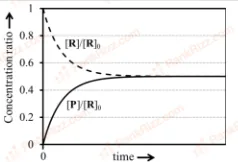
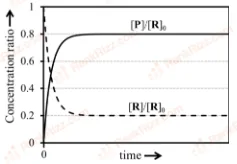
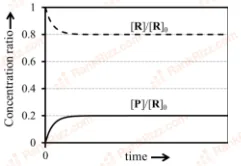
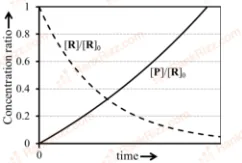
For a reversible reaction R⇌P\mathbf{R}\rightleftharpoons\mathbf{P}, at constant temperature, both the forward and the backward reactions are first order elementary reactions with rate constants kfk_f and kbk_b, respectively. At time zero, the concentration of R\mathbf{R} is [R]0[\mathbf{R}]_0 and the concentration of P\mathbf{P} is zero. At any given time, [R][\mathbf{R}] and [P][\mathbf{P}] are the concentrations of R\mathbf{R} and P\mathbf{P}, respectively. If kb=4kfk_b=4k_f, the correct graphical representation of the reaction is

  1. A
    Figure for JEE Advanced 2026 Chemistry question on Integrated rate laws and half-life (zero and first order)
  2. B
    Figure for JEE Advanced 2026 Chemistry question on Integrated rate laws and half-life (zero and first order)
  3. C
    Figure for JEE Advanced 2026 Chemistry question on Integrated rate laws and half-life (zero and first order)
  4. D
    Figure for JEE Advanced 2026 Chemistry question on Integrated rate laws and half-life (zero and first order)
Q19Dipole moment and molecular polarityTRANSCRIBED

The correct order of dipole moments for the given species is

  1. A

    BF3=NH4+<NF3<NH3BF_3=NH_4^{+}\lt NF_3\lt NH_3

  2. B

    BF3<NH4+<NF3<NH3BF_3\lt NH_4^{+}\lt NF_3\lt NH_3

  3. C

    NH4+<BF3<NH3<NF3NH_4^{+}\lt BF_3\lt NH_3\lt NF_3

  4. D

    BF3<NH4+<NH3<NF3BF_3\lt NH_4^{+}\lt NH_3\lt NF_3

Q20Acidity of carboxylic acidsTRANSCRIBED

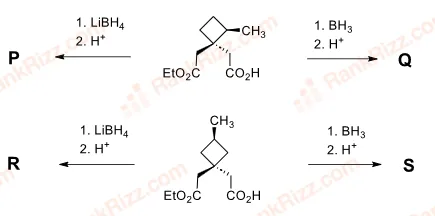
Considering LiBH4LiBH_4 reduces an ester group to the corresponding alcohol and does not reduce a carboxylic acid group, the correct statement about the major products P\mathbf{P}, Q\mathbf{Q}, R\mathbf{R} and S\mathbf{S} is

Figure for JEE Advanced 2026 Chemistry question on Acidity of carboxylic acids
  1. A

    P\mathbf{P} & Q\mathbf{Q} are identical, and R\mathbf{R} & S\mathbf{S} are diastereomers.

  2. B

    P\mathbf{P} & Q\mathbf{Q} are diastereomers, and R\mathbf{R} & S\mathbf{S} are identical.

  3. C

    P\mathbf{P} & Q\mathbf{Q} are diastereomers, and R\mathbf{R} & S\mathbf{S} are diastereomers.

  4. D

    P\mathbf{P} & Q\mathbf{Q} are identical, and R\mathbf{R} & S\mathbf{S} are identical.

Q21Quantum numbers and shapes of orbitalsTRANSCRIBED

The 2s2s and the 2p2p orbital energies of hydrogen atom are E2s(H)E_{2s}(\mathrm{H}) and E2p(H)E_{2p}(\mathrm{H}), respectively. The 2s2s and the 2p2p orbital energies of lithium atom are E2s(Li)E_{2s}(\mathrm{Li}) and E2p(Li)E_{2p}(\mathrm{Li}), respectively. The correct option(s) about the orbital energies is(are)

  1. A

    E2s(Li)<E2p(Li)E_{2s}(\mathrm{Li})\lt E_{2p}(\mathrm{Li})

  2. B

    E2s(H)=E2p(H)E_{2s}(\mathrm{H})=E_{2p}(\mathrm{H})

  3. C

    E2p(H)<E2s(Li)E_{2p}(\mathrm{H})\lt E_{2s}(\mathrm{Li})

  4. D

    E2s(H)>E2s(Li)E_{2s}(\mathrm{H})\gt E_{2s}(\mathrm{Li})

Q22Group 17: halogens and hydrogen halidesTRANSCRIBED

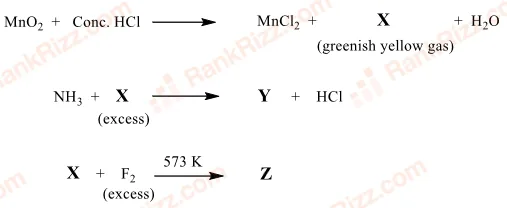
Correct statement(s) about the compounds X\mathbf{X}, Y\mathbf{Y} and Z\mathbf{Z} is(are)

Figure for JEE Advanced 2026 Chemistry question on Group 17: halogens and hydrogen halides
  1. A

    X\mathbf{X} is used for sterilizing drinking water.

  2. B

    Y\mathbf{Y} has a planar structure.

  3. C

    Z\mathbf{Z} is used in the enrichment of 235U^{235}\mathrm{U}.

  4. D

    Y\mathbf{Y} is a stronger Lewis base than ammonia.

Q23Oxidising/reducing agents and types of redox reactionsTRANSCRIBED

Reaction of PtF6PtF_6 with oxygen (O2)(O_2) gas results in the formation of an ionic compound, X+Y−\mathbf{X^{+}Y^{-}}. Correct statement(s) is(are)

  1. A

    The bond order of X+\mathbf{X^{+}} is 1.51.5.

  2. B

    Valence dd-orbitals of the metal ion in X+Y−\mathbf{X^{+}Y^{-}} has 55 electrons.

  3. C

    PtF6PtF_6 acts as an oxidant in this reaction.

  4. D

    PtF6PtF_6 acts as a fluorinating agent in this reaction.

Q24Nucleophilic addition reactions of carbonyl compoundsTRANSCRIBED

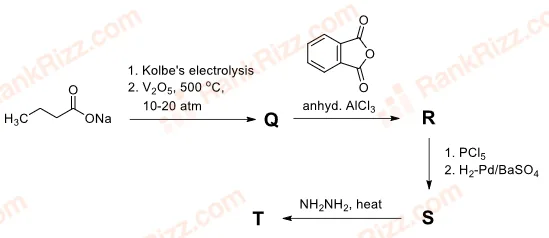
In the following reaction sequence, Q\mathbf{Q}, R\mathbf{R}, S\mathbf{S} and T\mathbf{T} are the major products.

Figure for JEE Advanced 2026 Chemistry question on Nucleophilic addition reactions of carbonyl compounds

The correct statement(s) about Q\mathbf{Q}, R\mathbf{R}, S\mathbf{S} and T\mathbf{T} is(are)

  1. A

    S\mathbf{S} on warming with ammoniacal AgNO3AgNO_3 results in the formation of silver mirror.

  2. B

    Q\mathbf{Q} on treatment with Cl2Cl_2 (excess)/UV gives gammaxane.

  3. C

    T\mathbf{T} is a heterocyclic compound.

  4. D

    R\mathbf{R} on acid catalyzed intramolecular cyclization followed by treatment with Zn-Hg/HClZn\text{-}Hg/HCl gives 9,109,10-dihydroxyanthracene.

Q25Gas laws and ideal gas equationTRANSCRIBED

Two cylinders, both fitted with frictionless pistons, are filled with mixtures of He\mathrm{He} and Ar\mathrm{Ar} gases. In the first cylinder, the masses of He\mathrm{He} and Ar\mathrm{Ar} are m1m_1 and m2m_2, respectively. In the second cylinder, the masses of He\mathrm{He} and Ar\mathrm{Ar} are m2m_2 and m1m_1, respectively. The molar mass of Ar\mathrm{Ar} is 1010 times the molar mass of He\mathrm{He}. The external pressure applied by the piston on the first cylinder needs to be 55 times that on the second cylinder so that the volume of the gas mixtures in both the cylinders are equal at the same temperature. Assuming He\mathrm{He} and Ar\mathrm{Ar} behave like ideal gases, the value of (m1/m2)(m_1/m_2) is ___.

Q26Geometrical and optical isomerism in complexesTRANSCRIBED

The total number of all possible isomers for the square planar complex with formula K[M(NCS)(NO2)(gly)]K[M(NCS)(NO_2)(gly)] is ___.

(M = metal ion and gly = NH2CH2COO−NH_2CH_2COO^{-})

Q27Acid derivatives: esters, amides, anhydrides and acid chloridesTRANSCRIBED

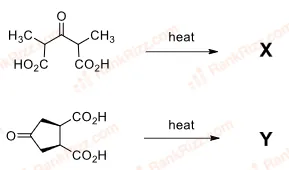
The sum of total number of carbonyl groups (>C=O)(>C=O) present in the major products X\mathbf{X} and Y\mathbf{Y} in the following reactions is ___.

Figure for JEE Advanced 2026 Chemistry question on Acid derivatives: esters, amides, anhydrides and acid chlorides
Q28Reactions of alkynesTRANSCRIBED

Treatment of buta-1,31,3-diyne with NaNH2NaNH_2 (22 equivalents), followed by reaction with excess of trans-CH3-CH ⁣= ⁣CH-CH2-BrCH_3\text{-}CH\!=\!CH\text{-}CH_2\text{-}Br gives X\mathbf{X} as the major product. The maximum number of carbon atoms that are collinear (in a straight line) in X\mathbf{X} is ___.

Q29Gibbs energy and spontaneityTRANSCRIBED

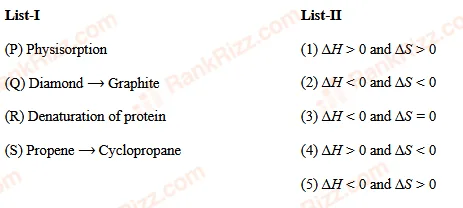
List-I contains various physical/chemical processes, and List-II contains combinations of changes in enthalpy (ΔH)(\Delta H) and entropy (ΔS)(\Delta S). Match each entry in List-I to the appropriate entry in List-II, and choose the correct option.

Figure for JEE Advanced 2026 Chemistry question on Gibbs energy and spontaneity
  1. A

    (P)→\to(2), (Q)→\to(3), (R)→\to(5), (S)→\to(4)

  2. B

    (P)→\to(4), (Q)→\to(3), (R)→\to(5), (S)→\to(1)

  3. C

    (P)→\to(2), (Q)→\to(5), (R)→\to(1), (S)→\to(4)

  4. D

    (P)→\to(2), (Q)→\to(5), (R)→\to(1), (S)→\to(3)

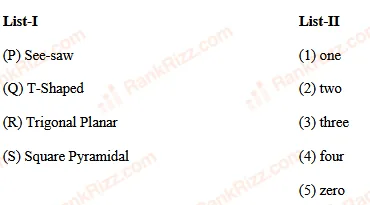
Q30VSEPR theory and shapes of molecules and ionsTRANSCRIBED

Consider the following species:

SOCl2SOCl_2, XeOF4XeOF_4, ClF3ClF_3, ClF5ClF_5, XeF5+XeF_5^{+}, SO32−SO_3^{2-}, XeF3+XeF_3^{+}, SF4SF_4

List-I contains different molecular shapes and List-II contains total number of species with the same molecular shapes from the given species. Match each entry in List-I with the appropriate entry in List-II and choose the correct option.

Figure for JEE Advanced 2026 Chemistry question on VSEPR theory and shapes of molecules and ions
  1. A

    (P)→\to(1), (Q)→\to(2), (R)→\to(5), (S)→\to(3)

  2. B

    (P)→\to(5), (Q)→\to(4), (R)→\to(2), (S)→\to(3)

  3. C

    (P)→\to(3), (Q)→\to(2), (R)→\to(1), (S)→\to(4)

  4. D

    (P)→\to(1), (Q)→\to(3), (R)→\to(5), (S)→\to(4)

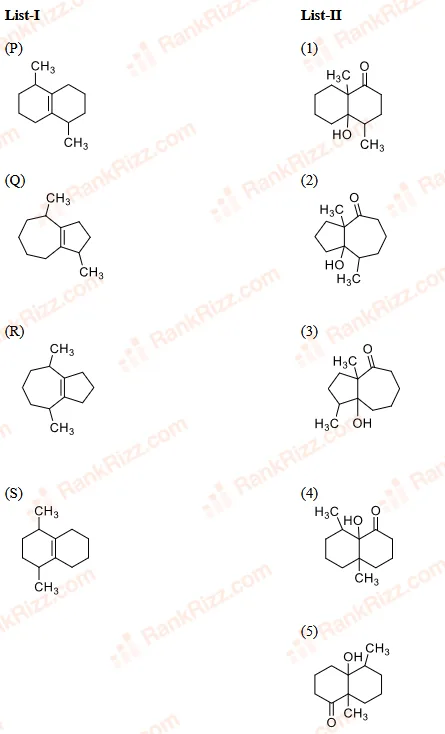
Q31Nucleophilic addition reactions of carbonyl compoundsTRANSCRIBED

The List-II contains products obtained from the reaction of compounds in List-I with O3O_3/ZnZn-H2OH_2O followed by cyclization (via more stable enolate) in the presence of aqueous NaOHNaOH. Match each entry in List-I with appropriate entry in List-II and choose the correct option.

Figure for JEE Advanced 2026 Chemistry question on Nucleophilic addition reactions of carbonyl compounds
  1. A

    (P)→\to(2), (Q)→\to(4), (R)→\to(1), (S)→\to(3)

  2. B

    (P)→\to(3), (Q)→\to(4), (R)→\to(5), (S)→\to(2)

  3. C

    (P)→\to(2), (Q)→\to(1), (R)→\to(5), (S)→\to(3)

  4. D

    (P)→\to(3), (Q)→\to(5), (R)→\to(4), (S)→\to(2)

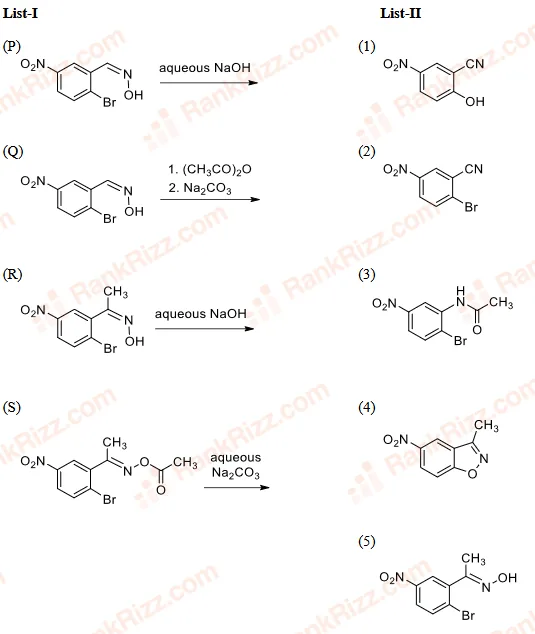
Q32Nucleophilic addition reactions of carbonyl compoundsTRANSCRIBED

Match the major products obtained in the reactions given in List-I with the corresponding structures in List-II and choose the correct option.

Figure for JEE Advanced 2026 Chemistry question on Nucleophilic addition reactions of carbonyl compounds
  1. A

    (P)→\to(2), (Q)→\to(1), (R)→\to(5), (S)→\to(4)

  2. B

    (P)→\to(1), (Q)→\to(2), (R)→\to(4), (S)→\to(5)

  3. C

    (P)→\to(1), (Q)→\to(2), (R)→\to(3), (S)→\to(4)

  4. D

    (P)→\to(2), (Q)→\to(1), (R)→\to(3), (S)→\to(5)

NEXT IN THIS PAPER →Maths, Q33 onwards