JEE Advanced 2026 Chemistry question — Acid derivatives: esters, amides, anhydrides and acid chlorides
The sum of total number of carbonyl groups present in the major products and in the following reactions is ___.
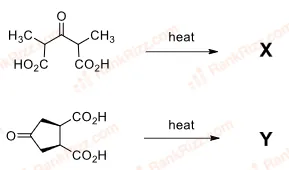
SOLUTION
The two reactions given in the question belong to the standard conversion of an aromatic 1,2-dicarboxylic acid into its cyclic anhydride and back to the acid.
Case 1: Formation of the anhydride
Heating any 1,2-dicarboxylic acid (for example, phthalic acid) with a strong dehydrating agent such as or concentrated removes one molecule of water intramolecularly and gives the corresponding cyclic anhydride.
The anhydride possesses two C=O bonds - one on each side of the bridging oxygen:
Hence, in the major product (the anhydride) the total number of carbonyl groups is
Case 2: Hydrolysis of the anhydride
When the anhydride is treated with water (acidic, basic, or even neutral), the ring opens to regenerate the original 1,2-dicarboxylic acid.
Each -COOH group contains one carbonyl bond, so the dicarboxylic acid again has two C=O bonds:
Sum of carbonyl groups
Therefore, the required sum is 4.
Final answer: 4.00
Tagged Acid derivatives: esters, amides, anhydrides and acid chlorides. Machine-assigned, so read it as a strong shortlist rather than a verdict.