RankRizz

JEE Advanced 2026 Paper 1: Maths

The 16 Maths questions of JEE Advanced 2026 Paper 1, numbered across the whole paper. Pick an answer on any question to check it against the key. Free to read, nothing to download.

Maths

Q33Local maxima and minima and concavityTRANSCRIBED

Consider the function f:(0,∞)→(−∞,∞)f:(0,\infty)\to(-\infty,\infty) given by

f(x)=x log⁡e(x)−x+1.f(x)=\sqrt{x}\,\log_e(x)-x+1.

Then which one of the following statements is TRUE?

  1. A

    The derivative of the function ff is decreasing in the interval (0,1)(0,1)

  2. B

    The function ff has a local maximum at some point a∈(0,∞)a\in(0,\infty)

  3. C

    The function ff has a local minimum at some point b∈(0,∞)b\in(0,\infty)

  4. D

    The function ff has NEITHER a point of local maximum NOR a point of local minimum in the interval (0,∞)(0,\infty)
Q34Tangents, pair of tangents and chord of contactTRANSCRIBED

Let PP be the point on the parabola y=x2y=x^2 such that the slope of the tangent to the parabola at the point PP is 44. Let QQ be the point in the first quadrant lying on the circle x2+y2=2x^2+y^2=2 such that the slope of the tangent to the circle at the point QQ is −1-1. Let RR be the point in the first quadrant lying on the ellipse x2+4y2=8x^2+4y^2=8 such that the slope of the tangent to the ellipse at the point RR is −12-\tfrac{1}{2}. Then the radius of the circle passing through the points P,QP,Q and RR is

  1. A

    10\sqrt{10}

  2. B

    5\sqrt{5}

  3. C

    52\sqrt{\tfrac{5}{2}}

  4. D

    252\sqrt{5}

Q35Types of matrices and matrix algebraTRANSCRIBED

Which one of the following matrices can be obtained by performing elementary row transformations on the 3×33\times 3 identity matrix?

  1. A

    [111111111]\begin{bmatrix}1&1&1\\1&1&1\\1&1&1\end{bmatrix}

  2. B

    [111234121]\begin{bmatrix}1&1&1\\2&3&4\\1&2&1\end{bmatrix}

  3. C

    [111234258]\begin{bmatrix}1&1&1\\2&3&4\\2&5&8\end{bmatrix}

  4. D

    [111−112023]\begin{bmatrix}1&1&1\\-1&1&2\\0&2&3\end{bmatrix}

Q36Domain, range and principal valuesTRANSCRIBED

Considering only the principal values of the inverse trigonometric functions, the value of

cot⁡−1(cot⁡(−11))+10 sin⁡ ⁣(2cos⁡−1 ⁣(12))+10sin⁡(2tan⁡−1(2))\cot^{-1}(\cot(-11))+10\,\sin\!\left(2\cos^{-1}\!\left(\tfrac{1}{\sqrt{2}}\right)\right)+10\sin(2\tan^{-1}(2))

is

  1. A

    3π+73\pi+7

  2. B

    77

  3. C

    4π+74\pi+7

  4. D

    3π−53\pi-5

Q37Conditional probability and multiplication theoremTRANSCRIBED

Suppose that Box I contains 6 red balls and 9 green balls, and Box II contains 8 red balls and 12 green balls. All the balls of Box I and Box II are mixed together and a ball is chosen at random from them. Let E1E_1 be the event that the ball chosen belonged to Box I and let E2E_2 be the event that the ball chosen belonged to Box II. Let F1F_1 be the event that the ball chosen is red and let F2F_2 be the event that the ball chosen is green.

Then which of the following statements is (are) TRUE?

  1. A

    The events E1E_1 and F1F_1 are independent

  2. B

    The events E2E_2 and F2F_2 are dependent

  3. C

    The conditional probability P(F1∣E1)P(F_1\mid E_1) is less than the conditional probability P(F1∣E2)P(F_1\mid E_2)

  4. D

    The conditional probability P(F1∣E1)P(F_1\mid E_1) is greater than the conditional probability P(F2∣E2)P(F_2\mid E_2)

Q38Distance, foot and image with respect to a planeTRANSCRIBED

Let PP be the plane such that it contains the straight line x−12=y−33=z+21\dfrac{x-1}{2}=\dfrac{y-3}{3}=\dfrac{z+2}{1} and is perpendicular to the plane x+2y+3z=4x+2y+3z=4. Let P1P_1 be the plane which passes through the point (4,2,2)(4,2,2) and is parallel to PP.

Then which of the following statements is (are) TRUE?

  1. A

    The equation of the plane PP is 7x−5y+z=−107x-5y+z=-10

  2. B

    The distance between the planes PP and P1P_1 is 3030

  3. C

    The distance of the plane PP from the origin is 232\sqrt{3}

  4. D

    The acute angle between the plane PP and the plane 2x+2y+z=32x+2y+z=3 is cos⁡−1 ⁣(133)\cos^{-1}\!\left(\tfrac{1}{3\sqrt{3}}\right)

Q39Differentiability at a pointTRANSCRIBED

Let R\mathbb{R} denote the set of all real numbers. Let f:R→Rf:\mathbb{R}\to\mathbb{R} be an arbitrary function and let g:R→Rg:\mathbb{R}\to\mathbb{R} be the function defined by

g(x)=x f(x),for all x∈R.g(x)=x\,f(x),\quad\text{for all }x\in\mathbb{R}.

Then which of the following statements is (are) TRUE?

  1. A

    The function gg is always continuous at x=0x=0

  2. B

    If ff is continuous at x=0x=0, then gg is differentiable at x=0x=0

  3. C

    If gg is differentiable at x=0x=0, then ff is continuous at x=0x=0

  4. D

    If gg is differentiable at x=0x=0, then lim⁡x→0f(x)\lim_{x\to 0}f(x) exists

Q40Adjoint and inverse of a matrixTRANSCRIBED

Consider the matrix M=[2−110].M=\begin{bmatrix}2&-1\\1&0\end{bmatrix}.

Let p,q,r,s,a,b,cp,q,r,s,a,b,c and dd be integers such that M26=[pqrs]M^{26}=\begin{bmatrix}p&q\\r&s\end{bmatrix} and ∑k=126Mk=[abcd].\displaystyle\sum_{k=1}^{26}M^k=\begin{bmatrix}a&b\\c&d\end{bmatrix}.

Then which of the following statements is (are) TRUE?

  1. A

    There exists a 2×22\times 2 invertible matrix NN with real entries such that MN=N[1101]MN=N\begin{bmatrix}1&1\\0&1\end{bmatrix}

  2. B

    The value of aa is 378378

  3. C

    For any two given integers mm and nn, there exist unique integers xx and yy such that px+qy=mpx+qy=m and rx+sy=nrx+sy=n

  4. D

    For each positive real number tt, the system of linear equations (a+t)x+by=1,  cx+(d+t)y=−1(a+t)x+by=1,\;cx+(d+t)y=-1 has a unique solution

Q41Combinations and selections with conditionsTRANSCRIBED

Let S={1,2,3,…,10}S=\{1,2,3,\dots,10\}. Consider the set

X={R:R is an equivalence relation on the set S such that R has exactly 42 elements}.X=\{R:R\text{ is an equivalence relation on the set }S\text{ such that }R\text{ has exactly 42 elements}\}.

Then the number of elements in XX is ___.

Q42Differentiability at a pointTRANSCRIBED

Consider the function f:(−π2,π2)→(−∞,∞)f:\left(-\tfrac{\pi}{2},\tfrac{\pi}{2}\right)\to(-\infty,\infty) defined by

f(x)=(∣x∣+∣x−1∣)sin⁡x+[xsin⁡x],f(x)=(|x|+|x-1|)\sin x+[x\sin x],

where [xsin⁡x][x\sin x] is the greatest integer less than or equal to xsin⁡xx\sin x.

Let α\alpha be the total number of points in the interval (−π2,π2)\left(-\tfrac{\pi}{2},\tfrac{\pi}{2}\right) at which ff is NOT continuous, and let β\beta be the total number of points in the interval (−π2,π2)\left(-\tfrac{\pi}{2},\tfrac{\pi}{2}\right) at which ff is NOT differentiable. Then the value of α+β\alpha+\beta is ___.

Q43Combinations and selections with conditionsTRANSCRIBED

The number of ways to distribute 10 identical red pens and 14 identical blue pens among four persons such that each person gets 6 pens, is ___.

Q44Multiple and sub-multiple angle formulasTRANSCRIBED

Let α=(1−2cos⁡π11)(1−2cos⁡3π11)(1−2cos⁡9π11)(1−2cos⁡27π11)(1−2cos⁡81π11).\alpha=\left(1-2\cos\tfrac{\pi}{11}\right)\left(1-2\cos\tfrac{3\pi}{11}\right)\left(1-2\cos\tfrac{9\pi}{11}\right)\left(1-2\cos\tfrac{27\pi}{11}\right)\left(1-2\cos\tfrac{81\pi}{11}\right).

Then the value of 5−α25-\alpha^2 is ___.

Q45Relation between roots and coefficientsTRANSCRIBED

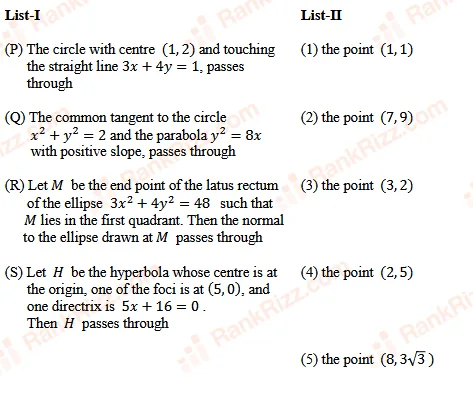
Match each entry in List-I to the correct entry in List-II and choose the correct option.

Figure for JEE Advanced 2026 Mathematics question on Relation between roots and coefficients
  1. A

    (P)→\to(1), (Q)→\to(2), (R)→\to(5), (S)→\to(4)

  2. B

    (P)→\to(3), (Q)→\to(1), (R)→\to(4), (S)→\to(5)

  3. C

    (P)→\to(1), (Q)→\to(2), (R)→\to(4), (S)→\to(5)

  4. D

    (P)→\to(2), (Q)→\to(3), (R)→\to(5), (S)→\to(4)

Q46Cube roots and nth roots of unityTRANSCRIBED

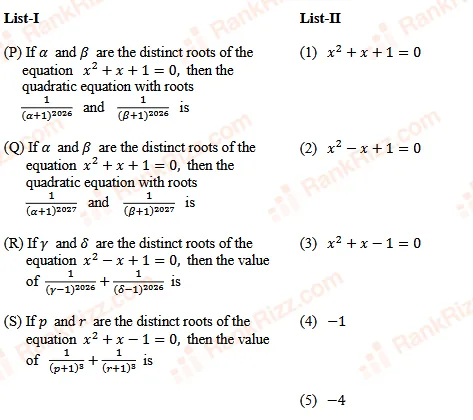
Match each entry in List-I to the correct entry in List-II and choose the correct option.

Figure for JEE Advanced 2026 Mathematics question on Cube roots and nth roots of unity
  1. A

    (P)→\to(2), (Q)→\to(5), (R)→\to(3), (S)→\to(4)

  2. B

    (P)→\to(5), (Q)→\to(3), (R)→\to(2), (S)→\to(4)

  3. C

    (P)→\to(5), (Q)→\to(4), (R)→\to(1), (S)→\to(3)

  4. D

    (P)→\to(4), (Q)→\to(3), (R)→\to(2), (S)→\to(5)

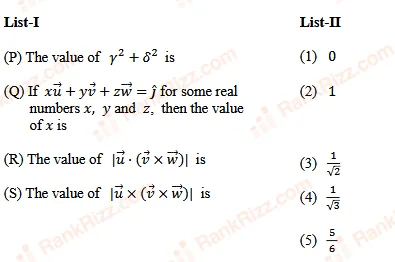
Q47Scalar triple product and coplanarityTRANSCRIBED

For real numbers α,β,γ,δ\alpha,\beta,\gamma,\delta and μ\mu, consider the matrix M=[α12−1213β13γδμ].M=\begin{bmatrix}\alpha&\tfrac{1}{\sqrt{2}}&-\tfrac{1}{\sqrt{2}}\\[2pt]\tfrac{1}{\sqrt{3}}&\beta&\tfrac{1}{\sqrt{3}}\\[2pt]\gamma&\delta&\mu\end{bmatrix}.

Suppose that MMT=IMM^{T}=I, where MTM^{T} is the transpose of MM and II is the 3×33\times 3 identity matrix. Let u⃗=αi^+13j^+γk^,v⃗=12i^+βj^+δk^,w⃗=−12i^+13j^+μk^.\vec{u}=\alpha\hat{i}+\tfrac{1}{\sqrt{3}}\hat{j}+\gamma\hat{k},\quad \vec{v}=\tfrac{1}{\sqrt{2}}\hat{i}+\beta\hat{j}+\delta\hat{k},\quad \vec{w}=-\tfrac{1}{\sqrt{2}}\hat{i}+\tfrac{1}{\sqrt{3}}\hat{j}+\mu\hat{k}.

Match each entry in List-I to the correct entry in List-II and choose the correct option.

Figure for JEE Advanced 2026 Mathematics question on Scalar triple product and coplanarity
  1. A

    (P)→\to(5), (Q)→\to(4), (R)→\to(2), (S)→\to(1)

  2. B

    (P)→\to(4), (Q)→\to(5), (R)→\to(1), (S)→\to(2)

  3. C

    (P)→\to(5), (Q)→\to(3), (R)→\to(2), (S)→\to(1)

  4. D

    (P)→\to(5), (Q)→\to(4), (R)→\to(1), (S)→\to(2)

Q48Number of solutions in an intervalTRANSCRIBED

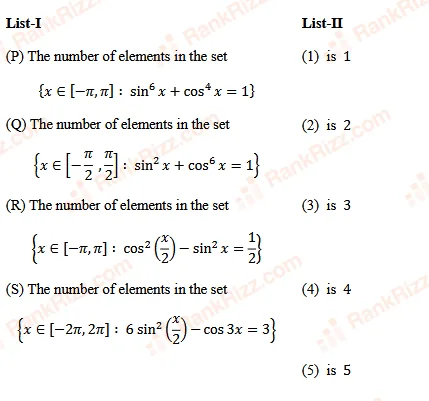
Match each entry in List-I to the correct entry in List-II and choose the correct option.

Figure for JEE Advanced 2026 Mathematics question on Number of solutions in an interval
  1. A

    (P)→\to(3), (Q)→\to(4), (R)→\to(1), (S)→\to(2)

  2. B

    (P)→\to(3), (Q)→\to(2), (R)→\to(1), (S)→\to(5)

  3. C

    (P)→\to(3), (Q)→\to(2), (R)→\to(4), (S)→\to(5)

  4. D

    (P)→\to(4), (Q)→\to(1), (R)→\to(2), (S)→\to(3)