JEE Advanced 2026 Chemistry question — Nucleophilic addition reactions of carbonyl compounds
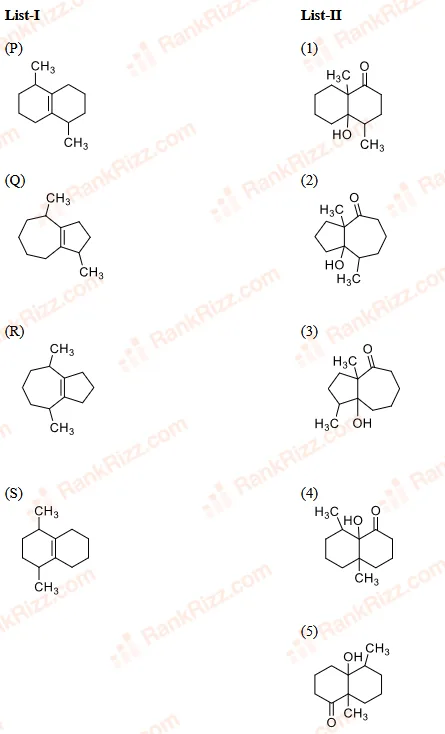
The List-II contains products obtained from the reaction of compounds in List-I with /- followed by cyclization (via more stable enolate) in the presence of aqueous . Match each entry in List-I with appropriate entry in List-II and choose the correct option.
SOLUTION
Ozonolysis in the presence of - cleaves every bond and converts the two vinylic carbons into carbonyl groups (an aldehyde if the carbon was and formaldehyde if it was ).
With the dienes given in List-I, this step therefore furnishes an ω-dialdehyde (or an ω-aldehyd-one when a double bond is internally substituted) plus two molecules of that are of no further consequence.
When the dialdehyde is now treated with aqueous the more stable enolate (the one that is more highly substituted) is generated first. That enolate performs an intramolecular aldol addition on the other carbonyl group, producing a β-hydroxy-carbonyl compound. The size of the ring obtained is decided purely by the number of carbon atoms that originally separate the two carbonyl groups:
Number of carbon atoms between the two groups =
Ring size produced in the aldol step = (because a new C-C bond is formed between the α-carbon of one carbonyl and the carbonyl carbon of the other).
The two double bonds of P are situated at C-1 and C-9 of a nonane chain (1,8-nonadiene). After ozonolysis
Six methylenes are now counted from one carbonyl carbon to the other, so and the intramolecular aldol gives a six-membered β-hydroxy aldehyde. That product is entry (2) of List-II.
Case QQ is 1,7-octadiene. Ozonolysis furnishes
Now ; the aldol cyclisation therefore delivers a five-membered β-hydroxy aldehyde, which is shown as entry (1) in List-II.
Case RR is a methyl-substituted analogue of Q (2-methyl-1,7-octadiene). Ozonolysis gives
Again , so a five-membered ring is formed. Because the more substituted enolate is generated at the α-carbon that bears the group, the methyl ends up on the ring carbon bearing the newly formed hydroxyl group. This corresponds to entry (5) in List-II.
Case SS is 2-methyl-1,8-nonadiene. Its ozonolysis product is
Now , hence the aldol condensation builds a six-membered ring. As in case R the enolate forms preferentially at the end, so the methyl group becomes attached to the β-hydroxy carbon of the ring, giving entry (3) of List-II.
Collecting the results:
(P) (2), (Q) (1), (R) (5), (S) (3)
Therefore the correct option is:
Option C which is: (P)(2), (Q)(1), (R)(5), (S)(3)
Tagged Nucleophilic addition reactions of carbonyl compounds. Machine-assigned, so read it as a strong shortlist rather than a verdict.