RankRizz

JEE Advanced 2025 Paper 1: Maths

The 16 Maths questions of JEE Advanced 2025 Paper 1, numbered across the whole paper. Pick an answer on any question to check it against the key. Free to read, nothing to download.

Maths

Q33Cubic and higher degree polynomial equationsTRANSCRIBED

Let R\mathbb{R} denote the set of all real numbers. Let ai,bi∈Ra_i, b_i \in \mathbb{R} for i∈{1,2,3}i \in \{1, 2, 3\}. Define the functions f:R→Rf: \mathbb{R} \to \mathbb{R}, g:R→Rg: \mathbb{R} \to \mathbb{R}, and h:R→Rh: \mathbb{R} \to \mathbb{R} by

f(x)=a1+10x+a2x2+a3x3+x4,f(x) = a_1 + 10x + a_2 x^2 + a_3 x^3 + x^4,

g(x)=b1+3x+b2x2+b3x3+x4,g(x) = b_1 + 3x + b_2 x^2 + b_3 x^3 + x^4,

h(x)=f(x+1)−g(x+2).h(x) = f(x+1) - g(x+2).

If f(x)≠g(x)f(x) \neq g(x) for every x∈Rx \in \mathbb{R}, then the coefficient of x3x^3 in h(x)h(x) is

  1. A

    88

  2. B

    22

  3. C

    −4-4

  4. D

    −6-6

Q34Conditional probability and multiplication theoremTRANSCRIBED

Three students S1,S2,S_1, S_2, and S3S_3 are given a problem to solve. Consider the following events:

UU: At least one of S1,S2,S_1, S_2, and S3S_3 can solve the problem,

VV: S1S_1 can solve the problem, given that neither S2S_2 nor S3S_3 can solve the problem,

WW: S2S_2 can solve the problem and S3S_3 cannot solve the problem,

TT: S3S_3 can solve the problem.

For any event EE, let P(E)P(E) denote the probability of EE. If

P(U)=12,P(V)=110,P(U) = \frac{1}{2}, \quad P(V) = \frac{1}{10}, \quad and P(W)=112,\quad P(W) = \frac{1}{12},

then P(T)P(T) is equal to

  1. A

    1336\frac{13}{36}

  2. B

    13\frac{1}{3}

  3. C

    1960\frac{19}{60}

  4. D

    14\frac{1}{4}

Q35Differentiability at a pointTRANSCRIBED

Let R\mathbb{R} denote the set of all real numbers. Define the function f:R→Rf: \mathbb{R} \to \mathbb{R} by

f(x)={2−2x2−x2sin⁡1xif x≠0,2if x=0.f(x) = \begin{cases} 2 - 2x^2 - x^2 \sin \frac{1}{x} & \text{if } x \neq 0, \\ 2 & \text{if } x = 0. \end{cases}

Then which one of the following statements is TRUE?

  1. A

    The function ff is NOT differentiable at x=0x = 0

  2. B

    There is a positive real number δ\delta, such that ff is a decreasing function on the interval (0,δ)(0, \delta)

  3. C

    For any positive real number δ\delta, the function ff is NOT an increasing function on the interval (−δ,0)(-\delta, 0)

  4. D

    x=0x = 0 is a point of local minima of ff

Q36Adjoint and inverse of a matrixTRANSCRIBED

Consider the matrix

P=(200020003).P = \begin{pmatrix} 2 & 0 & 0 \\ 0 & 2 & 0 \\ 0 & 0 & 3 \end{pmatrix}.

Let the transpose of a matrix XX be denoted by XTX^T. Then the number of 3×33 \times 3 invertible matrices QQ with integer entries, such that

Q−1=QTandPQ=QP,Q^{-1} = Q^T \quad \text{and} \quad PQ = QP,

is

  1. A

    3232

  2. B

    88

  3. C

    1616

  4. D

    2424

Q37Line and plane: intersection, coplanarity and projectionTRANSCRIBED

Let L1L_1 be the line of intersection of the planes given by the equations

2x+3y+z=4andx+2y+z=5.2x + 3y + z = 4 \quad \text{and} \quad x + 2y + z = 5.

Let L2L_2 be the line passing through the point P(2,−1,3)P(2, -1, 3) and parallel to L1L_1. Let MM denote the plane given by the equation

2x+y−2z=6.2x + y - 2z = 6.

Suppose that the line L2L_2 meets the plane MM at the point QQ. Let RR be the foot of the perpendicular drawn from PP to the plane MM.

Then which of the following statements is (are) TRUE?

  1. A

    The length of the line segment PQPQ is 939\sqrt{3}

  2. B

    The length of the line segment QRQR is 1515

  3. C

    The area of △PQR\triangle PQR is 32234\frac{3}{2}\sqrt{234}

  4. D

    The acute angle between the line segments PQPQ and PRPR is cos⁡−1(123)\cos^{-1}\left(\frac{1}{2\sqrt{3}}\right)

Q38Composite functionsTRANSCRIBED

Let N\mathbb{N} denote the set of all natural numbers, and Z\mathbb{Z} denote the set of all integers. Consider the functions f:N→Zf: \mathbb{N} \to \mathbb{Z} and g:Z→Ng: \mathbb{Z} \to \mathbb{N} defined by

f(n)={(n+1)/2if n is odd,(4−n)/2if n is even,f(n) = \begin{cases} (n+1)/2 & \text{if } n \text{ is odd}, \\ (4-n)/2 & \text{if } n \text{ is even}, \end{cases}

and

g(n)={3+2nif n≥0,−2nif n<0.g(n) = \begin{cases} 3 + 2n & \text{if } n \geq 0, \\ -2n & \text{if } n < 0. \end{cases}

Define (g∘f)(n)=g(f(n))(g \circ f)(n) = g(f(n)) for all n∈Nn \in \mathbb{N}, and (f∘g)(n)=f(g(n))(f \circ g)(n) = f(g(n)) for all n∈Zn \in \mathbb{Z}.

Then which of the following statements is (are) TRUE?

  1. A

    g∘fg \circ f is NOT one-one and g∘fg \circ f is NOT onto

  2. B

    f∘gf \circ g is NOT one-one but f∘gf \circ g is onto

  3. C

    gg is one-one and gg is onto

  4. D

    ff is NOT one-one but ff is onto

Q39Locus and regions in the Argand planeTRANSCRIBED

Let R\mathbb{R} denote the set of all real numbers. Let z1=1+2iz_1 = 1 + 2i and z2=3iz_2 = 3i be two complex numbers, where i=−1i = \sqrt{-1}. Let

S={(x,y)∈R×R:∣x+iy−z1∣=2∣x+iy−z2∣}.S = \{(x, y) \in \mathbb{R} \times \mathbb{R} : |x + iy - z_1| = 2|x + iy - z_2|\}.

Then which of the following statements is (are) TRUE?

  1. A

    SS is a circle with centre (−13,103)\left(-\frac{1}{3}, \frac{10}{3}\right)

  2. B

    SS is a circle with centre (13,83)\left(\frac{1}{3}, \frac{8}{3}\right)

  3. C

    SS is a circle with radius 23\frac{\sqrt{2}}{3}

  4. D

    SS is a circle with radius 223\frac{2\sqrt{2}}{3}

Q40Combinations and selections with conditionsTRANSCRIBED

Let the set of all relations RR on the set {a,b,c,d,e,f}\{a, b, c, d, e, f\}, such that RR is reflexive and symmetric, and RR contains exactly 10 elements, be denoted by S\mathcal{S}.

Then the number of elements in S\mathcal{S} is ________.

Q41Vector algebra, components and section formulaTRANSCRIBED

For any two points MM and NN in the XYXY-plane, let MN→\overrightarrow{MN} denote the vector from MM to NN, and 0⃗\vec{0} denote the zero vector. Let P,QP, Q and RR be three distinct points in the XYXY-plane. Let SS be a point inside the triangle △PQR\triangle PQR such that

SP→+5 SQ→+6 SR→=0⃗.\overrightarrow{SP} + 5\,\overrightarrow{SQ} + 6\,\overrightarrow{SR} = \vec{0}.

Let EE and FF be the mid-points of the sides PRPR and QRQR, respectively. Then the value of

length of the line segment EFlength of the line segment ES\frac{\text{length of the line segment } EF}{\text{length of the line segment } ES}

is ________.

Q42Arrangements with restrictionsTRANSCRIBED

Let SS be the set of all seven-digit numbers that can be formed using the digits 0, 1 and 2. For example, 2210222 is in SS, but 0210222 is NOT in SS.

Then the number of elements xx in SS such that at least one of the digits 0 and 1 appears exactly twice in xx, is equal to ________.

Q43Existence of limits, LHL and RHLTRANSCRIBED

Let α\alpha and β\beta be the real numbers such that

lim⁡x→01x3(α2∫0x11−t2 dt+βxcos⁡x)=2.\lim_{x \to 0} \frac{1}{x^3} \left( \frac{\alpha}{2} \int_0^x \frac{1}{1 - t^2}\, dt + \beta x \cos x \right) = 2.

Then the value of α+β\alpha + \beta is ________.

Q44Differentiability via functional equationsTRANSCRIBED

Let R\mathbb{R} denote the set of all real numbers. Let f:R→Rf: \mathbb{R} \to \mathbb{R} be a function such that f(x)>0f(x) > 0 for all x∈Rx \in \mathbb{R}, and f(x+y)=f(x)f(y)f(x + y) = f(x)f(y) for all x,y∈Rx, y \in \mathbb{R}.

Let the real numbers a1,a2,…,a50a_1, a_2, \ldots, a_{50} be in an arithmetic progression. If f(a31)=64f(a25)f(a_{31}) = 64f(a_{25}), and

∑i=150f(ai)=3(225+1),\sum_{i=1}^{50} f(a_i) = 3(2^{25} + 1),

then the value of

∑i=630f(ai)\sum_{i=6}^{30} f(a_i)

is ________.

Q45Variable separable equationsTRANSCRIBED

For all x>0x > 0, let y1(x)y_1(x), y2(x)y_2(x), and y3(x)y_3(x) be the functions satisfying

dy1dx−(sin⁡x)2 y1=0,y1(1)=5,\frac{dy_1}{dx} - (\sin x)^2\, y_1 = 0, \quad y_1(1) = 5,

dy2dx−(cos⁡x)2 y2=0,y2(1)=13,\frac{dy_2}{dx} - (\cos x)^2\, y_2 = 0, \quad y_2(1) = \frac{1}{3},

dy3dx−(2−x3x3)y3=0,y3(1)=35e,\frac{dy_3}{dx} - \left(\frac{2 - x^3}{x^3}\right) y_3 = 0, \quad y_3(1) = \frac{3}{5e},

respectively. Then

lim⁡x→0+y1(x) y2(x) y3(x)+2xe3xsin⁡x\lim_{x \to 0^+} \frac{y_1(x)\, y_2(x)\, y_3(x) + 2x}{e^{3x} \sin x}

is equal to ________.

Q46Variance and standard deviationTRANSCRIBED

Consider the following frequency distribution:

Value458961211
Frequency5f1f_1f2f_22113

Suppose that the sum of the frequencies is 19 and the median of this frequency distribution is 6.

For the given frequency distribution, let α\alpha denote the mean deviation about the mean, β\beta denote the mean deviation about the median, and σ2\sigma^2 denote the variance.

Match each entry in List-I to the correct entry in List-II and choose the correct option.

List-I                                                  List-II

(P) 7f1+9f27f_1 + 9f_2 is equal to           (1) 146 

(Q) 19α19\alpha is equal to                     (2) 47

(R) 19β19\beta is equal to                    (3) 48

(S) 19σ219\sigma^2 is equal to                  (4) 145

                                                        (5) 55

  1. A

    (P)→\to(5), (Q)→\to(3), (R)→\to(2), (S)→\to(4)

  2. B

    (P)→\to(5), (Q)→\to(2), (R)→\to(3), (S)→\to(1)

  3. C

    (P)→\to(5), (Q)→\to(3), (R)→\to(2), (S)→\to(1)

  4. D

    (P)→\to(3), (Q)→\to(2), (R)→\to(5), (S)→\to(4)

Q47Differentiability at a pointTRANSCRIBED

Let R\mathbb{R} denote the set of all real numbers. For a real number xx, let [x][x] denote the greatest integer less than or equal to xx. Let nn denote a natural number.

Match each entry in List-I to the correct entry in List-II and choose the correct option.
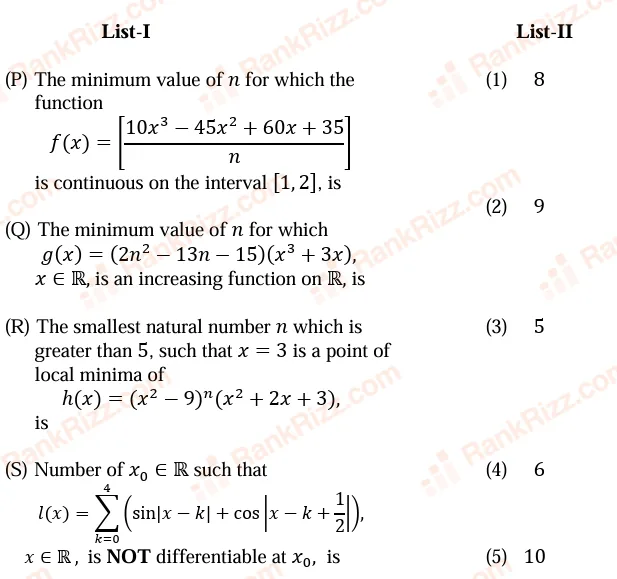
Figure for JEE Advanced 2025 Mathematics question on Differentiability at a point
  1. A

    (P)→\to(1), (Q)→\to(3), (R)→\to(2), (S)→\to(5)

  2. B

    (P)→\to(2), (Q)→\to(1), (R)→\to(4), (S)→\to(3)

  3. C

    (P)→\to(5), (Q)→\to(1), (R)→\to(4), (S)→\to(3)

  4. D

    (P)→\to(2), (Q)→\to(3), (R)→\to(1), (S)→\to(5)

Q48Scalar triple product and coplanarityTRANSCRIBED

Let w⃗=i^+j^−2k^\vec{w} = \hat{i} + \hat{j} - 2\hat{k}, and u⃗\vec{u} and v⃗\vec{v} be two vectors, such that u⃗×v⃗=w⃗\vec{u} \times \vec{v} = \vec{w} and v⃗×w⃗=u⃗\vec{v} \times \vec{w} = \vec{u}. Let α,β,γ\alpha, \beta, \gamma, and tt be real numbers such that

u⃗=αi^+βj^+γk^,−tα+β+γ=0,α−tβ+γ=0,andα+β−tγ=0.\vec{u} = \alpha\hat{i} + \beta\hat{j} + \gamma\hat{k}, \quad -t\alpha + \beta + \gamma = 0, \quad \alpha - t\beta + \gamma = 0, \quad \text{and} \quad \alpha + \beta - t\gamma = 0.

Match each entry in List-I to the correct entry in List-II and choose the correct option.
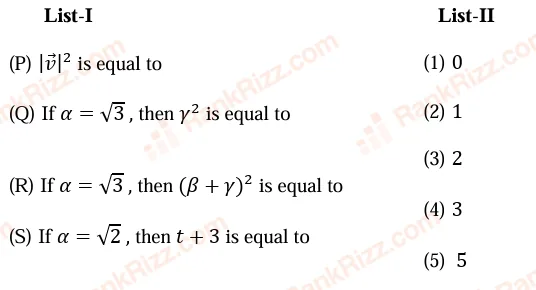
Figure for JEE Advanced 2025 Mathematics question on Scalar triple product and coplanarity
  1. A

    (P)→\to(2), (Q)→\to(1), (R)→\to(4), (S)→\to(5)

  2. B

    (P)→\to(2), (Q)→\to(4), (R)→\to(3), (S)→\to(5)

  3. C

    (P)→\to(2), (Q)→\to(1), (R)→\to(4), (S)→\to(3)

  4. D

    (P)→\to(5), (Q)→\to(4), (R)→\to(1), (S)→\to(3)